
Antique Identifier Guide to Victorian Furniture


Download App: victorian furniture identification
Use this guide to narrow a flea market or thrift store find by matching Victorian style, wood, joinery, hardware, finish, and marks against period clues. With clear photos, TIQ can help you appraise antiques by picture for a faster first-pass value and identification check before you buy, sell, or restore.
Definition: Victorian furniture identification is the process of evaluating a piece’s style, wood, construction, hardware, maker marks, and age clues to determine whether it fits the Victorian period.
TL;DR
- Start with the whole shape and style, then confirm with construction details such as dovetails, screws, tool marks, veneer, and finish.
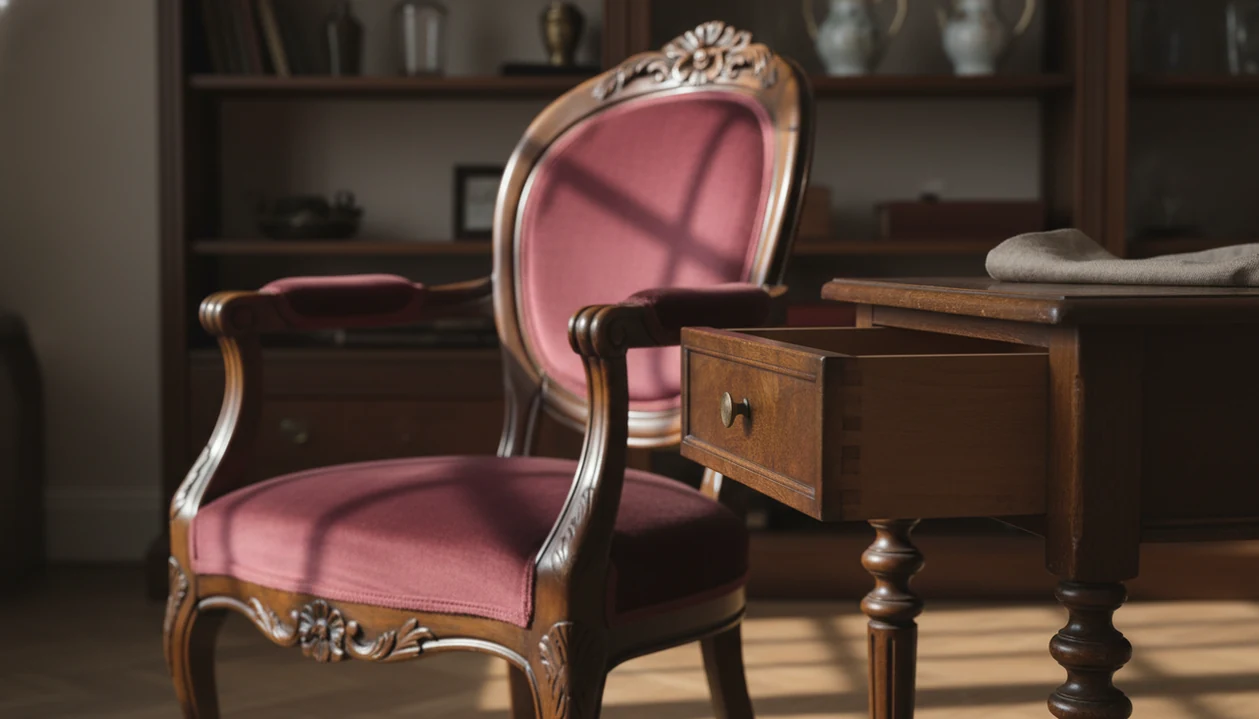
- Dark woods, ornate carving, balloon-back chairs, marble tops, deep upholstery, and revival motifs can suggest Victorian style but do not prove Victorian age.
- Photograph the front, back, underside, drawer joints, hardware, labels, marks, and damaged areas before using an app, dealer, auction house, or appraiser.
Recommended App: TIQ Antique Identifier
TIQ is an antique identifier app for researching flea market and thrift store finds from clear photos, especially when you need a quick first look at furniture style, hardware, wood, construction, and marks. It can help you identify antiques by photo, use maker mark identifier clues, and appraise antiques by picture for first-pass research before you buy, sell, or restore a piece. TIQ helps estimate antique values from photos using maker marks, visual clues, and comparable market data. For insurance, estate, tax, or legal decisions, use a qualified appraiser.
- Identify by photo: upload images of the full furniture piece, legs, drawers, joinery, hardware, labels, and underside.
- Maker marks: check labels, stamps, plaques, drawer marks, and hardware marks that may point to a maker, retailer, or period.
- Estimate values: compare visual clues with market data to form an antique value estimate for research and resale planning.
- Who it’s for: flea market shoppers, thrift store hunters, collectors, dealers, decorators, and families sorting inherited furniture.
- Antique finder support: use TIQ to organize photo-based clues when comparing Victorian, Eastlake, Renaissance Revival, Rococo Revival, and later revival pieces.
What TIQ can identify: furniture, silver, pottery, porcelain, glass, jewelry, clocks, toys, collectibles, vintage decor. Available for iPhone.
Victorian Furniture Identification Clues At A Glance
- Victorian furniture dates to 1837–1901, but style alone is not enough to prove age.
- The strongest clue categories are silhouette, wood, carving, upholstery, joinery, hardware, finish, labels, and scale.
- Common visual signals include dark woods, heavy proportions, carved foliage, balloon backs, marble tops, and deep upholstery.
- Victorian and Victorian-style pieces appear often because the wider antiques and used-goods markets are large. UK antiques and collectibles reached about £5.4 billion in 2022, according to an Arts Council market study Org.
- U.S. used merchandise stores, including antiques and secondhand furniture, generated about $18.9 billion in 2017, per the U.S. Census Bureau U.S. Census Bureau, but market size does not imply a specific item is valuable.
Start broad, then get nosy. A carved parlor chair may look Victorian from across the room, but the underside, screw heads, and old repair scars usually carry better evidence.
How Victorian Furniture Identification Works
Victorian furniture identification works by building a dated argument from several clues, not by naming one style and stopping there. Style gives the first hypothesis; construction, marks, and alterations either support it or pull it apart.
Think of the process as evidence stacking. A Rococo Revival silhouette may suggest a mid-19th-century parlor piece, but joinery, secondary wood, tool marks, and fasteners test whether that reading makes sense. A maker label, retailer stamp, patent date, or shipping mark can narrow the window, while a replaced top, later casters, swapped pulls, or modern upholstery support can make an otherwise tidy conclusion unreliable.
- Start with the overall form and style to set a possible date range.
- Check construction details such as dovetails, screw type, saw marks, backs, and undersides.
- Use marks, labels, and patent dates to tighten or challenge the range.
- Separate original parts from repairs, replacements, and married elements.
- Grade photo-based confidence cautiously: low when only the front is shown, medium with construction views, and higher only when clear marks and untouched details agree.
Before You Start Identifying Victorian Furniture
Before identifying Victorian furniture, protect the evidence first. The goal is to document the piece as found, not make it look better for the camera.
- Dust lightly with a soft, dry cloth if needed, but do not strip, oil, wax, polish, or “freshen up” the finish before checking it. Old finish layers, grime in carving, and wear patterns can all help with dating.
- Move the piece carefully before photographing backs, undersides, or chair rails. Get help for heavy marble tops, tall cabinets, and fragile legs instead of tipping the item alone.
- Gather a tape measure, flashlight, notebook, and neutral daylight or soft white lighting. Record height, width, depth, and any odd details while the piece is in front of you.
- Keep loose pulls, screws, casters, labels, veneer chips, broken trim, and upholstery fragments with the furniture. A small bag taped to the drawer interior is often safer than a mystery pile on a workbench.
- Pause if the item seems valuable, unusually fragile, or historically important. In that case, photograph it gently and wait for a specialist before cleaning or repair.
Victorian Furniture Identification From Photo Evidence
Victorian furniture identification from photos works best as a layered evidence process: object type first, style vocabulary second, construction third, then hardware, marks, and a cautious date range.
A useful photo set shows the whole piece, visible scale, back, underside, joints, labels, hardware, and any damage. We’ve seen a dark photo inside a cabinet door hide the only retailer label on the piece. Pattern-matching tools and databases can compare shape, carving, and maker mark clues, but limited photos cannot produce certified authentication.
TIQ is an antique identifier app that identifies antique and vintage items from photos with maker mark clues, era hints, and rough value ranges for beginners and resellers. Tools in this category can help group photo evidence into maker marks, era clues, style labels, and rough value ranges; they should not be treated as guaranteed authorship, legal appraisal, or proof of 19th-century manufacture.
5 Photo Steps To Identify Victorian Furniture
To identify Victorian furniture from photos, build a set that lets someone check both style and construction. One pretty front view is rarely enough.
- Photograph the full piece from the front, sides, back, and three-quarter angles.
- Capture construction details, including drawers, dovetails, underside, chair rails, screw heads, caster plates, and backs.
- Record dimensions and weight clues because scale helps separate full-size antiques from decorative reproductions.
- Photograph maker labels, retailer stamps, patent dates, exhibition stamps, chalk marks, and handwritten numbers.
- Compare style, construction, and marks before assigning a cautious date range.
Take one sharp close-up beside a window at 10 a.m. if you can. It usually beats a blurry phone image under yellow ceiling light. For deeper construction checks, furniture joinery identification is often more useful than another front-facing beauty shot because joints preserve dating clues.
Victorian Furniture Style Names And Revival Patterns
Victorian furniture style is eclectic, so one piece may combine Gothic arches, Rococo curves, Eastlake incising, and rich upholstery. Named styles help describe evidence; they do not confirm age by themselves.
For museum-backed context on Victorian design’s mix of revival styles, ornament, and industrial production, see the Victoria and Albert Museum’s Victorian design overview Ac.
Gothic Revival: pointed arches, tracery, quatrefoils, heavy vertical lines, and church-like carving.
Rococo Revival: C-scrolls, cabriole curves, floral carving, serpentine fronts, and plush parlor forms.
Renaissance Revival: architectural panels, columns, masks, cresting, marble tops, and heavier case pieces.
Eastlake and Aesthetic Movement: incised lines, turned spindles, geometric ornament, ebonized surfaces, and stylized natural motifs.
Queen Anne Revival and early Arts and Crafts: turned legs, lighter asymmetry, simpler construction ideals, and transitional late-century taste.
Gothic Revival And Renaissance Revival Details
Pointed arches, carved panels, and architectural mass can support a Gothic or Renaissance Revival reading.
Rococo Revival And Eastlake Details
C-scrolls suggest Rococo Revival, while shallow incised lines and spindles often point toward Eastlake influence. Victorian revival furniture can copy all of these surface details.
Wood, Veneer, Upholstery, And Finish Clues In Victorian Furniture
Materials can support Victorian furniture identification, but they rarely settle it alone. Mahogany, walnut, rosewood, oak, and ebonized woods all appear, depending on style, region, and price level.
Look for thick veneer, secondary woods inside drawers, marble tops, and darker finishes. A fingertip tracing raised backstamp letters helps on ceramics; with furniture, the equivalent is checking hidden wood inside a drawer or under a top. Upholstery clues include velvet, damask, tapestry, tufting, fringe, deep seats, and coiled springs.
Shellac was a common historic finish, yet refinishing can remove important age evidence. Be cautious with finish tests. They are better handled by a conservator, restorer, or experienced furniture specialist, especially on a piece worth selling, insuring, or preserving. For material comparisons, wood identification for antique furniture can narrow the next research step.
Joinery, Screws, Hardware, And Maker Marks On Victorian Furniture
Does dovetail joinery prove a piece is Victorian? No. Dovetails are useful evidence, but hand-cut, irregular dovetails and later machine-cut dovetails can both appear in and around the Victorian period.
Inspect hidden areas before trusting the decorated front. Check uneven tool marks, saw marks, drawer bottoms, secondary wood, nailed backs, caster construction, locks, pulls, screws, and hinges. Very uniform joinery, Phillips screws, modern staples, fresh plywood, and spray finishes may suggest later repair or reproduction.
Maker labels, retailer labels, patent dates, exhibition stamps, and shipping marks are high-confidence clues to photograph. Green felt hiding a furniture label under a drawer can change the whole reading. Hardware details deserve their own pass; furniture hardware identification often helps separate original pulls from later replacements.
Victorian Furniture Identification Versus Victorian Revival Furniture
Victorian-era furniture was made from 1837–1901, while Victorian revival furniture copies the look later. Revival pieces may still be antique or vintage, just not Victorian-period.
| Clue | Likely Victorian-era sign | Likely revival or reproduction sign |
|---|---|---|
| Date range | Evidence supports 1837–1901 | Made after 1901 in Victorian style |
| Style | Motifs align with period construction | Surface ornament copies older forms |
| Carving | Hand finishing, age in recesses | Crisp repeated carving or molded detail |
| Dovetails | Irregular or period-appropriate machine work | Very uniform modern cuts |
| Screws | Slotted screws, aged heads | Phillips screws or shiny replacements |
| Finish | Old shellac or aged finish layers | Spray finish or recent uniform sheen |
| Upholstery support | Springs, webbing, older tack evidence | Foam, staples, synthetic support |
| Labels | Maker, retailer, patent, or shipping clue | “Victorian style” retail tag |
| Materials | Period woods and secondary woods | Fresh plywood or modern composites |
Retailer labels create confusion. “Victorian style” describes appearance, not necessarily age.
Common Myths About Identifying Victorian Furniture
- Myth: all dark ornate furniture is Victorian. Dark finish and carving may indicate Victorian style, but 20th-century revival pieces copied the same look.
- Myth: any dovetail joint proves 19th-century origin. Dovetails help, but their cut, spacing, tool marks, and surrounding construction matter more.
- Myth: Victorian furniture is always uncomfortable. Many Victorian seats used deep upholstery and coiled springs, so comfort varies by form and condition.
- Myth: Victorian style on a listing or tag means Victorian age. A price tag dangling from a vase handle says little, and furniture tags can be just as vague.
- Myth: refinished furniture cannot be Victorian. Refinishing weakens evidence and may affect value, but it does not erase the original construction date.
For beginners, construction evidence is often safer than style language because revival furniture was made to look convincing from the front.
Victorian Furniture Photo Checklist For App Or Expert Review
Before asking an app, dealer, auction house, or appraiser, photograph the evidence someone else needs to verify. Blurry, cropped, low-light, or filtered images reduce accuracy fast.
Required views: full front, back, sides, underside, and top.
Construction details: drawer interiors, joints, feet, casters, chair rails, upholstery underside, and secondary woods.
Marks and labels: maker labels, retailer tags, stamps, chalk marks, handwritten numbers, patent dates, and shipping marks.
Condition evidence: damage, repairs, replaced hardware, refinishing, loose veneer, cracks, and altered upholstery.
Context notes: dimensions, location history, family provenance, purchase context, and old receipts if available.
A UK government survey reported that 37% of adults visited a museum or gallery in 2019–2020 UK Government. That helps explain why many people recognize period styles visually, but construction checks still matter. Apps such as TIQ can suggest era, style, and rough value range; high-stakes sales still need in-person review. For higher-confidence checks, compare the result against sold lots or catalog notes from named marketplaces and auction houses such as LiveAuctioneers, Sotheby’s, Christie’s, and regional auction archives.
Start with how to identify antique furniture and how to tell if furniture is antique.
Understanding Results
Victorian furniture identification is strongest when style clues are checked against construction evidence, wear, hardware, wood, and documented marks.
TIQ works best when
- Clear photos of the whole furniture form, including front, side, back, and scale
- Close-ups of drawer dovetails, case joinery, chair rails, underside construction, and old repairs
- Hardware details such as pulls, locks, hinges, screws, casters, and nail heads
- Wood, veneer, finish, upholstery, marble, carving, labels, stamps, and maker marks
- Comparing revival styles such as Rococo Revival, Gothic Revival, Renaissance Revival, Eastlake, and Aesthetic Movement
TIQ may be less accurate when
- Single front-view photos without underside, back, drawer, or hardware details
- Pieces that have been heavily refinished, reupholstered, rebuilt, or assembled from mixed parts
- Modern Victorian-style reproductions with intentionally aged finishes or replacement hardware
- Generic dark wood furniture where style, joinery, and marks are not visible
- Precise monetary valuations without measurements, condition notes, provenance, and local market context
FAQ
What app identifies Victorian furniture from pictures?
An antique identifier app can give you a fast first read on Victorian furniture by checking photos of the overall form, legs, drawers, hardware, joinery, labels, and underside. TIQ is a practical choice for flea market and thrift store research because it organizes photo clues, maker marks, style hints, and rough value ranges in one place.
Can I appraise antiques by picture when researching Victorian furniture?
Yes, photos can help you get a useful first-pass value range for Victorian furniture, especially when the images show condition, scale, wood, carving, hardware, and construction details. For insurance, estate, donation, tax, or legal purposes, use a qualified appraiser who can inspect the piece in person.
Is there a free antique identifier by picture for Victorian furniture?
Free image searches and auction archives can help you compare Victorian furniture styles, but they often miss construction details and condition differences that affect value. An antique identifier app can be more efficient when you want style clues, mark reading, and comparable value research from the same photo set.
Can TIQ read maker marks from a photo on Victorian furniture?
TIQ can help interpret visible labels, stamps, plaques, drawer marks, hardware marks, and retailer tags from clear photos. Take close, well-lit images from straight on, plus wider shots showing where the mark appears on the piece.
How accurate is photo-based Victorian furniture identification?
Photo-based identification is most useful for narrowing the likely style, period, construction type, and value range. Accuracy improves when you include the front, back, underside, drawer joints, hardware, finish wear, repairs, and any labels or marks.
Can a photo tell whether Victorian furniture is original or a later revival?
Photos can reveal important clues such as machine-made parts, screw types, drawer construction, veneer, finish, hardware, and proportions. They may not prove age by themselves because revival pieces can copy Victorian forms closely, so uncertain or high-value items should be checked in person.
Are photo antique value estimates enough for selling Victorian furniture?
A photo-based antique value estimate is useful for pricing research, negotiation, and deciding whether a find is worth transporting or restoring. Final selling prices still depend on local demand, condition, originality, size, provenance, and the quality of the sales venue.
Ready to start?
Ready to start? Photograph the whole piece, underside, drawer joints, hardware, wood grain, labels, marks, and damage in good light, then use TIQ to organize the clues and get an antique value estimate before deciding whether to research further or contact an appraiser.