
Antique Identifier Guide for Estate Sale Finds


Download App: what to look for at estate sales
Definition: An estate sale antique identifier helps shoppers research age, maker marks, category, and likely market value before buying or cataloging a find.
Estate sales are easier to shop when you know which clues make a find researchable before you buy. Use TIQ to identify unknown items, check maker marks, and appraise antiques by picture so you can make faster, more confident buying and cataloging decisions.
An estate sale is a household liquidation, often tied to death, downsizing, or relocation, where buyers can inspect and purchase personal property directly from the home or sale venue.
- Look first for maker marks, labels, signatures, stamps, tags, original boxes, and style details that make an item easier to identify.
- Check condition before value: chips, cracks, repairs, odors, stains, missing parts, and water damage can erase resale potential.
- Use a photo-identification check before buying when an item has a mark, unclear age, possible resale value, or a price that requires confidence.
Recommended App: TIQ Antique Identifier
TIQ is an antique identifier app for estate sale shoppers, collectors, and beginners who want a faster way to research finds before they buy, catalog, or resell. You can use TIQ to identify antiques by photo, read maker marks, and appraise antiques by picture for first-pass research. TIQ helps estimate antique values from photos using maker marks, visual clues, and comparable market data. For insurance, estate, tax, or legal decisions, use a qualified appraiser.
- Identify estate sale finds by photo, including furniture, ceramics, glass, jewelry, silver, and collectibles.
- Check maker marks, signatures, stamps, labels, and back marks that can point to origin or maker.
- Estimate values using visual clues and comparable market data before deciding whether to buy or resell.
- Build better research habits by saving details, comparing similar items, and noting condition issues.
- Useful for collectors, beginners, resellers, thrift shoppers, and families cataloging inherited items.
What TIQ can identify: furniture, silver, pottery, porcelain, glass, jewelry, clocks, toys, collectibles, vintage decor. Available for iPhone.
Estate Sale Finds at a Glance
The strongest estate-sale finds usually have five traits: visible identification clues, good condition, quality materials, completeness, and enough researchability to support a buying decision. That means a marked lamp, signed print, labeled chair, boxed tool, or clean piece of jewelry often deserves a second look before an unmarked “old” object.
Estate sales mix ordinary household goods with higher-value personal property because many are tied to death, downsizing, or relocation, according to the National Association of Estate Liquidators Nationalassociationofestatesales. Expect furniture, jewelry, art, lamps, kitchenware, tools, books, and vintage decor in the same rooms as towels and half-used garage supplies.
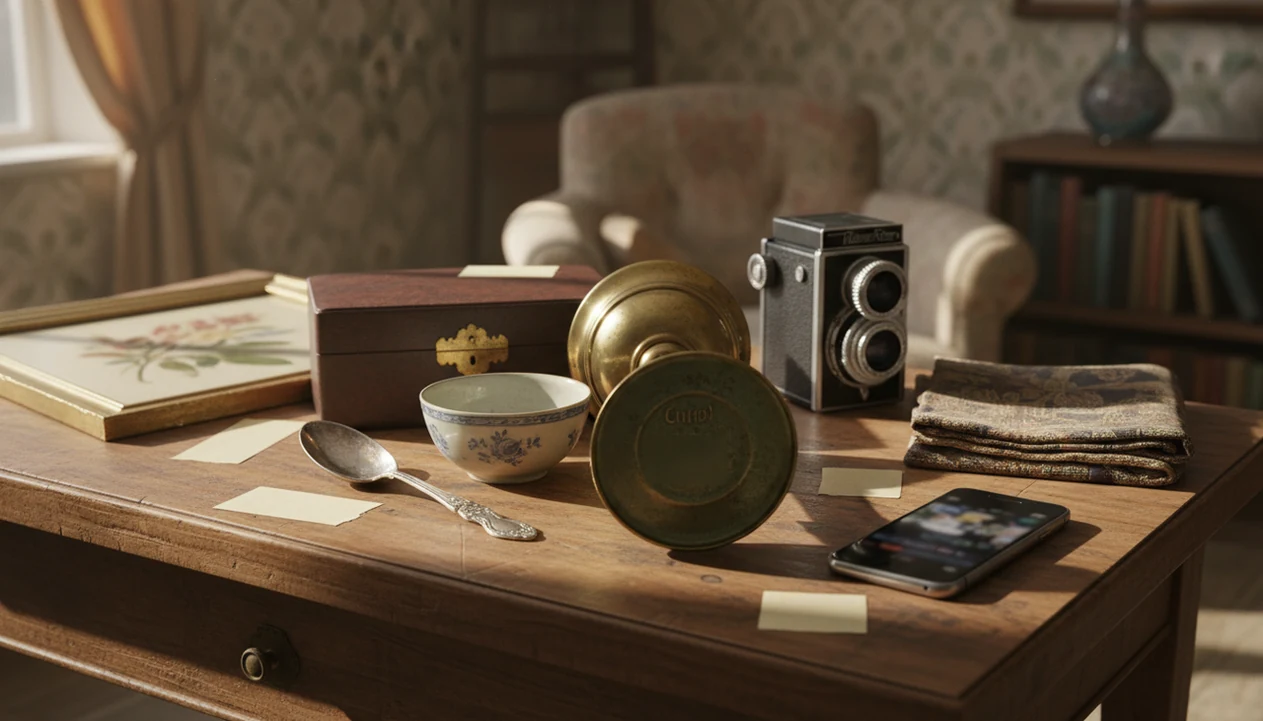
The masking tape matters.
A $3 tag on a dusty box lid can be interesting, but only if the contents are complete, identifiable, and not ruined by damp storage.
How Estate Sales Work
Estate sales are usually run by a liquidation company, auctioneer, or family representative hired to empty a household after death, downsizing, divorce, relocation, or a move to assisted living. The goal is orderly liquidation: turning rooms of personal property into cash while clearing the home on a short schedule.
Most sales follow a simple rhythm, but the posted terms control the details.
- Arrive knowing that opening-day prices are often firm or closest to market because the best items draw the most competition.
- Watch for discount days, usually later in the sale, when remaining goods may drop by a set percentage.
- Ask before assuming holds, written bids, or sold stickers are allowed; every company handles those differently.
- Inspect quickly but carefully because crowded rooms, basement lighting, and room-by-room setups can hide damage or make ordinary items look more important.
- Verify maker marks, labels, completeness, and pickup rules before paying, especially for furniture or heavy garage items.
- Decide with the assumption that items are sold as-is, with limited or no return options once they leave the property.
That pressure is why experienced buyers move fast, photograph clues, check condition, and avoid letting a busy hallway make the decision for them.
Before You Start: What To Bring To An Estate Sale
Bring the tools that let you inspect, measure, carry, and protect items without slowing down the room. Also bring a firm spending limit, because the best preparation is partly physical and partly financial.
Before you leave, treat the sale listing like the first inspection. Terms can decide whether a good find is actually practical.
- Pack a small flashlight, tape measure, charged phone, backup charger, tote bag, and a little packing material for glass, ceramics, jewelry, or framed pieces.
- Check the posted rules for cash, cards, checks, pickup windows, loading help, parking limits, and whether discounts start on the second or final day.
- Set your maximum price before you enter a crowded room, join a line, or make a bid, especially on furniture, jewelry, artwork, and tools.
- Wear clothes and shoes that can handle garages, basements, attics, sheds, dusty closets, and tight storage corners.
- Leave space in your vehicle if you plan to buy anything bulky, and know when you would rather walk away than solve transport under pressure.
Five Facts About Estate Sale Finds
- Maker marks, labels, signatures, and stamps are the best first filter. They give you names, countries, pattern clues, and search terms.
- Condition matters as much as age. A chipped vase, rewired lamp, or cracked frame should be priced differently.
- Old does not automatically mean valuable. Demand, maker, material, condition, and rarity all matter.
- Usable, shippable, complete, easy-to-identify items are often more practical than large fragile items. For resellers, a clean marked brooch may be easier than a heavy mirror with silver loss.
- A safer workflow is look, photograph, identify, compare, then decide. Photo-based research can help check era, style, maker clues, and rough value ranges from clear images.
For estate-sale buyers, marked and complete items are often safer to research than unmarked decorative pieces because the evidence is easier to verify.
Estate Sale Identification Process
Estate-sale identification starts with observable evidence: marks, labels, signatures, materials, construction, wear, style, and provenance clues. These details create research leads, not certified authentication or guaranteed appraisal values.
Photo-based identification works by comparing visible clues against known maker, era, style, and category patterns. A sharp close-up beside a window at 10 a.m. usually beats a blurry phone photo taken under basement lighting. Raised backstamp letters, screw types, dovetails, mold seams, hallmarks, and old paper labels can all narrow the search.
A photo-based antique identifier app can help surface maker-mark clues, era hints, style matches, and rough value ranges for beginners and resellers. Treat those outputs as research leads, not guaranteed authenticity or certified appraisal.
Estate Sale Checklist Before Buying
Use this quick workflow before paying, especially when the sale is crowded and decisions feel rushed.
- Scan for marked, signed, labeled, complete, or unusually well-made items.
- Inspect condition under good light, including undersides, backs, seams, hinges, rims, and bases.
- Photograph the whole item, close-up details, maker marks, damage, and scale.
- Run likely candidates through TIQ before committing to uncertain purchases.
- Compare the rough value range with sale price, shipping difficulty, cleaning needs, and return risk.
- Decide quickly, but avoid buying on age, story, or pressure alone.
If you’re sorting several rooms, an app to help sort estate items can keep the research pile separate from the donate or leave-behind pile. We often wrap a questionable item in a towel before setting it aside for one more condition check.
Best Estate Sale Categories To Check First
Popular categories deserve attention, but category popularity does not guarantee value. Shippability, storage space, condition, and research difficulty should shape every buying decision.
| Category | What to check first | Practical caution |
|---|---|---|
| Furniture | Labels, joinery, wood, style, finish, stability | Large pieces need transport and local demand |
| Jewelry | Hallmarks, clasps, materials, wear, missing stones | Costume jewelry can still be misidentified |
| Artwork | Signatures, labels, edition numbers, frame condition | Asking prices often overstate importance |
| Lamps | Maker marks, rewiring, shade fit, base material | Unsafe wiring lowers resale appeal |
| Kitchenware | Backstamps, pattern names, chips, completeness | Single pieces may move slowly |
| Tools | Brand, condition, completeness, rust | Heavy tools can be hard to ship |
| Books | Edition points, dust jackets, condition | Old books are often common |
| Vintage decor | Labels, materials, style clues, damage | Trend demand changes quickly |
For resellers, portable marked goods usually beat bulky fragile items because storage and shipping costs can erase the margin.
Estate Sale Condition Checks That Protect Your Money
What condition problems should you check before buying at an estate sale? Look for chips, cracks, hairlines, repairs, missing parts, stains, odors, water damage, warped wood, rewiring, rust, and pest damage before you think about resale value.
Turn pieces over. Open drawers. Smell the fabric.
A damaged item may still be worth buying, but the price should reflect the defect. Sun-faded fabric on one arm of a chair, for example, changes the value conversation even if the maker label is strong. Photograph defects before using any identification or value tool, since damage affects both category research and resale confidence.
The Federal Trade Commission says estate-sale buyers generally have no right to return items simply because they change their mind under “all sales final” rules FTC consumer guidance. That makes inspection part of the purchase, not an afterthought.
Five Myths About Valuable Estate Sale Items
Myth 1: Anything old is valuable. Age may help, but value depends on maker, demand, material, rarity, and condition.
Myth 2: Estate-sale prices are always cheap. Researched jewelry, art, and furniture may be priced near market value, especially on opening day.
Myth 3: Every vintage item is collectible. Many vintage goods are useful or decorative, not scarce. Completeness still matters.
Myth 4: You can judge value from one quick glance. A fingertip tracing raised backstamp letters tells you more than a fast shelf scan.
Myth 5: A seller’s description proves age, maker, or authenticity. Treat stories as leads until marks, sold-comps, and construction details support them.
If authenticity is the question, the reproduction vs authentic antique issue usually needs closer comparison than a sale tag provides. For field shopping, keep a flea market antique checklist, use a garage sale antique identifier workflow, and scan for hidden antique treasures at home before you donate or discard. When you need a shareable record, export an antique collection PDF.
When To Use Photo Identification At An Estate Sale
Use photo identification when an item has a maker mark, signature, unclear age, distinctive style, uncertain category, or possible resale value. It is most useful as a buying confidence check when you need fast leads before paying.
Good photo inputs include the full item, a close-up mark, underside or back, damage, scale, labels, and construction details. Put a thumbnail photo beside a measuring tape if size affects identification. For furniture, photograph drawer joints, labels, hardware, and the underside. For ceramics, angle the base away from ceiling glare so the backstamp is readable.
The app can help with maker mark clues, era hints, style identification, and rough value ranges. It does not replace hands-on inspection, specialist authentication, or a certified appraisal. Resellers doing repeated sale research may also want a broader workflow for listing language, sold comps, and condition notes.
Understanding Results
Photo-based results are most useful when an estate sale item has visible clues that can be matched to known makers, styles, materials, or comparable sales.
TIQ works best when
- Marked ceramics, silver, glass, jewelry, tools, and decorative objects
- Signed art, prints, pottery, carvings, and studio pieces
- Furniture with labels, stamps, hardware details, or distinctive construction
- Complete boxed items, sets, manuals, packaging, and accessories
- Clean photos of maker marks, labels, signatures, hallmarks, and damage
TIQ may be less accurate when
- Unmarked generic household goods with few identifying details
- Items photographed in poor lighting, clutter, glare, or heavy shadow
- Objects with major repairs, missing parts, odors, or water damage not shown in photos
- Mass-produced decor where style is similar across many decades
- Items needing specialist testing, authentication, or hands-on inspection
FAQ
What app identifies estate sale antiques from pictures?
An antique identifier app can help you research estate sale finds from photos before you commit to buying. TIQ is a practical choice for shoppers who want to identify antiques by photo, check maker marks, and compare rough value signals while they are still at the sale.
What is the best antique identifier app for estate sale shoppers?
The best antique identifier app for estate sale shoppers is one that combines photo identification, maker mark research, and value context from comparable items. Look for an app that helps you document condition, save research, and avoid relying on age alone.
Is there a free antique identifier by picture for estate sale finds?
Some tools offer limited free photo checks, but deeper research often requires better images, maker mark details, and comparable sales review. For estate sales, the most useful workflow is to photograph the item, capture marks or labels, and compare results before deciding whether the asking price makes sense.
Can an antique identifier read maker marks from estate sale photos?
Yes, a good antique identifier can often help interpret maker marks, hallmarks, back stamps, labels, and signatures from clear close-up photos. Marks are especially useful at estate sales because they can point to origin, age range, manufacturer, and whether an item is worth further research.
Which estate sale finds are easiest to research from photos?
Marked, signed, labeled, or boxed items are usually the easiest to research from photos. Ceramics, silver, glass, jewelry, clocks, art, toys, and branded vintage decor often provide visual clues that can be compared against known examples.
How accurate are photo-based value estimates at estate sales?
Photo-based estimates are most useful as a rough value range, not a guaranteed sale price. Accuracy improves when you include clear photos of the whole item, close-ups of marks, measurements, damage, repairs, and any original packaging or provenance.
Can an app replace a formal appraisal for an estate sale purchase?
An app can help with first-pass research, quick identification, and deciding whether an item deserves more attention. For insurance, tax, legal, charitable donation, or high-value estate decisions, use a qualified appraiser who can inspect the item and document the valuation.
Can photo identification spot fakes or reproductions at estate sales?
Photo identification can flag warning signs such as inconsistent marks, modern hardware, artificial wear, incorrect materials, or style details that do not match the claimed period. It cannot guarantee authenticity from photos alone, so high-value purchases should be verified with expert review before you rely on them.
Ready to start?
Ready to start? Photograph the item, maker mark, label, signature, and any damage, then use TIQ to organize clues, compare similar finds, and decide whether an estate sale, thrift find, or inherited object deserves a closer look.