
Reproduction vs Authentic Antique
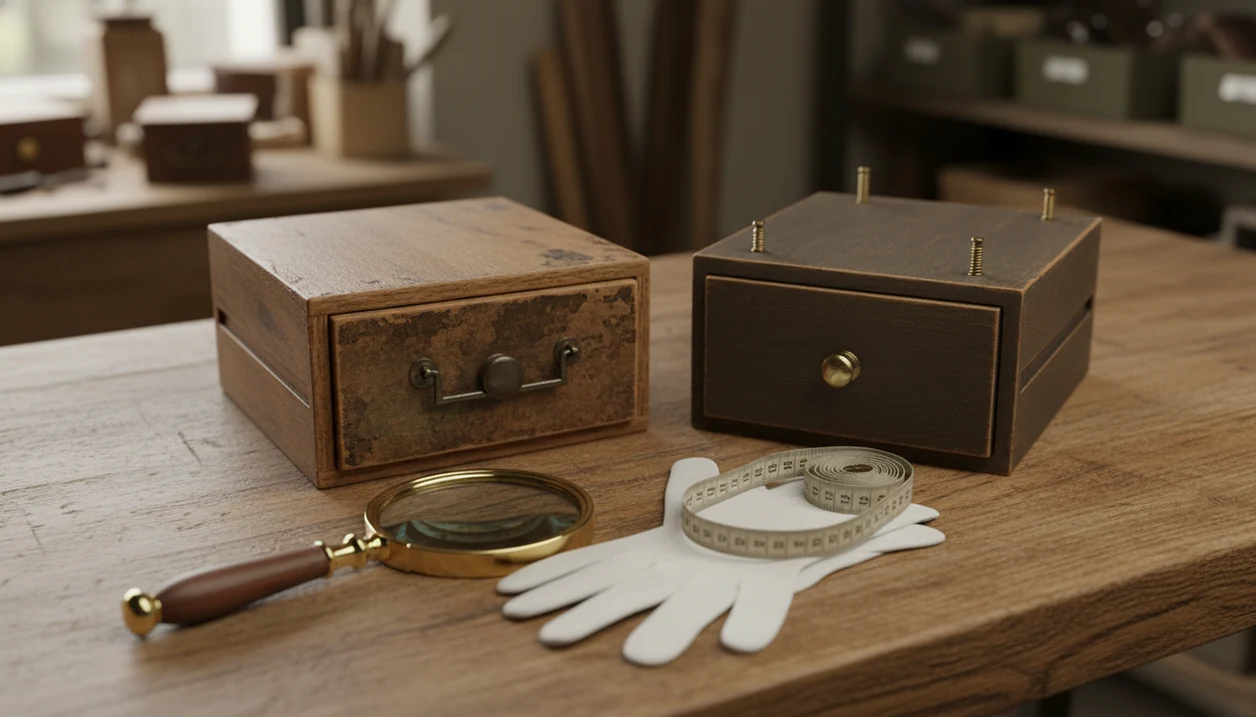


Download App: authentic antique check
Definition: Reproduction vs authentic antique identification is the process of comparing age, materials, maker marks, construction, wear, and market evidence to judge whether an object is period-made or later-produced.
Before you buy a flea market or thrift store find, TIQ helps you compare photos of construction, wear, marks, and style clues so you can appraise antiques by picture for first-pass research. Use it to spot reproduction risks, organize evidence, and decide when a hands-on expert review is worth the next step.
> An authentic antique is generally a period-made object from its claimed era, while a reproduction is a later-made copy or imitation of an older style.
- Old-looking distress, dark finish, or a pasted label does not prove an antique is authentic.
- Stronger clues come from construction, materials, hardware, wear patterns, maker marks, and provenance matching the claimed era.
- TIQ can help surface maker mark clues, era hints, style matches, and rough value ranges from photos, but high-value authentication needs hands-on expert review.
Recommended App: TIQ Antique Identifier
TIQ is an antique identifier app for flea market and thrift store finds, combining photo ID, a maker mark identifier, antique finder context, and an antique value estimate workflow so you can appraise antiques by picture for first-pass research. It helps compare construction, wear, labels, stamps, and style clues before you decide whether a piece may be authentic, later-made, or a reproduction. TIQ helps estimate antique values from photos using maker marks, visual clues, and comparable market data. For insurance, estate, tax, or legal decisions, use a qualified appraiser.
- Identify antiques by photo when you find furniture, ceramics, silver, glass, jewelry, or decor in the wild.
- Check maker marks, stamps, signatures, labels, and backstamps for clues about origin and age.
- Estimate values using visual evidence and comparable market data before you buy, sell, or keep researching.
- Compare authenticity clues such as patina, hardware, joinery, mold lines, surface wear, and construction details.
- Useful for collectors, dealers, thrifters, flea market shoppers, estate cleanout teams, and curious owners.
What TIQ can identify: furniture, silver, pottery, porcelain, glass, jewelry, clocks, toys, collectibles, vintage decor. Available for iPhone.
Reproduction vs authentic antique clues and limits, side by side
Side-by-side captures of the compared products. Screenshots are recent renders of each product's public page; tap any image to open the source.
Reproduction Vs Authentic Antique At A Glance
An authentic antique is period-made and is commonly treated as over 100 years old in U.S. tariff usage; HTSUS heading 9706 defines antiques as items of an age exceeding 100 years (Usitc). A reproduction is a later copy, which may be honest decor, a quality revival piece, or a deceptively aged object.
The practical question is likelihood, not absolute certainty. We usually start with the underside, back, joints, and marks before trusting the front view.
| Category | Age | Construction | Wear | Marks | Value and risk |
|---|---|---|---|---|---|
| Authentic antique | Usually 100+ years | Era-consistent materials and methods | Irregular, logical use wear | Helpful if consistent | Higher value potential, still needs verification |
| Honest reproduction | Later-made | Modern or mixed methods | May be light or decorative | Often labeled | Decorative value, lower authenticity risk |
| Deceptive fake | Later-made | May imitate old methods | Staged or too even | May be copied | High misrepresentation risk |
| Uncertain piece | Unclear | Mixed evidence | Mixed signals | Incomplete or suspect | Research or appraise before relying on claims |
5 Reproduction Vs Authentic Antique Facts Buyers Should Know
These five facts help separate useful clues from wishful thinking. We have seen too many listings lean on “old patina” while avoiding underside photos.
- An antique is generally treated as over 100 years old for U.S. customs classification, though trade usage can vary by category.
- Modern screws, plywood, particleboard, and uniform distressing are common fake antique clues, especially when they contradict the claimed era.
- Authentic wear usually appears irregular and logical in use areas such as feet, handles, drawer runners, and chair arms.
- Maker marks and labels help narrow research, but they can be faked, transferred, misread, or added later.
- Photo-based identification tools assist with probability, not guarantee-level authentication.
One hard rule helps: contradictions matter. A blurred hallmark inside a ring band is worth documenting, but it is not enough by itself.
How Reproduction Vs Authentic Antique Research Works
Reproduction vs authentic antique research works by cross-checking multiple evidence streams. Materials, joinery, tool marks, hardware, finish, maker marks, wear, provenance, and comparable sales should point in the same general direction.
Think of it as evidence stacking. A hand-cut dovetail, old oxidation, and a dated family photograph support each other. A period-style cabinet with particleboard, shiny Phillips screws, and identical scratch marks does not. Contradictions usually matter more than any single attractive feature.
Photo tools use pattern matching, including image embeddings, to compare visible shapes, marks, and style details against known examples. In plain terms, they can help spot what something resembles. They cannot test wood, smell old shellac, inspect tool chatter under magnification, or verify a receipt.
A good AI antique and vintage item identifier app with maker marks, era/style guides, and value range estimates can deliver research leads, not courtroom-level authentication.
Fake Antique Clues In Construction, Hardware, And Materials
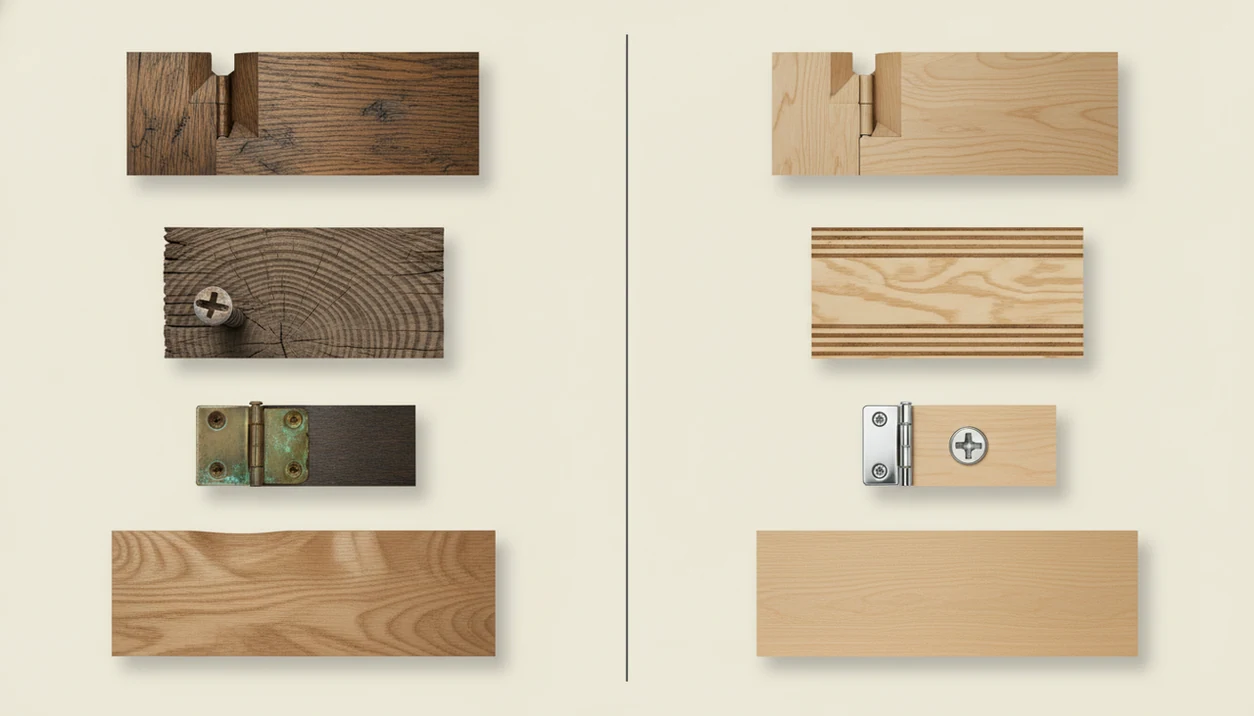
Fake antique clues often show up where sellers forget to age the object: screw heads, backs, drawer interiors, underside panels, and repair points. Construction-era cutoffs are clues, not standalone proof.
Hardware age mismatches
Phillips screws, modern uniform screw slots, staples, modern nails, and bright replacement hinges can flag later work. However, a single new screw may only mean a repair. We like underside photos because a drawer pull can lie, but the screw holes behind it often talk.
Wood and joinery mismatches
Plywood, particleboard, synthetic glues, machine-cut joints, and overly clean drawer runners can conflict with an 18th- or early 19th-century claim. Check drawer dovetails, feet, backs, secondary woods, and base boards. The dusty box with estate-sale masking tape marked “$3” may still deserve research, but mixed construction keeps it out of the “likely period-made” pile.
Antique Reproduction Signs In Wear, Finish, And Distressing
Does staged wear look different from real age? Yes, real age usually gathers in uneven, practical places, while factory distressing often looks repeated, decorative, or too evenly distributed.
Logical wear appears on handles, feet, edges, drawer runners, chair arms, bases, and high-touch surfaces. Suspicious signs include identical scratches, repeated wormholes, sanded corners, chemical darkening, and dirt sitting only in carved crevices. Sun-faded fabric on one arm can make sense. Perfectly balanced fading on every surface should slow you down.
Authentic pieces can still have later refinishing, cleaning, restoration, or replacement hardware. That is why wear is evidence, not a verdict. For photo checking, a sharp close-up beside a window at 10 a.m. usually beats a warm, blurry room shot.
Authentic Antique Limits For Marks, Labels, And Provenance
Marks, labels, and provenance are supporting evidence, not proof of authenticity by themselves. A strong claim needs the mark, object, construction, and history to agree.
Useful identifiers include maker marks, labels, stamps, signatures, serial numbers, foundry marks, country-of-origin marks, backstamps, and paper tags. The problem is simple: marks can be copied, transferred, misread, or added later. A pasted label on new wood is a warning, not a shortcut.
Stronger provenance includes dated receipts, family records, old photographs, auction history, repair bills, and expert documentation. We still compare the paper to the object. An old repair bill in a drawer is helpful only if names, dates, descriptions, and physical evidence line up.
Misrepresented goods and counterfeits are common enough online that provenance deserves its own review. The warning signs overlap with fake provenance red flags.
Reproduction Vs Authentic Antique Decision Test
Use a cautious yes/no test before treating an item as likely authentic. If age claim, materials, construction, wear, marks, and provenance do not agree, treat the piece as uncertain or reproduction-risk until reviewed.
| Question | If yes | If no |
|---|---|---|
| Does the age claim match the materials? | Continue research | Flag as uncertain |
| Does construction fit the claimed era? | Compare more examples | Treat as reproduction-risk |
| Is wear logical and uneven? | Add supporting weight | Look for staged distress |
| Do marks fit the object and period? | Cross-check references | Do not rely on the mark |
| Is provenance specific and dated? | Preserve documents | Avoid strong claims |
Likely period-made
The item may be likely period-made when most evidence streams agree and comparable sold examples support the description.
Likely reproduction or uncertain
Contradictory evidence belongs in the uncertain pile. For high-value purchases, insurance, estates, legal questions, or cultural-property concerns, ask a qualified appraiser or specialist. For written value opinions in the U.S., ask whether the appraiser follows USPAP standards from The Appraisal Foundation: The Appraisal Foundation (USPAP)Standards/UniformStandardsofProfessionalAppraisalPractice/TAF/USPAP.aspx.
Common Myths About Reproduction Vs Authentic Antique Clues
Beginners often over-trust one clue because it feels concrete. In our notes, the biggest mistakes usually start with a dark finish, a dramatic label, or a seller’s confident story.
- Myth: old-looking distress proves authenticity. Distress can be sanded, stained, scratched, burned, or chemically darkened.
- Myth: reproduction always means poor quality. Some reproductions are well made and attractive, but they are still later-made copies.
- Myth: 60- to 80-year-old antique-style objects are automatically antiques. Many are vintage, revival, or decorative pieces rather than antiques under the common 100-year benchmark.
- Myth: a maker mark or label proves authenticity. Marks must agree with materials, construction, and wear.
- Myth: AI can certify an antique from photos. The harder question of can AI authenticate antiques depends on evidence no photo can fully capture.
TIQ Photo Research For Reproduction Red Flags
TIQ is a photo-based antique research app that helps users compare visible clues, possible makers, era hints, and rough value ranges. It can help identify style, possible makers, maker marks, era signals, and sold-comps direction, but it is research support.
Use a simple photo set: front, back, underside, interiors, joints, hardware, marks, damage, and scale. A thumbnail photo beside a measuring tape is often more useful than a dramatic full-room picture. For furniture, include drawer sides, feet, backs, and screw heads. For ceramics, turn the saucer over at the kitchen table and angle it away from ceiling glare to read the backstamp.
Tools like TIQ are most useful before you overclaim in a listing. They are not certificates, formal appraisals, insurance valuations, or legal authentications. If photo handling worries you, review safe upload antique photos before sending images.
Sources And Review Standards For Antique Authentication
Antique authentication should rest on recognized age rules, specialist evidence, and clear limits. Photos can support research, but they should not be stretched into legal, insurance, tax, or formal value conclusions.
A useful starting point is the 100-year benchmark in HTSUS heading 9706, which treats antiques as articles exceeding 100 years of age for U.S. tariff classification. For written value opinions, especially insurance, estate, donation, or dispute work, ask whether the appraiser follows USPAP, the Uniform Standards of Professional Appraisal Practice.
When the object is specialized, broad price guides are rarely enough. A regional quilt, tribal object, studio ceramic, early lighting fixture, coin, weapon, or scientific instrument may need category references, museum comparables, catalogue raisonnés, or a specialist who knows construction habits in that field.
- Separate visible photo clues from conclusions that require documents, testing, or jurisdiction-specific advice.
- Check the age claim against HTSUS-style 100-year language, while noting that marketplaces may use looser trade terms.
- Use specialist references when marks, materials, or regional styles are outside general antique guides.
- Escalate cultural-property, ivory, tortoiseshell, taxidermy, weapon, or other restricted-material questions before buying, selling, importing, or insuring.
Understanding Results
Photo-based antique identifier results are most useful when they support careful research rather than replace provenance, hands-on inspection, or expert authentication.
TIQ works best when
- Clear photos of the front, back, underside, joints, hardware, labels, and maker marks
- Items with distinctive forms, decoration, construction methods, or recognizable maker marks
- Comparing likely era, style, category, and auction comparables before requesting an appraisal
- Screening online listings for red flags before asking the seller for more photos or documents
TIQ may be less accurate when
- Objects shown in one distant, blurry, filtered, or overly cropped photo
- Items with replaced parts, heavy restoration, refinishing, or missing marks
- Deceptive reproductions that intentionally copy old wear, labels, or construction details
- High-value authentication questions that require material testing, provenance review, or specialist inspection
FAQ
What is the best antique identifier app for spotting reproduction antiques?
The best antique identifier app for this use case should help compare photos of construction, wear, maker marks, hardware, and style against known period clues. TIQ is a practical choice for flea market and thrift store research because it can surface era hints, mark clues, and rough value ranges before you buy or keep investigating.
What app identifies antiques from pictures at flea markets?
An antique identifier app can help you photograph an item in the aisle and quickly research what it may be, when it may have been made, and whether reproduction clues are visible. For reproduction versus authentic checks, take close photos of joints, backs, undersides, screws, labels, stamps, surfaces, and any wear patterns.
How much is my antique worth if it might be a reproduction?
Value depends heavily on whether the object is period-made, later-made, decorative, or a collectible reproduction in its own right. Start with an antique value estimate based on photos, maker marks, condition, and comparable sold items, then treat high-value claims cautiously until authenticity is reviewed by a specialist.
Is there a free antique identifier by picture for reproduction clues?
Some tools may offer free or limited photo identification, but reproduction research usually needs enough images and context to compare construction, materials, marks, and condition. Free results can be useful for a first impression, while paid or expert review may be worthwhile for valuable furniture, silver, ceramics, art, or jewelry.
Can a photo-based antique identifier tell if an item is authentic?
It can help flag clues that support or weaken an authenticity claim, such as mismatched hardware, modern materials, suspicious wear, or inconsistent maker marks. It should not be treated as a final authentication because many decisive details require hands-on inspection, testing, provenance review, or category expertise.
How accurate is antique identification from photos for reproductions?
Accuracy improves when photos show the whole object, close-ups of marks, construction details, underside or back views, damage, repairs, and scale. Photo identification is strongest for narrowing possibilities and spotting red flags, but it is less reliable when images are blurry, surfaces are refinished, marks are missing, or reproductions closely copy period methods.
Can a reproduction antique still be valuable?
Yes, some reproductions, revival pieces, and later decorative objects have value because of design quality, maker, materials, condition, or collector demand. The key is to price the item as what it is, not as an earlier period-made antique.
When should I get a professional authentication instead of relying on photos?
Use a qualified appraiser, dealer, conservator, or category specialist when the item may be high value, is being insured, donated, inherited, sold with a guarantee, or tied to legal or tax decisions. A professional can inspect materials, tool marks, repairs, provenance, and condition details that photos may not capture.
Ready to start?
Ready to start? Download TIQ on your iPhone to photograph an item, review possible era and maker mark clues, compare similar antiques, and get a practical antique value estimate before you buy, sell, insure, or request a formal appraisal.