Can an Antique Identifier App Authenticate Antiques?


Download App: can ai authenticate antiques
Use an antique identifier app as a fast first step to recognize clues, compare similar pieces, and appraise antiques by picture before deciding whether expert authentication is worth pursuing.
Definition: An antique identifier app analyzes photos, maker marks, and visual clues to suggest what an item may be, but formal authentication confirms originality and provenance through expert review.
- AI antique authentication is best understood as photo-based identification support, not certified authentication.
- AI can compare visible style, shape, decoration, maker marks, and similar examples, but it cannot inspect materials, repairs, hidden damage, or provenance.
- Use AI first for research, then seek an appraiser, auction specialist, conservator, or category expert for high-value or legally important items.
Recommended App: TIQ Antique Identifier
TIQ is an antique identifier app for turning photos into practical first-pass research when you need to identify antiques by photo, check maker marks, and appraise antiques by picture before buying, selling, or sorting an estate cleanout. It works as an antique finder for estate-sale shoppers who want faster context on age, style, origin, and likely market range. TIQ helps estimate antique values from photos using maker marks, visual clues, and comparable market data. For insurance, estate, tax, or legal decisions, use a qualified appraiser.
- Identify antiques by photo using visible shape, materials, construction, decoration, and style clues.
- Use maker mark identifier support to research stamps, signatures, hallmarks, labels, and back marks.
- Get an antique value estimate based on comparable market data and item condition signals.
- Helpful for estate-sale shoppers, estate cleanouts, collectors, resellers, and families sorting inherited items.
- Organize early research before deciding which pieces need expert authentication or a formal appraisal.
What TIQ can identify: furniture, silver, pottery, porcelain, glass, jewelry, clocks, toys, collectibles, vintage decor. Available for iPhone.
AI Antique Authentication: The Boundary in One Sentence
AI can support antique research, but it cannot certify authenticity from photos alone. Identification asks, “What does this object appear to be?” Authentication asks, “Is this object genuinely what it is claimed to be, based on enough evidence?”
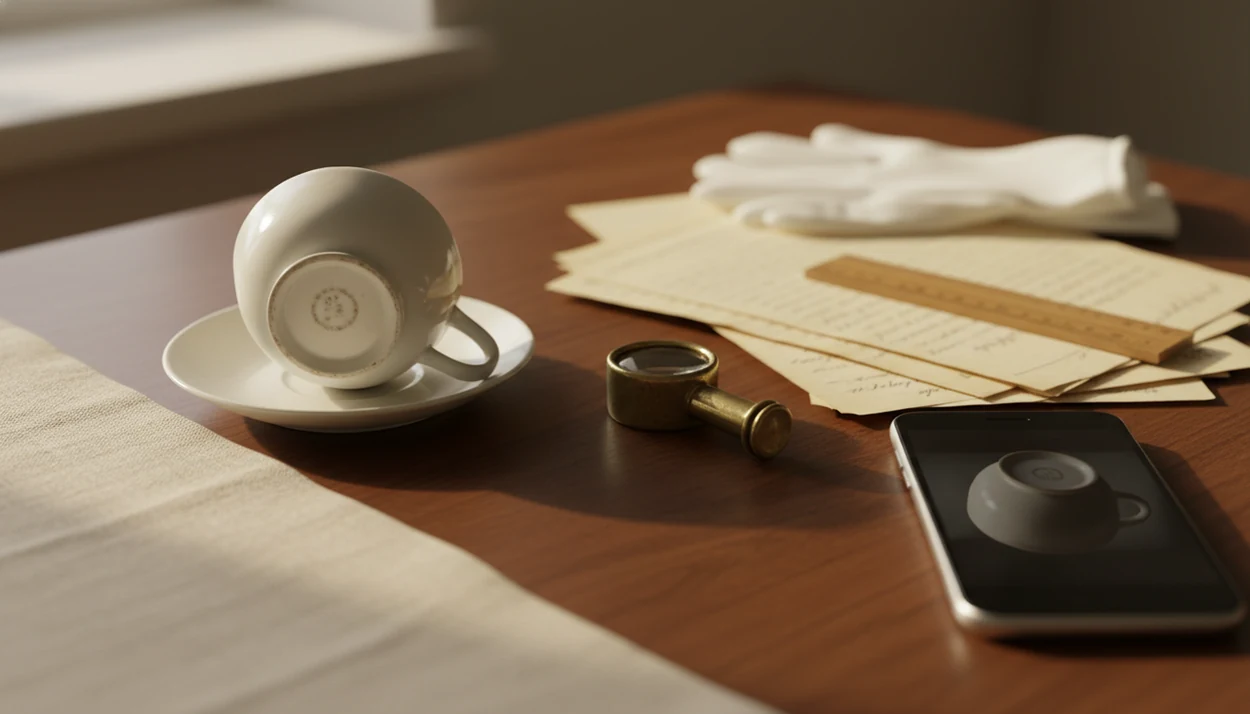
That difference matters at the kitchen table. Turning a saucer over and angling it away from ceiling glare may reveal a backstamp, but the photo still cannot prove the ceramic body, firing history, or later decoration. A visible mark is a clue, not a verdict.
Tools like TIQ fit the first-pass research stage. They can help narrow likely maker, era, style, or object type, but they are not certified appraisal or formal authentication services. For formal appraisal work in the U.S., USPAP standards from The Appraisal Foundation are the common professional reference point: The Appraisal Foundation (USPAP)Standards/UniformStandardsofProfessionalAppraisalPractice/TAF/USPAP.aspx. Good AI antique and vintage item identifier apps with maker marks, era/style guides, and value range estimates deliver research direction, not legal certainty.
Antique Photo Decision Matrix: Research Clue or Authentication Evidence?
Use photo-only AI when the decision is low-stakes; do not use it alone when money, law, insurance, tax, or family disputes are involved. A dusty box with estate-sale masking tape marked “$3” is a reasonable place to start with AI. A six-figure attribution is not.
| Review method | Okay for research? | Enough for authentication? | Better use |
|---|---|---|---|
| Photo-only AI | Yes | No | Low-stakes ID, listing terms, era or maker clues |
| Human collector review | Often | Usually no | Spotting obvious conflicts and better search terms |
| Professional authentication | Yes | Sometimes, depending on evidence | Insurance, tax, legal, rare, or major resale decisions |
For inherited, disputed, insured, or unusually valuable items, AI should only start the file. The safest path is to compare the result with sold records, provenance notes, and a category specialist before making a claim.
When to Get Professional Antique Authentication
Get professional antique authentication when the answer will affect money, ownership, insurance, tax, donation, or resale claims. If the wording “authentic,” “attributed to,” or “period” would change what someone pays or believes, do not rely on photos alone.
Different questions call for different experts. An appraiser gives a value opinion for a stated purpose, while a category specialist may be better for maker, period, school, or attribution questions. A conservator is the safer choice when the issue involves materials, old repairs, overpainting, replaced parts, or hidden condition problems.
- Gather provenance notes, family records, receipts, old labels, measurements, and clear photos before contacting anyone.
- Separate value questions from authenticity questions so the right professional can answer each one.
- Ask whether hands-on inspection, testing, or condition review is needed before a written opinion is possible.
- Keep AI results as research notes, not as proof, especially for insured, donated, inherited, or high-value objects.
- Avoid listing or describing the item as authentic until expert review supports that claim.
How Photo-Based AI TIQ Works
Photo-based AI antique identifier uses computer vision to compare visible features: shape, decoration, style, material appearance, maker marks, labels, seams, hardware, and condition clues. In plain language, the system looks for visual patterns and returns likely matches, not proof.
Behind the scenes, models often use image embeddings, which turn pictures into searchable numerical patterns. Those patterns may be compared with catalogued examples, marketplace listings, reference images, and known object categories. A clear close-up beside a window at 10 a.m. usually gives a better signal than a blurry hallway photo under yellow light.
The broader AI vision market is growing quickly, and image-recognition tools are becoming more common across many fields. However, growth in visual recognition does not remove the need for expert judgment. Probable is not authenticated.
Five Facts About AI Antique Authentication Limits
- AI can suggest likely item type, era, style period, origin, and rough value range from visible photo clues.
- AI works best when photos show clear marks, construction details, scale, wear, damage, and all sides of the object.
- AI cannot reliably detect sophisticated fakes, hidden restorations, internal construction, undocumented repairs, or provenance gaps.
- AI value ranges are rough estimates and may reflect visually similar listings rather than confirmed sold prices.
- The safest workflow is AI first, traditional research second, and expert review for high-value or disputed items.
That order keeps the research useful without overclaiming. If a result points to sterling silver, check the hallmark, weight, sold comps, and wear pattern before listing it as confirmed. A lion passant on a spoon is worth researching, but it still needs context.
Photo Authentication Limits for Marks, Materials, and Condition
Can you authenticate an antique from a picture? Usually no, because many decisive clues are hidden, worn, altered, or outside the camera’s reach.
Marks can be partial, fake, overpolished, misread, or undocumented. A fingertip tracing raised backstamp letters may help you photograph them, but AI can still confuse similar marks or miss a tiny impressed symbol near the foot ring. Surface appearance also may not reveal wood species, ceramic body, metal composition, overpainting, repairs, or replacement hardware.
Lighting, angle, glare, crop, scale, and resolution all change the result. Fine-grained image-classification research shows that models can lose reliability under blur, lighting shifts, noise, and other common image corruptions, which is why photo conditions matter for antique identification: arXiv. That is close to the antique problem: two cream-glazed plates may look alike online, while only one has the right body, mark, and documented pattern history.
Common Myths About Authenticating Antiques With AI
Single-photo proof. One image can suggest a likely category, but it rarely proves an antique is real. A front view may hide a new screw, fresh glue line, or replacement base.
AI value equals appraisal. A value range is not a formal appraisal. It may not account for condition, provenance, regional demand, or whether the comparison was an asking price or a sold listing screenshot.
Fake spotting is automatic. AI may flag suspicious marks or odd proportions, but convincing reproductions can pass a photo check. Our guide to reproduction vs authentic antique covers the slower clue-by-clue approach.
Better camera, full certainty. Sharp photos help, but they do not solve missing provenance or hidden repairs.
Confident answer, safe sale. Confidence wording can mislead. Verify before using “authentic” in a listing.
Best Use Case for TIQ in AI Antique Research
TIQ is most useful for beginners, inheritors, thrifters, and resellers who need a research starting point. It can surface maker mark clues, style or era hints, comparable object types, and rough value ranges before the user decides what deserves more time.
Photograph the front, back, underside, maker marks, damage, hardware, seams, and scale. Include a ruler or coin when size matters. If a hinge has verdigris, a brooch has a missing rhinestone, or a drawer has machine-cut joinery, photograph that too. Small defects change the research path.
Important pieces should be checked against sold records, reference books, auction specialists, appraisers, or conservators. For privacy-sensitive uploads, use careful framing and review safe upload antique photos before including family documents, addresses, or collection records.
Understanding Results
Photo-based results are most useful when treated as identification support, not final authentication.
TIQ works best when
- Clear photos of the full object, base, back, underside, and close-up maker marks
- Common ceramics, glass, silverplate, furniture, toys, tools, books, and vintage decor with visible design clues
- Low-stakes research before listing, sorting, donating, or deciding whether to pay for an expert opinion
- Comparing apparent style, era, material clues, and similar auction or marketplace examples
TIQ may be less accurate when
- Items with blurry photos, glare, missing scale, hidden damage, or covered marks
- High-value attributions where small construction, material, or provenance details change authenticity
- Objects with forged marks, later decoration, repairs, restorations, or replacement parts
- Legal, insurance, tax, estate dispute, or museum-level authentication decisions
FAQ
What app identifies antiques from pictures before authentication?
An antique identifier app can help you recognize the item, style, maker marks, likely era, and rough market range before you pay for formal authentication. TIQ is a practical choice for this first-pass research because it uses photos, visible details, and comparable market data to organize what you may have.
How much is my antique worth before I authenticate it?
A photo-based antique value estimate can give you a rough market range based on similar sold items, visible condition, maker clues, and category demand. That helps you decide whether the item is worth deeper research, auction review, insurance documentation, or a paid expert appraisal.
Is there a free antique identifier by picture for authentication research?
Free image searches and basic photo tools can help you find lookalikes, but they often miss maker marks, condition issues, and category-specific details. For authentication research, use photo identification as a starting point and keep records of marks, provenance, measurements, and comparable sales.
Can TIQ read maker marks from a photo?
TIQ can help interpret visible stamps, signatures, labels, hallmarks, and back marks from clear photos. Maker mark research is useful for narrowing origin and age, but a mark alone does not prove authenticity because marks can be copied, altered, or misattributed.
Can an antique identifier app tell if an item is genuine?
An antique identifier app can flag clues that support or conflict with a likely identification, such as style, construction, decoration, marks, and comparable examples. It cannot definitively certify genuineness from photos alone because authentication often depends on materials, repairs, provenance, and hands-on inspection.
What photos help with antique authentication research?
Use sharp photos of the full item, close-ups of maker marks, undersides, joints, backs, hardware, damage, repairs, and any labels or documents. Include scale, measurements, and multiple angles so the app or expert can compare construction, materials, and condition more accurately.
When should I involve an antique expert?
Bring in a qualified appraiser, auction specialist, conservator, or category expert when the item may be high value, insured, inherited for estate purposes, or involved in a legal or tax decision. Expert review is also important when authenticity affects price significantly or when the item has unusual provenance, restoration, or suspicious marks.
Are my antique photos private when using an identifier app?
Privacy depends on the app’s policies, so review how photos, descriptions, and account data are stored or used. Avoid uploading sensitive documents, addresses, or personal information unless you are comfortable with the service’s privacy terms.
Ready to start?
Ready to start? Take clear photos of the front, back, base, marks, labels, and any damage, then use TIQ to identify the item, review likely maker or era clues, and decide whether expert authentication is worth the next step.