
Are Antique Identifier Apps Accurate Enough to Trust?


Download App: are antique identifier apps accurate
Definition: Antique identifier app accuracy describes how reliably a photo-based tool can identify antiques, interpret maker marks, and estimate likely market value.
Use an antique identifier app to turn unknown items into research leads, compare clues, and appraise antiques by picture before you spend hours searching sold listings. This guide shows when photo-based results are useful, where accuracy can break down, and how to verify important finds.
> This guide explains where photo-based antique identification is useful, where it fails, and when to verify results with sold comps, maker-mark references, or a qualified appraiser.
- Antique app accuracy is usually strongest for common, well-photographed items with visible marks, distinctive shapes, and many sold comparisons.
- AI antique accuracy drops when photos are dark, angled, incomplete, or when the item is rare, repaired, altered, or heavily worn.
- Antique identifier confidence should be read as probability, not proof of authenticity, maker, age, or market value.
Recommended App: TIQ Antique Identifier
TIQ is an antique identifier app for collectors and beginners who want a faster way to identify antiques by photo, organize visual clues, and appraise antiques by picture for first-pass research. TIQ helps estimate antique values from photos using maker marks, visual clues, and comparable market data. It also works as a maker mark identifier and antique finder to help users build stronger research habits before checking sold comps or requesting expert review. For insurance, estate, tax, or legal decisions, use a qualified appraiser.
- Identify antiques by photo using visible style, materials, construction, age clues, and category patterns.
- Research maker marks, signatures, labels, stamps, hallmarks, and backstamps that may narrow attribution.
- Estimate values with comparable market data so you can judge whether an item deserves deeper research.
- Helpful for collectors, beginners, thrift shoppers, estate sale browsers, and families sorting inherited objects.
- Use results as a research starting point, then confirm important finds with sold listings or a specialist.
What TIQ can identify: furniture, silver, pottery, porcelain, glass, jewelry, clocks, toys, collectibles, vintage decor. Available for iPhone.
Are antique identifier apps accurate for real-world identification?
Are antique identifier apps accurate for real-world identification? They are useful for directional identification, but they should not be treated as definitive attribution, authentication, or appraisal.
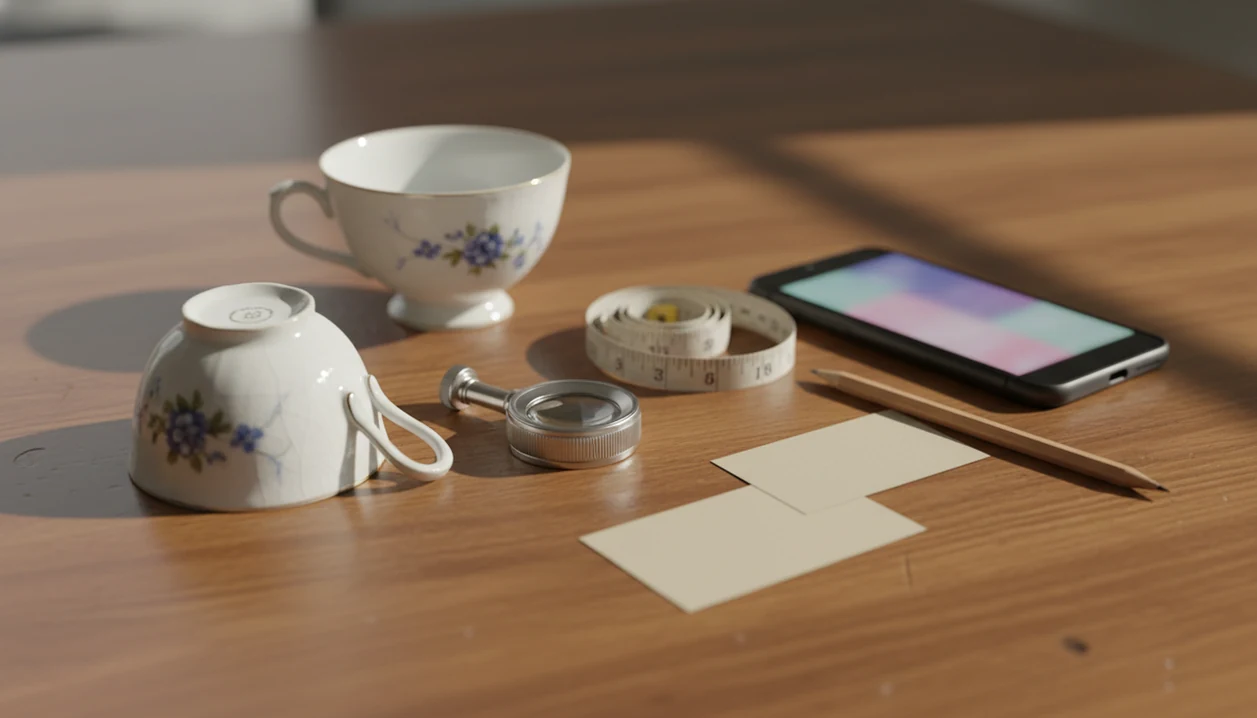
Accuracy depends on four things: the item category, photo quality, visible marks, and how many similar examples exist in reference or sale data. A transferware plate with a clear backstamp is easier than an unsigned regional chair with replaced feet. We have seen the same saucer produce a better result after turning it over at a kitchen table and angling it away from ceiling glare.
According to The Art Basel and UBS Art Market Report 2023, global art and antiques sales were estimated at $67.8 billion in 2022 (Artbasel). At that scale, even small identification errors can matter. For beginners, an app result is a research lead. For valuable objects, it is not the stopping point.
How AI antique accuracy works behind the app result
AI antique accuracy works by comparing a photo against visual patterns, maker-mark data, style signals, and past-sale examples; it predicts likely matches rather than proving identity.
Most systems use image recognition and visual similarity. In plain terms, the app looks for shapes, decoration, marks, materials, and proportions that resemble known examples. A good AI antique and vintage item identifier app with maker marks, era/style guides, and value range estimates can deliver useful research leads, not certified authentication or guaranteed sale prices.
Models usually perform better when the object resembles well-documented examples. A clear porcelain backstamp, a measured silver spoon, or a labeled clock movement gives the system more to compare. Tools like TIQ can help organize those clues, but the result still needs cross-checking against references.
Five antique app accuracy facts beginners should know
- Antique identifier apps give probable identification and rough value ranges, not final authentication.
- Common items are usually easier to identify than rare, regional, handmade, or poorly documented pieces.
- Visible maker marks, dimensions, material clues, and sharp detail photos usually improve antique identifier confidence.
- Wide value ranges, several close matches, or uncertain maker names are signals to keep researching.
- High-value items need sold comps, auction records, specialist references, or professional review before pricing.
A dusty box with estate-sale masking tape marked “$3” may still hold something worth checking, but the first app result should not decide the listing price. For resellers, sold-comparable research is often safer than asking-price research because sold listings show what buyers actually paid.
Photo quality factors that change antique identifier confidence
Photo quality can change antique identifier confidence because the app can only evaluate what the image shows. Lighting, angle, clutter, focus, scale, and missing underside or back photos all affect the result.
Take a straight front photo, a back photo, an underside photo, and close-ups of marks, signatures, labels, joinery, bases, rims, and hardware. A blurry phone photo inside a cabinet door tells the system much less than a sharp close-up taken beside a window at 10 a.m. Small details matter. Bubbles trapped in old glass, a paper label under a figurine base, or screws in a hinge can change the likely date.
Computer-vision robustness research shows that common image corruptions and perturbations can sharply reduce classifier performance, including in the ImageNet-C benchmark (arXiv). Retake the photo before you distrust the entire result.
Antique identifier confidence signals and what they mean
High confidence means the photo looks similar to known examples; it does not mean the object is authentic, complete, or correctly priced.
| Signal in the app | What it usually means | What to do next |
|---|---|---|
| High category confidence | The object type is visually consistent with known examples | Verify maker, age, condition, and measurements |
| Low confidence | The image or object does not match cleanly | Retake photos and add detail shots |
| Multiple close matches | The item shares features with several makers or eras | Compare marks, construction, and pattern names |
| Wide value range | Condition, rarity, or sale channel may vary greatly | Check sold comps, not just asking prices |
| Confident category, uncertain maker | The app may know “Art Deco lamp” but not the manufacturer | Research labels, sockets, hardware, and catalogs |
A narrow-looking result can still be wrong if the photo misses a repair, replaced part, or reproduction detail. The reproduction vs authentic antique question often starts with those hidden clues.
Common myths about antique app accuracy and value
Myth 1: A specific maker and year means the app is right. A named result is still a probable match, not proof. A mantel clock beside funeral cards may offer provenance clues, but the app cannot verify the family story.
Myth 2: High confidence means authentic. Confidence measures similarity. It cannot confirm originality, age, or untouched condition.
Myth 3: One app result is enough to set a sale price. It is safer to compare sold listings, auction records, and condition-matched examples. A polished marketplace asking price can be wishful thinking.
Myth 4: Apps work equally well on every object. Mass-produced ceramics, glass, and branded collectibles are often easier than museum-level, altered, or undocumented pieces.
Online resale is now mainstream, which helps explain why quick identification tools are popular. Popular does not mean final.
Sources and Evidence Behind Antique App Accuracy
The evidence behind antique app accuracy is strongest for broad risk patterns, not item-by-item certainty. Market reports, computer-vision research, and appraisal guidance all point to the same practical rule: use the app as a clue generator, then verify.
Large art-and-antiques market estimates explain why pricing mistakes matter; a small error can become expensive when buyers, sellers, insurance, and estate decisions are involved. Computer-vision robustness studies support the photo-quality advice above, because classifiers can change when images are blurred, dark, cropped, or visually distorted. Museum and appraisal guidance also tends to separate identification from authentication: a photo may suggest a maker or period, but physical inspection, provenance, condition, materials, and comparable sales still carry weight.
A sensible evidence check looks like this:
- Treat the app result as a hypothesis, not a certificate.
- Compare the category and maker claim against marks, dimensions, and construction details.
- Check sold examples and auction records before relying on a value range.
- Separate published evidence from field observations, such as better results after retaking photos or adding underside shots.
- Ask a qualified specialist when the answer affects money, ownership, insurance, or inheritance.
A safer antique identifier workflow for pricing decisions
Use an antique identifier app as one step in a verification workflow, especially before buying, selling, insuring, or dividing inherited property.
- Take multiple clear photos from the front, back, underside, marks, and construction details.
- Add dimensions, weight if safe, material clues, condition notes, and any provenance.
- Compare the app result against sold comps, auction records, mark references, and pattern guides.
- Flag uncertainty when the app shows multiple matches, a wide value range, or a vague maker.
- Escalate expensive, insured, inherited, legally sensitive, or culturally sensitive objects to a qualified appraiser.
Wrap a questionable item in a towel before placing it in the research pile. That simple pause prevents chips while you check marks, comps, and document antique provenance notes. Expert review can reduce AI-only errors in many fields, and antiques are no exception.
When to Consult an Appraiser or Specialist
Consult an appraiser or specialist when the result could affect money, insurance, inheritance, taxes, or legal decisions. An app can narrow the question, but it cannot replace a written professional opinion for high-stakes objects.
Some categories deserve extra caution from the start. Fine art, jewelry, weapons, coins, and antiquities often require field-specific training, condition inspection, market knowledge, and sometimes legal or regulatory awareness. A confident photo match also does not prove clean title, lawful export, or the right to sell; ownership and provenance questions sit outside app confidence.
- Escalate items that may be valuable, insured, inherited, donated, taxed, or part of an estate settlement.
- Choose a specialist whose category matches the object, such as a jewelry appraiser for stones or a numismatist for coins.
- Bring photos, dimensions, condition notes, receipts, family history, prior appraisals, and any maker-mark research.
- Ask for the intended use of the opinion, because resale advice, insurance scheduling, and estate valuation may require different formats.
- Seek review when apps disagree, name different makers, or show a value range too wide to price safely.
Understanding Results
Antique identifier results are most useful when you treat them as research leads supported by photos, marks, condition details, and comparable sales.
TIQ works best when
- Clear, well-lit photos from multiple angles, including the back, base, underside, and close-up details
- Items with visible maker marks, backstamps, signatures, labels, hallmarks, or model numbers
- Commonly traded categories with many comparable examples, such as ceramics, glass, silver plate, jewelry, toys, and small collectibles
- Objects with distinctive shapes, patterns, materials, or decoration that match known styles or makers
TIQ may be less accurate when
- Dark, blurry, cropped, reflective, or heavily angled photos
- Rare, regional, handmade, altered, repaired, or heavily worn items with few comparables
- Unsigned furniture, folk art, textiles, and objects where construction details matter more than one photo
- High-stakes authentication, insurance appraisal, legal valuation, or attribution to a major maker
FAQ
What is the best antique identifier app for accuracy?
The best antique identifier app is one that gives you useful photo-based clues, explains likely maker marks or style signals, and encourages verification with sold comps. TIQ is a practical choice for beginners and collectors because it helps identify antiques by photo, organize research leads, and estimate rough value ranges without treating results as certified proof.
Can I appraise antiques by picture?
Yes, you can use photos to get a first-pass value range and decide whether an item deserves deeper research. A picture-based result is most helpful when you include clear photos of the whole object, marks, labels, damage, materials, and scale.
What app identifies antiques from pictures?
An antique identifier app such as TIQ can identify antiques from pictures by analyzing shape, style, materials, maker marks, and comparable market signals. It works best as a fast research starting point before you confirm the result with sold listings, reference books, or a specialist.
Can TIQ read maker marks from a photo?
TIQ can help read visible maker marks, hallmarks, stamps, labels, signatures, and backstamps from clear photos. For the best results, photograph the mark straight on, in good light, and include a second image showing where the mark appears on the item.
How accurate are antique identifier apps from photos?
Antique identifier apps are often useful for common items, recognizable forms, visible marks, and broad style or period clues. Accuracy drops with rare objects, poor lighting, missing angles, repairs, reproductions, or items with few comparable sales.
Can an antique identifier app authenticate a rare or valuable antique?
No app should be treated as final authentication for a rare, high-value, legal, insurance, estate, or tax-related item. Use the app to gather clues, then confirm important conclusions with a qualified appraiser, specialist dealer, or relevant expert.
What photos improve antique identifier accuracy?
Clear, complete photo sets improve results because they give the app more evidence to compare. Include the front, back, sides, underside, close-ups of marks, hardware, joints, damage, repairs, and one photo showing scale.
Ready to start?
Ready to start? Use TIQ to photograph your item, review likely matches, check maker-mark clues, and compare value signals before deciding whether expert verification is needed.