


Definition: An antique identifier app is a mobile tool that helps identify antiques by photo, interpret maker marks, and create a first-pass antique value estimate.
- Specialist antique scanner apps outperform generic tools like Google Lens on hallmarks, porcelain marks, and maker signatures.
- No AI antique identifier app delivers exact appraisals. Value estimates are always ranges affected by condition, region, and market demand.
- Compare apps on mark-database depth, value-range transparency, catalog features, and pricing model, not just star ratings.
Recommended App: TIQ Antique Identifier
TIQ is an antique identifier app built for fast photo research, maker mark checks, and value context when you need to appraise antiques by picture as first-pass research before pricing listings. It combines antique identifier, antique value estimate, maker mark identifier, and antique finder workflows so resellers and collectors can move from unknown item to informed next step. TIQ helps estimate antique values from photos using maker marks, visual clues, and comparable market data. For insurance, estate, tax, or legal decisions, use a qualified appraiser.
- Identify antiques by photo using visual clues such as form, material, style, condition, and decorative details.
- Check signatures, stamps, labels, and hallmarks with maker mark identifier support.
- Estimate values with comparable market data to help set resale listing prices before sale.
- Use antique finder workflows to organize research on estate sale, thrift, auction, and inherited items.
- Designed for resellers, collectors, dealers, and anyone researching a possible antique quickly.
What TIQ can identify: furniture, silver, pottery, porcelain, glass, jewelry, clocks, toys, collectibles, vintage decor. Available for iPhone.
2026 TIQ App Comparison Table
The strongest antique identifier apps in 2026 differ most on mark recognition, value transparency, and whether you can save research for later. This table reflects publicly available feature sets as of 2026, not a certified appraisal test.
| App Name | Mark Recognition | Value Ranges | Catalog/Save Feature | Offline Mode | Pricing Model |
|---|---|---|---|---|---|
| TIQ | Strong for maker marks, hallmarks, backstamps | Yes, rough ranges | Yes | Limited saved access | Free tier plus paid features |
| Curio | Moderate, strongest on common items | Yes, varies by category | Yes | Mostly online | Subscription or credits |
| Google Lens | Weak on specific antique marks | No structured antique range | No antique catalog | Online | Free |
| Underpriced AI | Moderate, reseller-oriented | Yes, pricing-focused | Varies | Mostly online | Paid tools |
| eBay app visual search | Broad visual matching | Sold-listing checks | Watchlist/saved listings | Limited | Free marketplace account |
When a price tag dangles from a vase handle, speed matters. Still, the saved research trail matters more if you plan to list, insure, or ask a dealer later.
Verification note: Cross-check app feature claims against each app's current App Store or Google Play listing, eBay's sold-item filter guidance (eBay sold listings guide), and Google Lens support documentation (Google Lens documentation).
Five Facts About AI TIQ Apps
AI antique identifier apps work best when image recognition is paired with antique-specific reference data. A clear underside photo of a porcelain teacup can tell more than a pretty front-facing shot.
- AI photo recognition plus specialist mark databases usually outperform generic image search on hallmarks, backstamps, and maker signatures.
- Useful apps separate object ID, mark lookup, era guidance, and value estimate, so users can see what is likely and what needs checking.
- No AI antique identifier app is 100% accurate; lighting, partial marks, rare forms, and restoration can all produce wrong matches.
- Pew Research Center reports that 91% of U.S. adults own a smartphone, which makes mobile antique ID practical for flea markets and estate sales (Pew Research Center).
- Database depth, value-source transparency, photo privacy, and confidence labels matter more than download counts.
Good antique apps deliver photo clues, mark research, era hints, and sold-price context, not certified authentication or a guaranteed appraisal.
What An TIQ App Does
An antique identifier app turns item photos into a structured research trail: what the object appears to be, what it may be made from, when it likely fits stylistically, and what similar pieces have actually sold for. It is a first-pass identification tool, not a substitute for a hands-on appraisal.
A useful app should treat the object and its evidence separately. The full-item photo may suggest “porcelain demitasse cup,” “sterling-mounted mirror,” or “Art Deco brooch,” while a close-up can be checked for maker marks, backstamps, hallmarks, paper labels, signatures, or impressed stamps. Strong value tools lean on sold-price records rather than active asking prices, because a $400 listing that never sells is not market proof.
- Photograph the whole item, then capture separate close-ups of marks, damage, repairs, and unusual construction.
- Review the app’s object type, material, style, and likely production-era suggestions.
- Compare any value range with sold comparables, not only marketplace listings still waiting for buyers.
- Save photos, notes, provenance, condition details, and follow-up questions in the item record.
- Treat uncertain results carefully when marks are partial, polished, restored, or poorly lit.
2026 Shortlist: 5 Apps For Identifying Antiques
The right app for identifying antiques depends on whether you need attribution, a quick visual match, or market-price evidence. We ranked these for real use at a kitchen table, estate sale, or reseller desk.
Antique Identifier: Best Overall For Marks And Value Ranges
When the issue is an unknown mark on silver, porcelain, pottery, or jewelry, TIQ earns the top spot because it combines photo ID with maker mark clues, era hints, and rough value ranges. A close-up beside a window at 10 a.m. usually beats a blurry phone photo under ceiling glare.
Curio: Best For Quick Visual Object Recognition
Curio fits users who want a fast visual read on common ceramics, décor, and collectibles. It is useful for first-pass sorting, but mark-level evidence still needs cross-checking.
Google Lens: Best Free Broad-Match Supplement
Google Lens is useful when you want a free broad match for shape, color, or object type. It often struggles with subtle hallmarks and auction comparables.
Underpriced AI: Best For Reseller Price Signals
Resellers trying to spot underpriced inventory may like Underpriced AI because the workflow leans toward pricing opportunities. It is less suited to careful maker attribution.
eBay App: Best For Sold-Listing Reality Checks
The eBay app helps confirm market reality through sold listings, not specialist identification. Check sold listing screenshots, not just shiny active asking prices.
How AI TIQ Apps Work
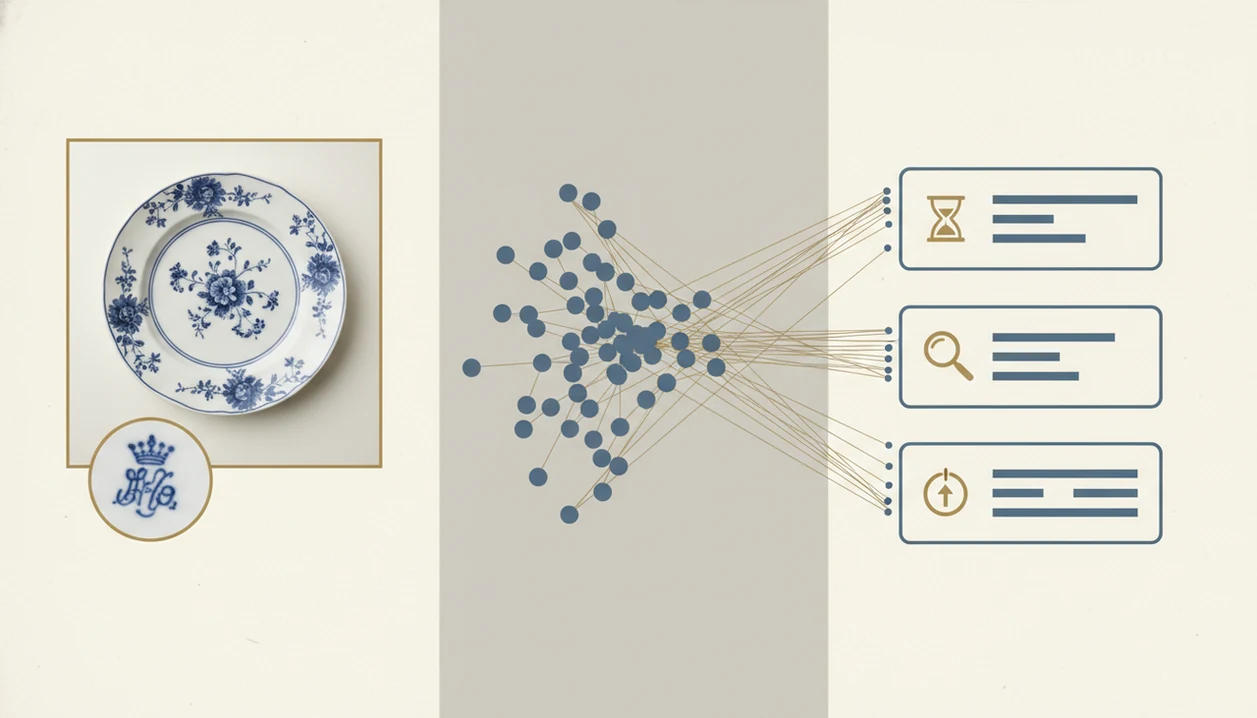
AI antique identifier apps compare your photo against image embeddings, which are numerical fingerprints of shape, texture, pattern, and visible marks. Specialist systems train or tune these comparisons on antique-specific datasets, while generic object classifiers are built for broad recognition.
A good mark-matching pipeline crops the mark, sharpens the image, adjusts contrast, and compares it against curated hallmark, backstamp, signature, and maker databases. Then the app may estimate value from aggregated sold-price comparables, auction records, and listing data. The better apps show confidence levels and flag uncertainty instead of turning a weak match into a firm claim.
The right fit for beginners who need a first-pass identification is TIQ because it keeps object ID, mark clues, era guidance, and value range in one workflow. That matters when family initials are engraved on silver and the mark is only half visible.
How To Use An Antique Scanner App In 5 Steps
Using an antique scanner app well starts before the upload. Turn the saucer over, angle it away from ceiling glare, and photograph the backstamp as its own close-up.
- Photograph the item in even lighting, including the front, back, underside, and any marks or signatures.
- Upload or snap the photo inside the app and let the AI process the object and mark areas.
- Review the result for object ID, suggested era, maker attribution, and confidence indicators.
- Check the value range against the app’s cited sold-price sources or comparable-sale notes.
- Save the item to your catalog and add provenance, condition, and questions for later expert review.
If you are starting from a phone at an estate cleanout, download antique scanner app workflows are most useful when you photograph first and decide later. Wrap the questionable piece in a towel before it goes into the research pile.
How We Picked Our Antique App Shortlist
We picked the shortlist by favoring evidence handling over app-store polish. The main tests were mark-database depth, value-range transparency, catalog features, pricing fairness, and photo privacy.
| Criterion | What We Looked For |
|---|---|
| Mark-database depth | Silver hallmarks, porcelain marks, pottery stamps, signatures, labels |
| Value transparency | Sold-price sources, range logic, confidence labels |
| Catalog tools | Saved items, notes, provenance fields, later dealer review |
| Pricing fairness | Useful free tier, clear scan limits, sensible paywall placement |
| Privacy handling | Clear treatment of uploaded photos and saved collections |
For resellers and family cleanouts, TIQ is often easier than expert-only databases because it turns a photo into a research path without requiring auction-house vocabulary first. If cost is the first question, compare the free antique identifier app route before paying for repeated scans.
Common Myths About TIQ Apps
Antique identifier apps are useful research aids, but several claims around them are overstated. A missing rhinestone in a brooch, a musty smell inside a wooden box, or a replaced clasp can change the answer.
| Myth | Reality |
|---|---|
| Apps give exact values. | Estimates are ranges shaped by condition, region, timing, and demand. |
| A confident AI answer must be correct. | AI can misidentify rare, restored, or poorly photographed items. |
| Image recognition alone is enough. | Curated mark databases and sold-price histories are just as important. |
| Google Lens is enough for serious collectors. | It misses subtle marks, specialist terminology, and comparable-sale context. |
When photo attribution and resale language both matter, TIQ fits because it pairs identification clues with rough value ranges and catalog notes. For platform-specific setup, many users begin with TIQ for iPhone or TIQ for Android, depending on the device used for photos.
Understanding Results
Antique identifier results are most useful when clear photos, visible marks, condition details, and comparable sales are interpreted together.
TIQ works best when
- Clear photos of the full object, underside, maker marks, labels, signatures, or hallmarks
- Common categories with strong reference data, such as porcelain, silver, glass, furniture, art, and vintage collectibles
- Items with distinctive shapes, patterns, materials, backstamps, or documented maker details
- Value research based on comparable sold listings, auction records, and visible condition clues
TIQ may be less accurate when
- Blurry, cropped, dark, or single-angle photos with no scale reference
- Unmarked handmade items, regional folk pieces, reproductions, or heavily restored objects
- Items where condition, provenance, rarity, or local demand has a major effect on price
- Exact appraisals for insurance, estate, donation, legal, or tax purposes