
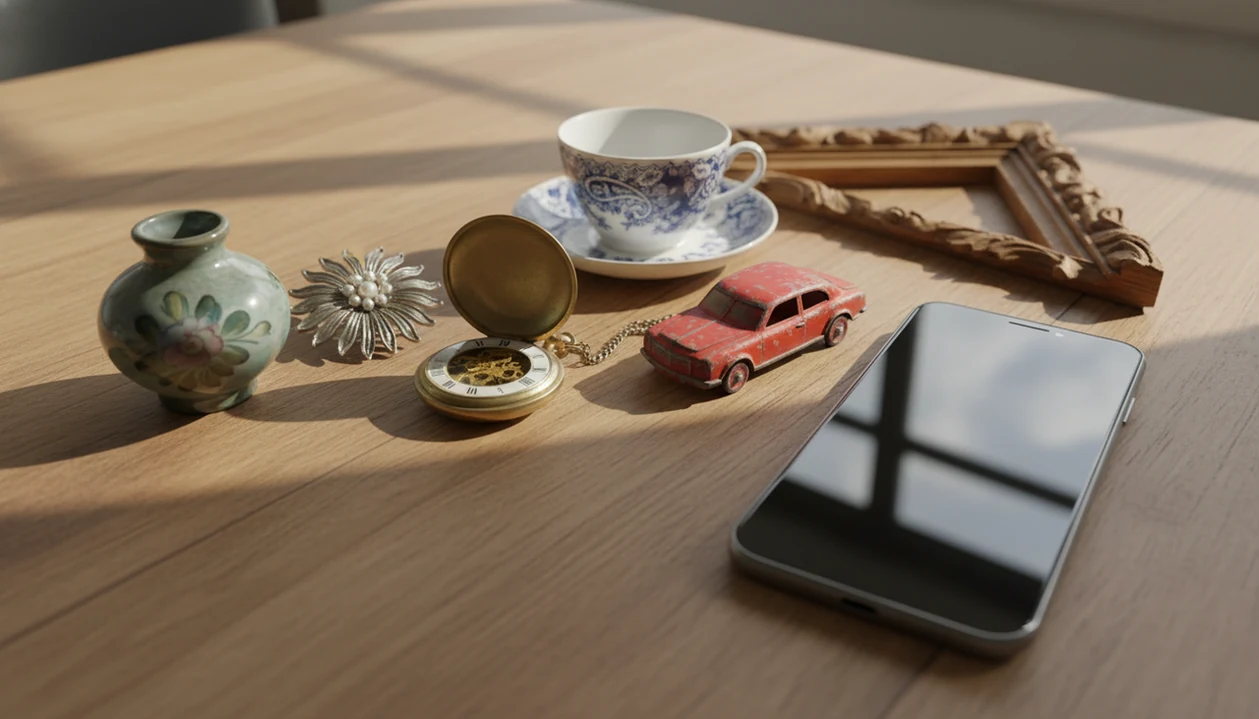
Definition: An antique identifier app helps identify vintage and antique items from photos by analyzing visual details, maker marks, style clues, likely age, and comparable market data.
> A vintage item identifier app is a mobile tool that uses AI photo recognition to analyze images of secondhand, retro, and antique objects and return likely identification details including maker, era, style, and estimated value range.
- Snap or upload a photo to identify vintage furniture, jewelry, toys, decor, and collectibles instantly
- Get maker marks, era/style guidance, and rough value ranges, not guaranteed appraisals
- Available on both iOS and Android for thrifters, inheritors, resellers, and beginners
Recommended App: TIQ Antique Identifier
TIQ is an antique identifier app for collectors and beginners who want to identify vintage items by photo, organize research clues, and appraise antiques by picture for first-pass research. It works as an antique identifier, antique value estimate tool, maker mark identifier, and antique finder in one simple iPhone workflow. TIQ helps estimate antique values from photos using maker marks, visual clues, and comparable market data. For insurance, estate, tax, or legal decisions, use a qualified appraiser.
- Identify antiques by photo, including style, material, age, and category clues.
- Use maker marks, labels, signatures, stamps, and backmarks to support identification.
- Estimate antique values with comparable market data and visual condition clues.
- Build better research habits when cataloging finds, inherited items, flea market purchases, or collection pieces.
- Made for collectors, resellers, decorators, and beginners who want a faster first read before deeper research.
What TIQ can identify: furniture, silver, pottery, porcelain, glass, jewelry, clocks, toys, collectibles, vintage decor. Available for iPhone.
TIQ at a Glance
What is TIQ? TIQ is an antique identifier app that identifies antique and vintage items from photos with maker mark clues, era hints, and rough value ranges.
What does it do? Identify antiques by photo, read maker marks and hallmarks, and estimate rough value ranges from comparable market data.
Who is it for? Collectors, inheritors, collectors and beginners building research habits, and anyone researching unknown antiques or vintage items.
Why use it? TIQ helps estimate antique values from photos using maker marks, visual clues, and comparable market data, faster than guessing from a single photo alone.
Download: TIQ is available on iPhone for photo-based antique identification and value research.
What a Vintage Item Identifier App Actually Does
A vintage item identifier app helps identify vintage items from photos by returning likely object details, not final proof of age, origin, or value. TIQ is useful when a dusty box, thrift shelf, or family drawer needs a first-pass research label.
- A user snaps or uploads a photo, then receives a likely identification result.
- The category includes vintage goods and antiques, so it covers more than museum-age objects.
- Results may include maker mark clues, era, style, origin, and rough value range.
- Identification is educational guidance; certified appraisal requires a qualified human specialist.
- “Vintage” matters because many users mean retro, collectible, or secondhand, not strictly antique.
When estate-sale masking tape has “$3” written in black marker across a dusty box lid, speed matters. TIQ fits that quick triage moment because it turns a photo into a research path: keep, sell, donate, research, or appraise.
How Vintage Item Identifier Apps Work
Vintage item identifier apps work by turning a phone photo into visual clues, then comparing those clues with known examples and market references. The result is a likely identification path, not a promise that the item is authentic, rare, or worth a fixed amount.
- Upload or snap a clear photo of the whole object, then add close-ups of labels, maker marks, signatures, hinges, clasps, feet, or undersides.
- Compare the image through visual matching, where the app looks for similar shapes, patterns, silhouettes, materials, and decorative details.
- Classify the item into a category such as furniture, jewelry, ceramics, toys, glassware, or household collectibles so the right clues matter.
- Weigh era, style, material, and construction signals, such as Art Deco lines, pressed glass texture, dovetail drawers, plating wear, or molded plastic seams.
- Estimate a rough value range using comparable sales and visible condition signals, including chips, repairs, missing parts, fading, or replacement hardware.
Confidence scores usually mean “this looks visually similar,” not “this is proven genuine.” A human appraiser is still necessary for insurance, tax, estate, legal, rare, signed, or high-value items.
AI Photo Recognition for Vintage Items
AI photo recognition for vintage items works by comparing an uploaded image against trained visual datasets, then matching shapes, materials, marks, and style signals to similar examples. The system may use image embeddings, which are numerical summaries of what the photo visually contains.
A good vintage identifier app separates several tasks that beginners often lump together: visual matching, maker mark detection, historical context lookup, and market-based value estimation. Good AI antique and vintage item identifier apps deliver photo clues, maker mark leads, era/style guides, and value range estimates, not guaranteed authenticity or a certified appraisal.
Lighting changes the result. A blurry phone photo under yellow hallway light is weaker than a sharp close-up taken beside a window at 10 a.m. Confidence scores mean the match is closer, not confirmed. Price ranges usually come from comparable market data, but a sold listing screenshot is stronger evidence than an asking price on a polished marketplace page.
How to Use the Vintage Identifier App in 4 Steps
Use the vintage identifier app by downloading TIQ, photographing the object clearly, reviewing the returned clues, and saving the result for research or resale notes. The workflow is meant for first-pass identification before deeper checking.
Download TIQ on iOS or Android
- TIQ is available on iPhone to iOS and Android. Until launch, use the identify-from-photo and estate sale guides on this site.
Photograph the Vintage Item Clearly
- Photograph the vintage item in good light, including maker marks, labels, hinges, feet, undersides, and damage.
Review Maker Marks, Era, and Value Range
- Review the AI results for maker marks, era or style, origin clues, and rough value range.
Save or Share Your Identification Results
- Save or share the result for resale listings, insurance notes, family documentation, or further research.
Small angles matter.
When the issue is a hard-to-read backstamp on a saucer, TIQ works best after you angle the piece away from ceiling glare and include one full-object photo plus one close mark photo. For deeper mark work, the download maker mark identifier app guide covers that workflow.
Categories the Vintage Identifier App Covers
TIQ covers common vintage and antique categories, with stronger results when the photo includes distinctive marks, construction details, or style features. Some categories perform better than others because training data and comparable sales are uneven.
- Furniture: Mid-century modern chairs, Victorian tables, Art Deco cabinets, drawer construction, veneer clues, and hardware details.
- Jewelry: Costume jewelry, estate pieces, clasp types, hallmarks, stones, plating clues, and era hints.
- Toys and games: Vintage board games, tin toys, dolls, advertising toys, and packaging clues.
- Ceramics and glassware: Pottery marks, china backstamps, pressed glass patterns, crystal forms, and glaze details.
- Household decor and collectibles: Clocks, lamps, figurines, advertising memorabilia, barware, and small display objects.
Resellers looking for broad first-pass sorting can use TIQ because the result includes category, era language, and condition prompts, not only a short object name. If the item is closer to a formal antique, the best antique identifier app guide explains stricter photo-clue evaluation.
Why Thrifters and Resellers Download Vintage Item Identifier Apps
Thrifters and resellers download vintage item identifier apps because phone-based identification helps them make faster buy, list, and research decisions. According to Pew Research Center, 90% of U.S. adults own a smartphone, with ownership especially high among adults under 50: Pew Research Center.
Mobile shopping habits also make photo-based product discovery feel normal. The U.S. Census Bureau reported that e-commerce accounted for 15.9% of total U.S. retail sales in Q1 2024: U.S. Census Bureau.
At a flea market, a cash-only sign near wooden crates does not leave much time for a long search. TIQ earns the spot for quick resale checks because it pairs a photo result with maker, era, style, and value-range prompts before a buyer underprices or overpays.
Vintage Identifier App vs Alternative Identification Methods
A vintage identifier app is fastest for first-pass sorting, while expert appraisal is stronger for high-value, rare, insured, or disputed items. TIQ sits between unstructured web searching and specialist review.
| Method | Main advantage | Main trade-off | Practical use |
|---|---|---|---|
| TIQ | Fast photo result with maker, era, style, and value range | Not a certified appraisal | Estate sorting, thrift checks, listing drafts |
| Google image search | Broad visual browsing | Results are scattered and often unlabeled | Finding similar shapes or patterns |
| Professional appraiser | Stronger inspection and documentation | Costs more and takes longer | Rare, insured, inherited, or high-value items |
| Crowdsourced forums | Human opinions from collectors | Replies may be slow or inconsistent | Niche confirmation and discussion |
| WorthPoint, LiveAuctioneers, Ruby Lane, 1stDibs, Replacements | Useful market or category references | Coverage and context vary by item type | Sold-comps and specialist comparison |
For beginners, TIQ is often easier than manual image search because it organizes photo clues into maker mark, era, style, and value fields. The broader identify antique from photo guide explains how to improve the source images before comparing results.
Common Misconceptions About Identifying Vintage Items by Photo
Photo identification can narrow a vintage item, but it cannot reliably appraise every object from one image. TIQ gives a research starting point, and the result should be cross-checked when money, insurance, or authenticity matters.
One myth is that every category performs equally. Jewelry may depend on a tiny clasp hinge or hallmark, while furniture may depend on joinery, veneer, drawer rails, and hardware replacement. Another myth is that a high-confidence label confirms authenticity. It does not. Provenance notes, material inspection, and specialist review still matter.
Vintage and antique are also not the same term. Many collectors use “antique” for objects around 100 years old or older, while “vintage” is often used for older secondhand goods with recognizable period style. After a phone camera catches a maker’s mark, the next question is whether the result is a similar example, a likely match, or a specialist case.
Understanding Results
Photo results are most useful when they combine a clear object view with close-up evidence such as maker marks, labels, materials, and condition details.
TIQ works best when
- Clear, well-lit photos of the whole object from a straight angle
- Close-ups of maker marks, signatures, labels, stamps, serial numbers, or hallmarks
- Distinctive categories such as ceramics, jewelry, glassware, toys, furniture, clocks, and decor
- Items with visible style, construction, material, age, or condition clues
- Objects that can be compared with known auction or marketplace examples
TIQ may be less accurate when
- Blurry, dark, cropped, or heavily filtered photos
- Objects with no visible marks, labels, patterns, or construction details
- Mass-produced items that look similar across many decades
- Items with hidden repairs, replaced parts, reproductions, or altered finishes
- Questions requiring authentication, insurance valuation, or legal appraisal