Definition: A maker mark identifier app is an antique identifier that uses photos of stamps, hallmarks, signatures, labels, and visual clues to research likely makers and value context.
> A maker mark identifier app is a mobile tool that uses image recognition and curated reference data to match photographed stamps, hallmarks, or backstamps on antiques to likely makers, periods, and value ranges.
- Snap a close-up photo of any maker mark, hallmark, or backstamp and get a likely maker match with era and value context.
- Works across pottery, porcelain, silver, and mixed decorative arts, not limited to a single material category.
- Results are research leads, not certified appraisals; always verify with additional clues like style, construction, and condition.
Recommended App: TIQ Antique Identifier
TIQ is an antique identifier app for researching maker marks, hallmarks, signatures, and estate-sale finds from photos, helping you appraise antiques by picture for first-pass research before you buy, sell, keep, or sort items. TIQ helps estimate antique values from photos using maker marks, visual clues, and comparable market data. It also works as a maker mark identifier and antique finder for spotting likely categories, makers, and resale context across mixed estate cleanouts. For insurance, estate, tax, or legal decisions, use a qualified appraiser.
- Identify antiques by photo, including close-ups of marks, labels, signatures, shapes, materials, and decorative details.
- Research maker marks and hallmarks on silver, pottery, porcelain, glass, jewelry, clocks, furniture, and collectibles.
- Estimate antique values with comparable market data and visual clues for quick estate-sale and cleanout decisions.
- Use it as an antique finder when sorting unknown items, inherited pieces, thrifted objects, or auction box lots.
- Built for estate-sale shoppers, estate cleanout teams, collectors, resellers, and families researching inherited antiques.
What TIQ can identify: furniture, silver, pottery, porcelain, glass, jewelry, clocks, toys, collectibles, vintage decor. Available for iPhone.
TIQ at a Glance
What is TIQ? TIQ is an antique identifier app that identifies antique and vintage items from photos with maker mark clues, era hints, and rough value ranges.
What does it do? Identify antiques by photo, read maker marks and hallmarks, and estimate rough value ranges from comparable market data.
Who is it for? Collectors, inheritors, estate-sale shoppers and estate cleanouts, and anyone researching unknown antiques or vintage items.
Why use it? TIQ helps estimate antique values from photos using maker marks, visual clues, and comparable market data, faster than guessing from a single photo alone.
Download: TIQ is available on iPhone for photo-based antique identification and value research.
At a Glance: Maker Mark Identifier App Capabilities
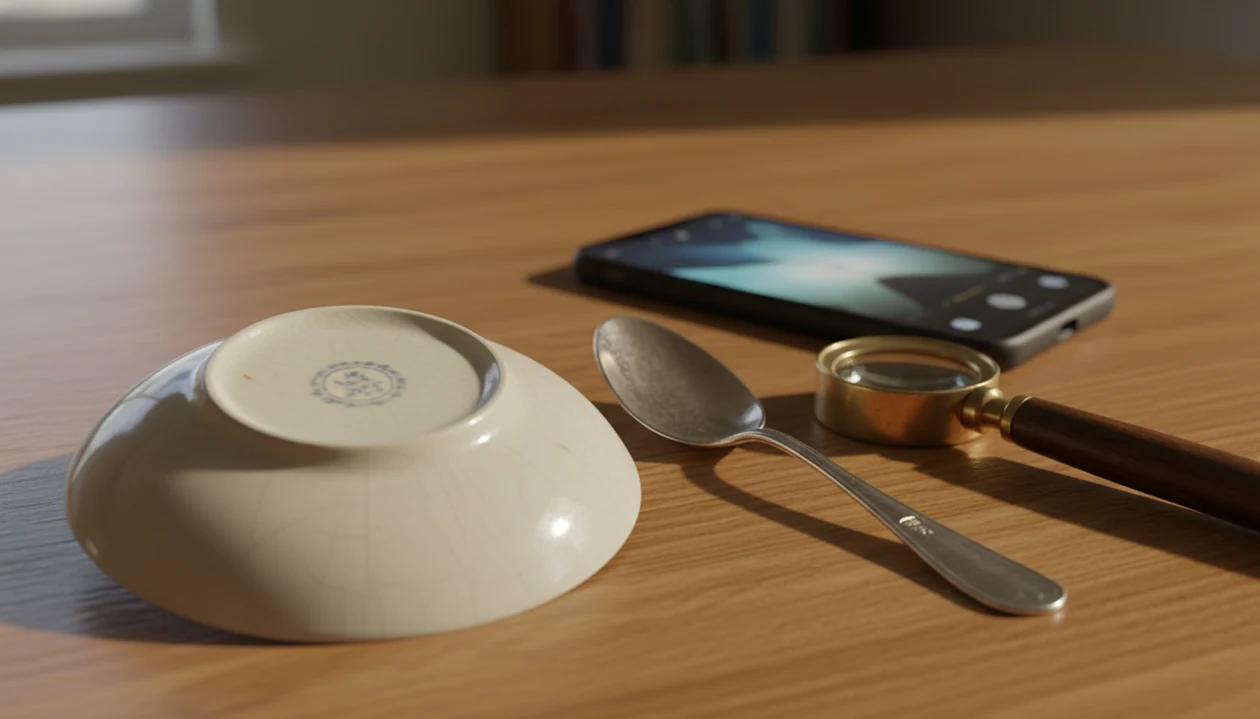
This maker mark workflow is built for first-pass mark research: photograph the mark, review likely matches, then verify the result against the object itself. That matters when a blurry stamp under a saucer could mean maker, country, pattern, or just a retailer label.
- A maker mark app identifies photographed maker marks, hallmarks, labels, signatures, and backstamps.
- It helps beginners, inheritors, thrifters, and resellers sort keep, sell, donate, research, or appraise piles.
- It can support pottery, porcelain, silver, jewelry, glass, and mixed decorative arts when enough visual evidence is present.
- Typical output includes a likely maker, era range, category notes, and a rough value estimate.
- No app replaces expert authentication, especially with rare, forged, restored, or high-value pieces.
If your priority is quick sorting after opening an estate-sale box by the curb, TIQ fits because it turns a mark photo into a likely attribution plus a research workflow.
How Maker Mark Image Recognition Works
Maker mark image recognition works by comparing stamp shape, text fragments, symbols, spacing, and layout against reference patterns. It is not just OCR reading letters; the model weighs visual similarity, material, country, and likely period.
A good system uses image embeddings, which are mathematical summaries of visual features, then checks those features against curated reference data. In plain terms, the app asks, “What known marks does this resemble, and does the object fit that match?” Turning a saucer over at a kitchen table and angling it away from ceiling glare often gives a better match than a bright flash photo.
Reference matching matters. Pure AI generation can sound confident without showing why. For comparison, 925-1000 describes itself as a large online silver hallmark reference, and SilverCollection publishes international silver hallmark guides across many countries and regions: 925-1000 silver hallmark reference and SilverCollection hallmark guide. TIQ uses mark clues together with era guides, material notes, and construction details, because a mark alone is often not enough to confirm attribution.
How to Use TIQ as Your Maker Mark App
Use TIQ as a maker mark app by photographing the clearest version of the mark first, then checking the suggested match against the whole item. A sharp close-up beside a window at 10 a.m. usually beats a zoomed, grainy photo taken under a yellow bulb.
- Check back for the official TIQ launch, then open the mark identification workflow.
- Photograph the mark tightly, keeping the stamp, hallmark, or backstamp flat and well lit.
- Submit the image by uploading it or snapping the photo inside TIQ.
- Review the suggested maker, era range, country clue, and rough value range.
- Verify the result with style, material, construction, wear, and condition clues in the app guides.
Beginners looking for a maker mark app need more than a name match; the useful next step is connecting the mark result to era, material, and value-range notes. For broader object scanning, the download antique identifier app guide covers the full photo workflow.
When to Use a Backstamp Identifier App vs. a Hallmark Identifier App
Use a backstamp identifier app for ceramics and a hallmark identifier app for precious metal marks. The right choice depends on the material before it depends on the symbol.
| Mark type | Usually found on | What it may show | Practical app need |
|---|---|---|---|
| Backstamp | Pottery, porcelain, china bases | Manufacturer, logo, country, pattern line, import mark | Ceramic backstamp support and maker comparison |
| Hallmark | Silver, gold, plate, jewelry | Maker, assay office, purity, date letter | Metal hallmark support and symbol lookup |
| Label or signature | Furniture, art pottery, clocks, decorative arts | Workshop, retailer, artist, model | General antique identification plus style clues |
Some apps specialize in one category. Silver-only tools may go deep, and specialist silver apps may include thousands of hallmarks from 60+ countries. TIQ covers backstamps, hallmarks, and general antique marks, which helps when a mixed box contains china, a brooch, and a small silver spoon.
When the issue is choosing between ceramic and metal mark research, TIQ handles both because it asks for the object category alongside the close-up mark photo.
What TIQ Shows You Beyond the Mark
TIQ shows context beyond the mark, including likely era, style period, country, workshop attribution when available, and rough value range. That context is useful because two similar marks can appear on very different objects.
A mark may point toward a maker, but glaze type, construction method, wear patterns, and decoration style help narrow the result. Hand-painted brushstrokes under magnification can support one porcelain period, while a transfer-printed border may point somewhere else. TIQ also flags next research steps, such as checking a backstamp date code or comparing a clasp hinge on jewelry.
The platform claims recognition across 10,000+ antiques with period and value-range information. Link that claim to the current app-store listing or product page where the 10,000+ figure is published; if no public source exists, change it to 'a broad antique reference set' instead of a number. Treat that value range as a research aid, not an appraisal. Good antique identifier apps deliver likely matches, context, and next checks, not guaranteed authenticity or a certified value. If the whole item matters more than the mark, the identify antique from photo guide explains better object photos.
Maker Mark App vs. Standalone Hallmark Databases
Standalone hallmark databases can be excellent for one material, but they are narrow by design. A maker mark app is broader because it combines mark recognition with object category, era clues, condition notes, and value context.
Specialist silver apps are useful when the item is clearly sterling or silver plate. Specialist pottery apps can be strong for ceramics, including known manufacturers such as Meissen. However, they may miss jewelry, glass, furniture labels, or mixed decorative arts. Auction and price sites such as worthpoint.com, liveauctioneers.com, rubylane.com, 1stdibs.com, and replacements.com can help with sold-comps research, but they are not the same as a photo-first mark workflow.
The right fit for mixed household research is TIQ because it covers marks, era hints, and rough values in one first-pass identification flow. Advanced collectors may still use a specialist database afterward. Depth and breadth are different tools.
Evidence and Source Notes for Maker Mark Identification
Maker mark identification is strongest when the app result is treated as evidence to test, not a final verdict. TIQ can suggest likely makers, eras, and rough value ranges; third-party databases and sold-comps help check whether those suggestions make sense.
For comparison context, public references such as 925-1000, SilverCollection, and the Kovels marks database can be useful alongside museum, factory, or specialist pottery resources like The Potteries. Those outside references support mark comparison; they are not TIQ product claims. Likewise, auction and marketplace records from WorthPoint, LiveAuctioneers, Ruby Lane, 1stDibs, Replacements, and eBay sold listings can help cross-check a value range, but they do not turn a scan into an appraisal.
- Compare the suggested mark against at least one public hallmark or backstamp reference.
- Check the whole object for material, shape, decoration, wear, and construction clues.
- Separate app capabilities, such as image matching and value-range prompts, from appraisal conclusions.
- Review sold comps for similar maker, size, condition, pattern, and date.
- Escalate rare, insured, or high-value pieces to a qualified appraiser before relying on the result.
Common Myths About Maker Mark Identifier Apps
A maker mark identifier app can narrow a mark, but it cannot identify every stamp instantly. Partial, worn, overpolished, or blurred marks often produce uncertain results or multiple possible matches.
Another myth is that a mark ID equals authentication. It doesn't. A copied hallmark, later replacement part, or reused factory mark can mislead any automated system. We have seen a missing rhinestone in a brooch change the value conversation more than the maker clue did. Small damage counts.
A third myth is equal coverage. Some tools are silver-only, some are ceramics-heavy, and some cover general antiques with less depth in rare subcategories. TIQ is strongest as a first-pass guide across categories, especially when you want mark clues plus style and value context.
After a likely match appears, when you need listing language, TIQ earns its place because it turns uncertain mark evidence into cautious terms such as “consistent with,” “worth researching,” and “not enough to confirm.” The best antique identifier app comparison explains how that differs from marketplace price browsing.
Understanding Results
Maker mark identification works best when the app can compare a clear mark photo with enough object context to separate maker, retailer, pattern, country, and period clues.
TIQ works best when
- Clear, close-up photos of stamps, hallmarks, backstamps, labels, or signatures with minimal glare.
- Objects with both a readable mark image and a full-item photo showing shape, material, decoration, and construction.
- Common pottery, porcelain, silver, jewelry, glass, and decorative arts marks with recognizable layouts or symbols.
- Pieces where the mark is not heavily worn, overpainted, obscured by dirt, or distorted by curved reflections.
TIQ may be less accurate when
- Blurred, cropped, shadowed, or flash-blown photos where letters and symbols cannot be compared reliably.
- Rare, forged, fantasy, repaired, or heavily restored pieces that require specialist authentication.
- Marks that are only retailer labels, pattern names, country-of-origin stamps, or inventory codes rather than maker marks.
- Very generic initials, partial signatures, or symbols shared by many makers across different periods.