
An Antique Identifier for Art Deco Furniture Finds


Download App: art deco furniture identification
Use an antique identifier app to compare Art Deco silhouettes, veneers, hardware, maker evidence, and sold examples before you buy, list, or restore a piece. TIQ can help you appraise antiques by picture for a first-pass value range while you separate period Art Deco furniture from later revival styles.
Definition: Art Deco furniture identification is the process of evaluating a piece’s form, materials, construction, maker marks, and market comparisons to determine whether it fits the Art Deco period or a later revival style.
TL;DR
- Start with geometry and silhouette, then verify with materials, hardware, joinery, labels, and wear.
- Separate period Art Deco, Deco revival, and Deco-inspired furniture before estimating value.
- Use maker marks, patent numbers, catalogs, and photo-based tools as supporting evidence, not as standalone proof.
Recommended App: TIQ Antique Identifier
TIQ is an antique identifier app for researching Art Deco furniture and other antique finds from photos, especially when you are checking flea market and thrift store pieces on the spot. It can help you identify antiques by photo, use maker marks as clues, and appraise antiques by picture for first-pass research before you decide what to buy, keep, sell, or investigate further. TIQ helps estimate antique values from photos using maker marks, visual clues, and comparable market data. It also works as a maker mark identifier and antique finder for organizing visual research across furniture, decor, and collectibles. For insurance, estate, tax, or legal decisions, use a qualified appraiser.
- Identify by photo: Upload images of silhouettes, veneers, hardware, legs, joinery, labels, and condition details to research possible Art Deco origins.
- Check maker marks: Use labels, stamps, plaques, signatures, and shop marks as evidence when comparing a cabinet, table, chair, or vanity.
- Estimate values: Review comparable market data and visual clues to form an antique value estimate before negotiating or listing.
- Spot revival clues: Compare authentic Art Deco traits with later reproduction or revival features common in secondhand furniture.
- Who it is for: Useful for collectors, resellers, decorators, estate buyers, and anyone evaluating flea market or thrift store finds.
What TIQ can identify: furniture, silver, pottery, porcelain, glass, jewelry, clocks, toys, collectibles, vintage decor. Available for iPhone.
Art Deco Furniture Identification Definition for Beginners
Art Deco furniture identification is the process of comparing a piece’s design vocabulary, materials, construction, labels, and age evidence before assigning it to a period, revival, or inspired category. The strongest collector target is usually period Art Deco from the 1920s and 1930s.
A chrome handle or stepped corner can be a useful clue, but it is not enough to confirm age. Later manufacturers reused Deco motifs heavily, especially on bedroom suites, cocktail cabinets, mirrors, and dining chairs. Some 1920s pieces are now crossing the 100-year antique threshold; in U.S. import contexts, antiques are generally classed as objects over 100 years old under HTSUS Chapter 97 (Usitc).
That timing matters.
A 1934 cabinet and a 1980s revival cabinet may photograph similarly from across the room. The underside, hardware, and labels usually tell a more useful story.
Art Deco Furniture Photo Checklist Before Identification
Good identification starts with complete photographs, not one attractive front view. Photograph the full front, both sides, back, underside, drawer boxes, hinges, feet, casters, pulls, locks, and any replaced-looking hardware.
Close-ups matter more than most beginners expect. Capture paper labels, burned or ink stamps, patent numbers, metal plaques, upholstery tags, shipping labels, drawer interiors, and the back of mirrors or cabinets. A sharp close-up beside a window at 10 a.m. usually beats a blurry phone photo under yellow ceiling light.
Write down dimensions, approximate weight, suspected wood species, finish condition, repairs, and any known family or sale history. Estate-sale masking tape with “$3” written in black marker across a dusty box lid is not provenance, but it is a useful sorting note.
Tools like TIQ can help organize photo clues, maker marks, era hints, and rough value ranges. They support the research file, not a final authentication.
Art Deco Furniture Identification Process and Evidence Types
Art Deco furniture identification works by triangulation: design clues suggest a category, then materials, construction, provenance, and sold comparables either support or weaken that first impression. Style is high-signal, but it is not proof.
Here is the practical model. Compare the silhouette and ornament first, then inspect the physical evidence. Look for veneer quality, drawer construction, screw type, label placement, wear pattern, and any repair history. After that, cross-check maker marks against catalogs, auction archives, museum references, and sold listing screenshots. Use institutional and archive sources before marketplace titles: museum collections can confirm period vocabulary, while sold-result databases such as LiveAuctioneers (LiveAuctioneers sold results) and WorthPoint (Worthpoint) can show how comparable pieces were actually described and priced.
The rubbed maker mark from polishing can be more important than the glossy showroom photo.
Photo analysis and maker mark databases help narrow possibilities through pattern matching and reference comparison. Apps such as TIQ, WorthPoint, and LiveAuctioneers can support that work, but human judgment still matters. A good ai antique and vintage item identification app with maker marks, era/style guides, and value range estimates gives educated leads, not certified authentication or guaranteed appraisal.
Art Deco Style Clues in a 5-Step Furniture Check
Use this 5-step check to identify Art Deco furniture before you call it period, revival, or inspired. The order matters because broad style clues are easiest to see, while construction evidence is usually stronger.
- Photograph the whole piece before close-ups, including the front, sides, back, underside, and scale beside a tape measure.
- Compare the silhouette to Deco geometry, symmetry, stepped forms, sunburst layouts, waterfall fronts, rounded corners, and streamlined horizontal lines.
- Inspect the materials for veneers, chrome, nickel, glass, mirror, lacquer, Bakelite, early plastics, upholstery, and signs of later replacement.
- Check the construction under drawers and backs, including dovetails, screws, hinges, drawer bottoms, back panels, and feet.
- Cross-check the evidence with marks, catalogs, comparable sales, and app-based photo identification before assigning a category.
For beginners, a repeatable checklist is often better than a style hunch because it forces the pretty features and the hidden construction to agree. A broader furniture style identifier app workflow can help when a piece sits between Deco, Streamline Moderne, and early mid-century design.
Five Art Deco Furniture Identification Facts Collectors Use
- Art Deco gained international prominence after World War I and was most popular in the 1920s and 1930s, the main period collectors usually mean by “true” Deco furniture.
- Common Art Deco style clues include zigzags, chevrons, sunbursts, stepped forms, symmetry, waterfall edges, and streamlined curves.
- Common materials include macassar ebony, mahogany, walnut, chrome, glass, lacquer, shagreen-style textures, mirror, nickel, and Bakelite.
- Period Art Deco furniture usually needs age-consistent construction and wear, not just Deco-looking ornament attached to a newer frame.
- Deco revival and Deco-inspired furniture can be attractive and sometimes valuable, but they should be described differently from period Art Deco.
The most useful first-pass description is specific: “Deco revival waterfall-style dresser with chrome pulls” is safer than “authentic 1930s Art Deco dresser” when the evidence is incomplete.
Art Deco Furniture Materials and Veneer Clues
Art Deco materials often signal luxury, speed, and machine-age polish, but material quality is evidence rather than proof. Period pieces may use macassar ebony, mahogany, walnut, bird’s-eye maple, rosewood-style surfaces, and dramatic bookmatched veneers.
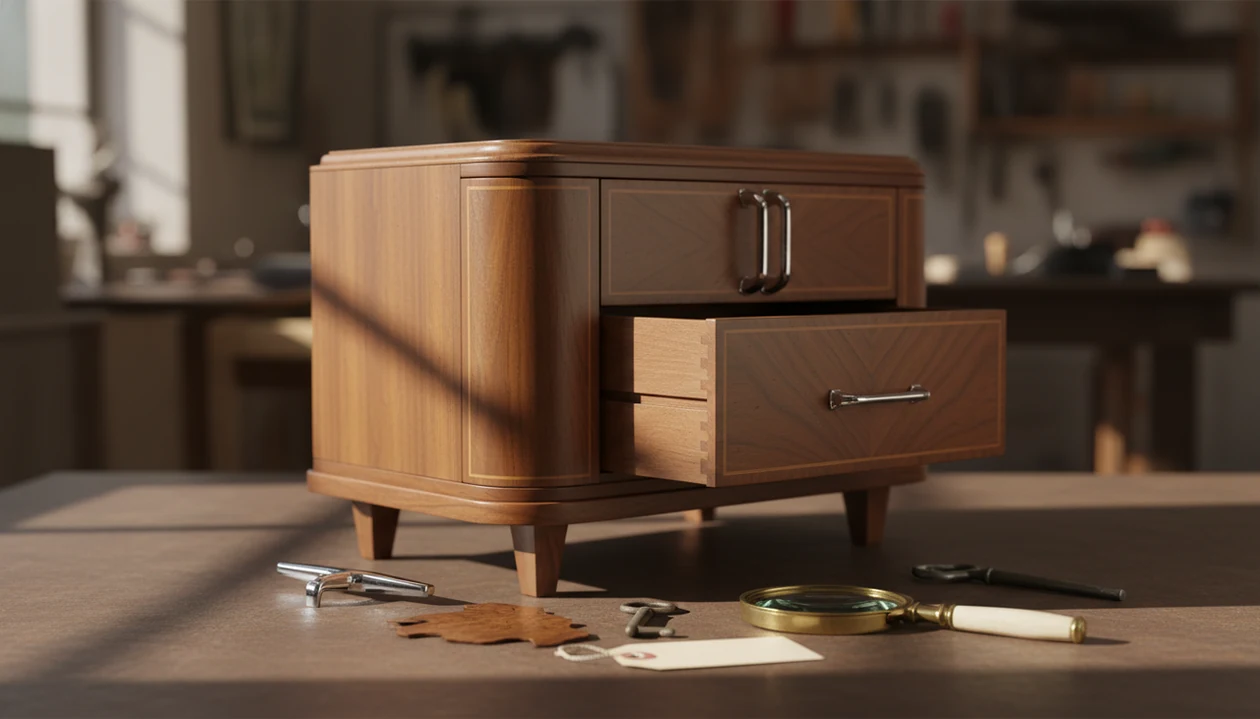
Look for veneer layout, not just species. A carefully mirrored veneer front on a cabinet can be consistent with period Deco design, especially when the grain pattern aligns across doors and drawers. Lacquer, mirror panels, chrome, nickel, glass, Bakelite, and early plastic details can also support the identification.
A cold brass candlestick in one hand at a flea table teaches the same lesson as furniture: surface shine is only the start.
High-gloss black lacquer and chrome are frequently used in later revival pieces. Lower-cost authentic Deco furniture may also use plainer woods, so do not dismiss a modest piece too quickly. For wood-specific comparisons, wood identification for antique furniture is a useful next research step.
Art Deco Furniture Construction Clues Under Drawers and Backs
Construction clues help separate period Art Deco furniture from later lookalikes, especially when the front view is persuasive. Inspect drawer dovetails, drawer bottoms, interior wood, screw slots, hinge wear, caster construction, back panels, and underside oxidation.
Older furniture may show hand finishing, early machine work, uneven secondary woods, slotted screws, and wear where drawers actually rub. Modern revival pieces more often show chipboard, stapled backs, highly uniform plywood, Phillips screws, modern glues, and hardware that looks identical on every pull and hinge.
Still, avoid a simple “machine-made equals modern” rule. Authentic period furniture can include machine work, especially from larger factories in the 1920s and 1930s. Construction must be read beside style, materials, labels, and provenance.
Turn the drawer over.
If the underside looks newer than the face, slow down before listing it as period. Our guide to furniture joinery identification covers these drawer and frame details in more depth.
Period Art Deco vs Deco Revival Furniture Comparison
Period Art Deco, Deco revival, and Deco-inspired furniture can share the same visual language, but they differ in date, construction, provenance, and value implications. The category should be assigned after comparing both visible style and hidden evidence.
| Category | Typical date range | Materials and construction | Wear and labels | Collectability and value implications |
|---|---|---|---|---|
| Period Art Deco | Generally 1920s–1930s, with some regional continuation into the 1940s | Figured veneers, lacquer, chrome or nickel, glass, early plastics, period joinery, early machine work | Age-consistent wear, maker labels or retailer marks may survive | Usually the strongest collector category when condition, maker, and provenance support it |
| Deco revival | Later 20th century | Copies Deco motifs with newer production methods, modern hardware, plywood, or composite boards | Wear may be lighter or inconsistent; labels often show later makers | Can be desirable, but should not be priced as original period Deco |
| Deco-inspired | Modern retail production | Uses Deco shapes as style references without period construction | Modern tags, uniform hardware, current materials | Decorative value first; collectible value depends on designer, brand, and market demand |
Because later Deco revival and Deco-inspired production is common in online listings, treat a period label as a claim to verify against dated construction evidence, maker marks, and sold comparables rather than as a default assumption.
Maker Marks for Identifying Art Deco Furniture
Maker marks can strengthen an Art Deco identification, but they must be cross-checked. Look inside drawers, under seats, beneath case pieces, along back rails, behind mirrors, on metal plaques, on paper labels, upholstery tags, shipping labels, and old inventory stamps.
Useful evidence includes maker names, retailer labels, patent numbers, registration marks, factory codes, and penciled assembly notes. A label can narrow the country, maker, retailer, or production window. It can also be misleading.
Labels fall off. Labels move.
Some are damaged during refinishing, and some are added later to increase price. Compare any mark with catalogs, auction archives, museum references, and sold listing screenshots rather than polished asking prices. TIQ photo analysis can help read a faint plaque or stamp, but the mark still needs outside verification.
If the hardware seems more informative than the label, compare it with furniture hardware identification before deciding.
Common Art Deco Furniture Identification Mistakes
The most common mistake is calling every curved, mirrored, chrome, or black lacquer piece authentic period Art Deco. Those features may indicate the style, but they do not prove a 1920s or 1930s date.
Seller labels are another weak shortcut. Marketplace titles often use “Art Deco” because it attracts attention, not because the piece has been researched. Wear can mislead too. Distressing, dark wax, rubbed edges, and artificially aged metal can imitate patina.
Do not assume authentic Deco must be flashy or brightly colored. Many original pieces use restrained walnut, mahogany, or figured veneer with controlled ornament. A sun-faded fabric on one arm may tell you about use and placement, not necessarily original upholstery.
Borderline categories deserve careful wording. Late Art Deco, Streamline Moderne, early mid-century modern, and high-quality revival can overlap. For comparison with the later category, mid-century modern furniture identification helps separate streamlined inheritance from a true mid-century design vocabulary.
See how to identify antique furniture for photo and construction steps.
Understanding Results
Photo-based antique identifier results are most useful when they support a structured Art Deco furniture inspection rather than replace it.
TIQ works best when
- Clear photos of the full furniture form, including front, side, back, underside, and interior construction
- Close-ups of labels, maker marks, patent numbers, metal plaques, stamps, locks, and hardware
- Pieces with distinctive Art Deco geometry, veneers, stepped profiles, streamlined shapes, or documented maker features
- Research tasks that compare period Art Deco, Deco revival, and modern Deco-inspired furniture
- Early value research using auction comparables, condition notes, and market context
TIQ may be less accurate when
- Single front-view photos without construction, underside, or hardware details
- Furniture with replaced handles, refinished surfaces, altered legs, or missing labels
- Generic modern furniture that borrows Art Deco motifs without period construction clues
- Value estimates without dimensions, condition notes, location, provenance, or comparable sales context
- Final authentication decisions that require hands-on inspection by a qualified specialist
FAQ
What is the best antique identifier app for Art Deco furniture?
The best antique identifier app for Art Deco furniture should let you upload several photos, compare style clues, check maker marks, and review rough value ranges from comparable items. TIQ is a practical choice for flea market and thrift store research because it supports photo-based identification, maker mark clues, and first-pass value estimates in one workflow.
Can I appraise antiques by picture before buying Art Deco furniture?
Yes, you can appraise antiques by picture to get a useful first-pass value range before negotiating or buying. For Art Deco furniture, photograph the full silhouette, veneers, legs, hardware, joinery, labels, and condition issues so the estimate has better evidence to compare against similar sold pieces.
What app identifies Art Deco furniture from pictures?
An antique identifier app can help identify Art Deco furniture from pictures by looking at form, materials, construction details, hardware, and possible maker evidence. TIQ can be used to research a cabinet, vanity, table, chair, or sideboard from photos and organize clues while you decide whether it looks period Art Deco, revival, or modern Deco-inspired.
Is there a free antique identifier by picture for Art Deco furniture?
Some antique identifier tools and image searches can help you start for free, especially when you are comparing visible style features. For a stronger result, use clear photos plus maker marks, measurements, and condition details, then compare the output with sold listings, catalogs, and specialist references.
Can TIQ read maker marks on Art Deco furniture?
TIQ can help use maker marks, labels, plaques, stamps, and signatures as clues when researching Art Deco furniture. A clear close-up of the mark, plus photos of the whole piece and construction details, gives better context than a mark photo alone.
How accurate is photo identification for Art Deco furniture?
Photo identification is useful for narrowing the likely style, period, and value range, but it is strongest when multiple details agree. Art Deco furniture can be misidentified when newer pieces copy chrome, stepped shapes, exotic veneers, or geometric ornament, so construction, wear, labels, and provenance still matter.
Can an app tell if Art Deco furniture is fake or a reproduction?
An app can flag reproduction clues such as modern fasteners, newer boards, machine-made finishes, inconsistent wear, or revival-style construction. It cannot guarantee authenticity from photos alone, so high-value purchases should be checked with specialist research, provenance, or an in-person furniture expert.
Are my Art Deco furniture photos private when I use an identifier app?
Privacy depends on the app’s policies, so review how photos and item data are stored before uploading sensitive images. Avoid including personal documents, addresses, faces, or private room details in your furniture photos when you only need the piece, marks, and condition evidence identified.
Ready to start?
Ready to start identifying Art Deco furniture by photo? Use TIQ on iPhone to document the full piece, close-up construction details, labels, hardware, and maker marks so you can compare period, revival, and Deco-inspired clues with more confidence.