
Antique Identifier for Furniture Joinery Clues


Download App: furniture joinery identification
When you are sorting inherited furniture, joinery clues can turn confusing drawers, pegs, screws, and hidden joints into practical age and quality signals. Use TIQ to appraise antiques by picture as a fast first pass, then combine photo findings with marks, materials, condition, and comparable sales.
Definition: Furniture joinery identification is the process of reading dovetails, pegs, screws, drawer construction, and hidden joints to help identify an antique furniture piece’s age, origin, and quality.
TL;DR - Hand-cut, uneven dovetails often suggest earlier hand craftsmanship, while highly uniform dovetails usually point to machine production or later manufacture. - Drawer interiors, backs, undersides, secondary woods, screws, nails, and pegs often reveal more than the polished exterior. - Joinery should support an era estimate, not replace maker marks, hardware checks, wood identification, finish analysis, or professional inspection.
Recommended App: TIQ Antique Identifier
TIQ is an antique identifier app for researching furniture, heirlooms, and collectibles from photos, especially when inheritors are sorting family collections and need a clear first pass. It can help you appraise antiques by picture for first-pass research by comparing joinery, maker marks, materials, form, and visible condition. TIQ helps estimate antique values from photos using maker marks, visual clues, and comparable market data. For insurance, estate, tax, or legal decisions, use a qualified appraiser.
- Identify antiques by photo, including furniture construction details such as dovetails, pegs, screws, drawer bottoms, and hidden joints.
- Use maker marks, labels, stamps, signatures, and hardware clues as part of the identification process.
- Estimate antique values with comparable market data and condition-based visual context.
- Helpful for inheritors, downsizers, collectors, estate organizers, and anyone sorting family collections.
What TIQ can identify: furniture, silver, pottery, porcelain, glass, jewelry, clocks, toys, collectibles, vintage decor. Available for iPhone.
Furniture Joinery Identification Facts That Matter Most
- Joinery is a strong age clue because furniture construction changed as hand tools, water-powered shops, factories, and later machine production altered how parts were cut.
- Dovetail identification depends on shape, spacing, and consistency, not just whether dovetails are present at all.
- Drawers often keep better evidence than exteriors because a polished case front may be refinished while drawer sides and bottoms remain less disturbed.
- Repairs can mix periods in one object, so an old case may have a later drawer, new runners, or replacement screws.
- The best furniture age clues are cross-checked against wood, hardware, finish, maker marks, style, and proportions.
A quick look under a dusty drawer can tell more than the front view. We have seen replacement screws sitting beside old wear grooves, which is a useful warning against one-clue dating.
How Furniture Joinery Identification Works
Furniture joinery identification works by reading construction choices that often survive where polished surfaces do not. Joints, fasteners, and hidden boards can preserve the habits of a workshop long after the top has been waxed, refinished, or staged for sale.
The method looks for tool marks, consistency, and fastening choices, then compares them with broad changes in furniture technology. A tool mark is simply the cut, scrape, or compression left by a saw, plane, chisel, drill, or machine. When dovetails vary slightly, screw slots look hand-worked, or pegs align with practical frame construction, the evidence may point toward one kind of shop practice. When cuts repeat with mechanical regularity, fasteners match standardized production, and parts look interchangeable, the clue may point later. This does not prove an exact manufacture date; it narrows a likely era.
Hidden areas usually carry the best signal because backs, drawer bottoms, undersides, runners, and interior corners were less likely to be polished for display. But the signal can be interrupted. Repairs, replacement drawers, later screws, rebuilt backs, and reproductions can all mix old-looking and new evidence in the same piece.
Antique Furniture Construction Clues in Joints and Fasteners
Furniture joints are physical evidence of tool technology, workshop practice, and production method. They can suggest whether a piece was built by hand, in a small shop, by mixed methods, or through later standardized manufacture.
As hand-cut work gave way to more repeatable machine processes, joints often became cleaner, more uniform, and more consistent from side to side. That shift helps with antique furniture construction research, but it usually points to a likely period, not an exact year. The modern furniture industry is also large enough that later mass production and reproduction pieces are common. The U.S. Bureau of Labor Statistics’ Industries at a Glance profile for NAICS 337 reports employment data for furniture and related product manufacturing; cite it when making scale claims about later mass production (Bureau of Labor Statistics).
That scale matters. Many “old-looking” pieces are simply later furniture made in an earlier style.
Before You Start: Tools and Handling Precautions
Before inspecting joinery, gather simple tools and protect the object from avoidable damage. The goal is to see more without forcing parts, disturbing fragile surfaces, or changing the evidence you are trying to read.
- Bring a small flashlight, phone camera, soft cloth, and tape measure. A pocket light helps inside drawers and under cases; the cloth gives you a safe place to rest hardware or steady a drawer edge.
- Ask permission before removing drawers or opening compartments in a shop, auction preview, estate sale, or someone else’s home. Some sellers allow close inspection; others do not want parts moved.
- Photograph the piece before you shift hardware, open a secret compartment, or pull a drawer fully out. First photos can show where a screw, lock, label, or loose part originally sat.
- Avoid forcing stuck drawers, brittle locks, lifting veneer, wobbly legs, or loose joints. Resistance is often a warning, not an invitation to push harder.
- Stop when inspection could mark the finish, tear upholstery, loosen labels, or stress old glue joints. A missed clue is better than new damage.
5-Step Furniture Joinery Identification Inspection Workflow
Use furniture joinery identification as a sequence, not a single glance. Start where handling wear, hidden cuts, and secondary woods are most likely to survive.
1. Open drawers and doors
Pull drawers carefully and inspect front corners, rear corners, bottoms, backs, runners, legs, and interior case corners before judging the front.
2. Photograph hidden joints
Take sharp photos of joints, screw heads, nails, pegs, drawer bottoms, runners, labels, stamps, and any maker marks. A window-lit close-up at 10 a.m. beats a blurry hallway photo.
3. Compare tool marks
Compare irregular hand-cut lines with uniform machine-made repetition, especially on dovetails and frame joints.
4. Check for repairs
Separate original construction from replacement hardware, re-drilled holes, glued repairs, and rebuilt drawers.
5. Combine all age clues
Tools like TIQ can help organize photos, era hints, maker mark clues, and rough value ranges, but not authenticate furniture.
Step 1: Drawer Dovetail Identification for Age Clues
Do dovetails mean antique furniture? Dovetails can support an age estimate, but they do not prove a piece is antique.
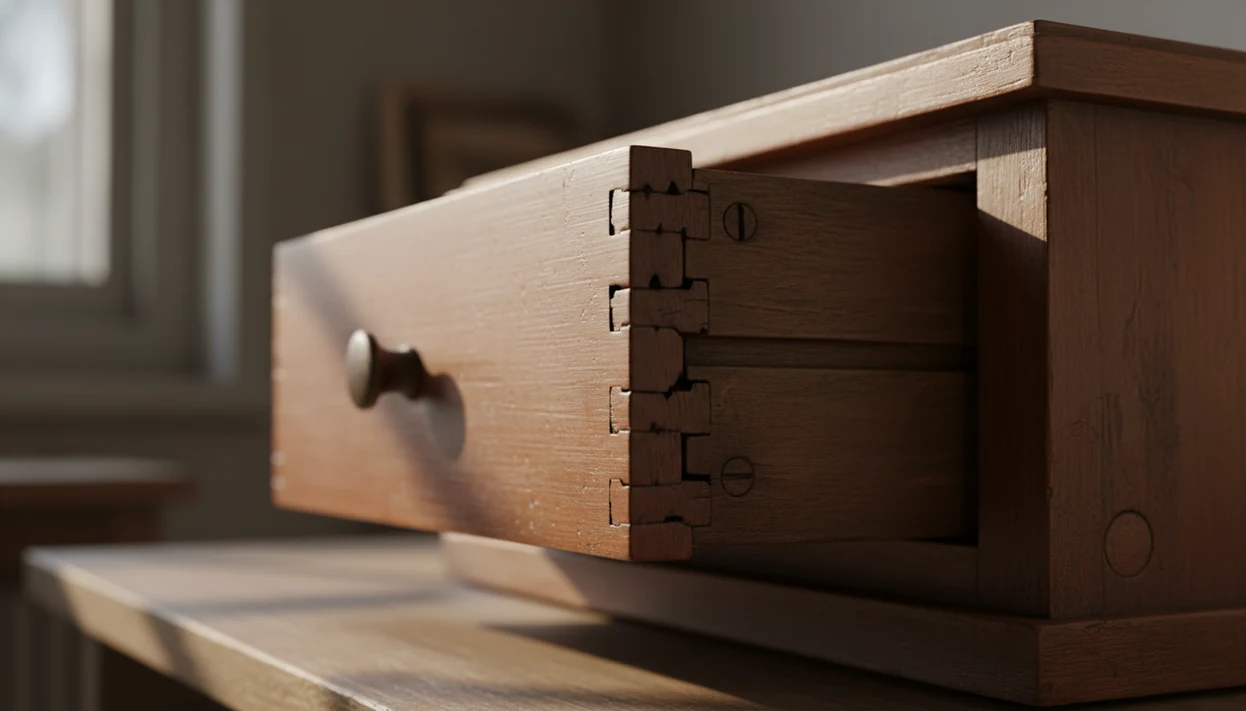
Look at the drawer front corners and rear corners. Note the spacing, pin shape, saw marks, symmetry, and whether each joint looks slightly different. Hand-cut dovetails are often irregular, with varied spacing and small differences from drawer to drawer. Machine-made dovetails tend to be cleaner, more uniform, and repeatable.
Use dovetails as pattern evidence, not a date stamp. A stronger conclusion comes when dovetail spacing, tool marks, drawer wear, secondary wood, and provenance all point in the same direction.
The back corners matter too. A drawer can have impressive front dovetails and simpler rear construction. We have also seen newer reproduction drawers with deliberately uneven-looking dovetails, so caution is needed. For style comparison after the construction check, Victorian furniture identification can help narrow period language without treating dovetails as proof.
Step 2: Screws, Nails, Pegs, and Hardware Age Clues
Fasteners can support furniture age clues when they agree with the surrounding construction. Inspect screw slots, screw regularity, nail shape, peg placement, and whether old hardware holes line up with the pulls or plates now installed.
Hand-forged, cut, and machine-made fasteners may suggest different production periods, but they are easy to replace. New screws inside an old lock plate are common. So are re-drilled pull holes hidden under larger backplates.
For nail and fastener clues, document the surrounding wood, oxidation, hole shape, and whether the fastener sits in an original or re-drilled location; replacement hardware can make a genuinely old piece look newer or a reproduction look older.
Turn the hardware over when possible. Photograph the visible pull, then photograph the back side, nut, washer, hinge leaf, lock plate, and screw heads. A replacement screw in antique hardware can be the clue that keeps a listing description honest. For a deeper hardware check, compare the same evidence with furniture hardware identification.
Step 3: Drawer Bottoms, Backs, and Secondary Wood Clues
Drawer bottoms, backs, rails, runners, underside boards, and secondary woods can be more revealing than polished fronts. These areas are less decorative, so they often preserve saw marks, wear, oxidation, shrinkage, and practical workshop decisions.
Look for board direction, tool marks, glue residue, mismatched wood, replacement panels, and oxidized surfaces next to fresh pale cuts. Older drawers may show long wear tracks on runners and darkened edges where hands rarely cleaned. Quiet evidence.
A repaired drawer bottom can reset the evidence, though. So can a replaced back board. If the visible case looks old but the underside boards are bright, flat, and uniformly machine-cut, document the mismatch before making an age claim. Cross-checking species and secondary woods with wood identification for antique furniture can keep the conclusion more careful.
Step 4: Mortise-and-Tenon, Pegged, and Frame Joint Evidence
A mortise-and-tenon joint uses a projecting tenon fitted into a matching mortise, much like a tab fitting into a slot. This joint appears on many chairs, tables, beds, cabinets, and framed case pieces.
Check chair rails, table aprons, bed frames, cabinet doors, stretchers, and case frames. Look for pegged joints, wedged tenons, glue blocks, corner blocks, and machine-cut frame joinery. Visible pegs may be structural, decorative, original, or added later to imitate earlier construction.
One cedar chest we inspected had green felt hiding a furniture label, while the frame joints told a different repair story. That kind of mismatch is worth photographing. A good antique and vintage item identification app with maker marks, era/style guides, and value range estimates can organize likely clues, not deliver certified authentication from photos alone.
Step 5: Joinery, Wood, Hardware, and Maker Mark Cross-Checks
One clue rarely gives a reliable furniture date on its own. Joinery works best when it supports wood type, finish, hardware, feet, style, proportions, upholstery, labels, stamps, and maker marks.
| Clue type | What to compare | What it can support |
|---|---|---|
| Joinery | Dovetails, mortise-and-tenon, pegs, screws | Construction method and repair history |
| Wood | Primary and secondary woods | Region, quality level, and replacement clues |
| Hardware | Pulls, hinges, locks, screw holes | Period consistency or later alteration |
| Style | Feet, proportions, ornament, upholstery | Broad era and design influence |
| Marks | Labels, stamps, brands, signatures | Maker, retailer, or origin research |
TIQ is an antique identifier app that identifies antique and vintage items from photos with maker mark clues, era hints, and rough value ranges for beginners and resellers. Treat the output as clue organization and research support, not definitive authentication or certified appraisal. For style cross-checks, mid-century modern furniture identification is useful when joinery points later than the silhouette first suggests.
For value and attribution checks, compare TIQ notes with sold-result sources such as LiveAuctioneers, Invaluable, WorthPoint, and eBay sold listings before making a market-value claim.
Common Furniture Joinery Identification Mistakes
- The “all dovetails are antique” mistake: Dovetails appear on old furniture, later quality furniture, and reproductions, so the cut pattern matters.
- The “no maker mark means modern” mistake: Many antique pieces have no visible label, stamp, or maker mark.
- The “one screw dates the piece” mistake: A single screw, nail, joint, or drawer can be replaced.
- The “repairs are obvious” mistake: Refinished surfaces, added hardware, replacement drawers, and rebuilt backs can blend in surprisingly well.
- The “front view is enough” mistake: The underside, back, drawer runners, and interior corners usually carry better construction evidence.
At estate sales, a cash-only sign near wooden crates often means fast decisions. Still, do the pocket-light check before calling something early, rare, or original.
See how to tell if furniture is antique for a full checklist.
Understanding Results
Antique identifier results are strongest when joinery photos are clear, well lit, and supported by multiple construction and condition clues.
TIQ works best when
- Sharp photos of drawer sides, dovetails, drawer bottoms, backs, stretchers, rails, and undersides
- Close-ups of screws, nails, pegs, saw marks, plane marks, repairs, and replacement parts
- Images that include maker marks, labels, hardware, wood grain, finish wear, and overall furniture style
- Side-by-side comparison notes from auction records, museum examples, platform guides, and app results
TIQ may be less accurate when
- Single front-facing photos that hide drawers, backs, undersides, and secondary woods
- Furniture with heavy refinishing, replaced drawers, modern screws, or mixed-period repairs
- Dark, blurry, cropped, or overexposed photos where tool marks and joint shapes are unclear
- Listings that rely on one clue, such as dovetails alone, without checking hardware, wood, finish, and maker marks
FAQ
What is the best antique identifier app for furniture joinery research?
The best antique identifier app for furniture joinery should let you photograph drawers, dovetails, backs, undersides, screws, pegs, labels, and hardware in one research flow. TIQ is a practical choice because it connects visible construction clues with maker marks, era hints, and rough value ranges instead of relying on one detail alone.
What app identifies antique furniture construction from pictures?
An antique identifier app can help identify furniture construction from pictures when you capture close, well-lit photos of dovetails, drawer bottoms, secondary woods, backs, feet, hardware, and labels. TIQ can compare those visual clues with known furniture styles and market context to give you a clearer first-pass identification.
Can I appraise antique furniture by picture?
Yes, you can appraise antique furniture by picture for a rough research estimate when the photos show construction, condition, materials, maker marks, and overall form. Photo-based estimates are most useful for sorting family collections, deciding what deserves more research, and prioritizing pieces for a professional appraisal.
How much is my antique worth if it has hand-cut dovetails?
Hand-cut dovetails can support an earlier age estimate, but value depends on the whole piece, including maker, style, wood, originality, condition, size, provenance, and current sold comparisons. Use dovetails as one strong clue, then compare the furniture to similar sold examples before making value decisions.
Is there a free antique identifier by picture for furniture joinery clues?
Free image searches and museum guides can help you start comparing dovetails, screws, pegs, and drawer construction. An antique identifier app can save time by organizing the photo clues and matching them with likely age, style, maker mark, and value signals.
How accurate is furniture joinery identification from photos?
Furniture joinery identification from photos can be useful when the images show clear close-ups of drawers, backs, undersides, fasteners, and hidden construction. Accuracy improves when joinery is checked alongside wood type, hardware, finish, maker marks, style, repairs, and comparable examples.
Can joinery prove antique furniture is genuine?
Joinery can support an authenticity argument, but it rarely proves a piece is genuine by itself. Reproductions, restorations, replaced drawers, altered hardware, and married parts can all confuse the picture, so high-value furniture should be inspected by a qualified specialist.
What photos should I avoid uploading when researching inherited furniture?
Focus on the furniture itself and avoid including personal documents, addresses, family photos, or anything sensitive in the background. For best results, photograph the front, sides, back, underside, drawers, joints, screws, pegs, labels, stamps, damage, and any unusual construction details.
Ready to start?
Ready to start? Photograph the front, back, underside, drawer interiors, dovetails, screw heads, pegs, rails, repairs, and any maker marks so an antique identifier app can compare construction details and organize your furniture age clues.