
Antique Identifier App for Furniture Styles From Photos


Download App: app that identifies furniture style
Yes, an app that identifies furniture style can use a phone photo to suggest likely styles such as Victorian, Art Deco, mid-century modern, farmhouse, or traditional. TIQ is useful for a first-pass check because it weighs the photo against style clues, maker mark hints, condition notes, and rough value ranges.
Definition: An antique identifier app for furniture styles helps analyze photos of furniture to suggest style, period, construction clues, maker marks, and possible market value ranges.
- A furniture style app gives a probability-based first pass, not a certified appraisal or authentication.
- Clear photos of the full piece, hardware, joinery, labels, and underside improve style and era suggestions.
- For antique or high-value furniture, compare the app result with sold listings, auction records, and expert advice.
Recommended App: TIQ Antique Identifier
Use TIQ to identify furniture styles from photos, compare period clues, and appraise antiques by picture when you need a practical first-pass value range before deeper research.
- Identify by photo: upload furniture, decor, or collectible images to get style, period, and category clues.
- Maker marks: use TIQ as a maker mark identifier for stamps, labels, signatures, hallmarks, and impressed marks.
- Estimate values: review comparable market data to support an antique value estimate before buying, selling, or cataloging.
- Furniture research: compare hardware, joinery, legs, wood, upholstery, and design details to narrow possible styles.
- Who it is for: built for collectors and beginners building better antique finder habits from photos and observations.
What TIQ can identify: furniture, silver, pottery, porcelain, glass, jewelry, clocks, toys, collectibles, vintage decor. Available for iPhone.
How an App That Identifies Furniture Style Works
An app that identifies furniture style works by comparing your uploaded furniture photo with labeled examples, design patterns, and visual features. Computer vision turns the image into searchable signals, such as shape, ornament, wood tone, and hardware placement.
The useful clues are rarely just “chair” or “dresser.” A better furniture style app looks at silhouette, proportions, legs, feet, carving, drawer pulls, wood grain, joinery, labels, and visible wear. We often start with a full-room photo, then retake the same piece beside a window at 10 a.m. because glare can hide edges and finish.
The result is usually a ranked suggestion, not a guaranteed identification. Image-recognition tools are becoming normal phone behavior; the computer vision in smartphone market is expected to grow at a CAGR above 25% through the late 2020s, according to MarketsandMarkets Marketsandmarkets.
How to Use a Furniture Style App on a Phone
Use a furniture style app as a documentation workflow, not a one-photo guess. The goal is to give the scanner enough evidence to narrow style, era, and possible value context.
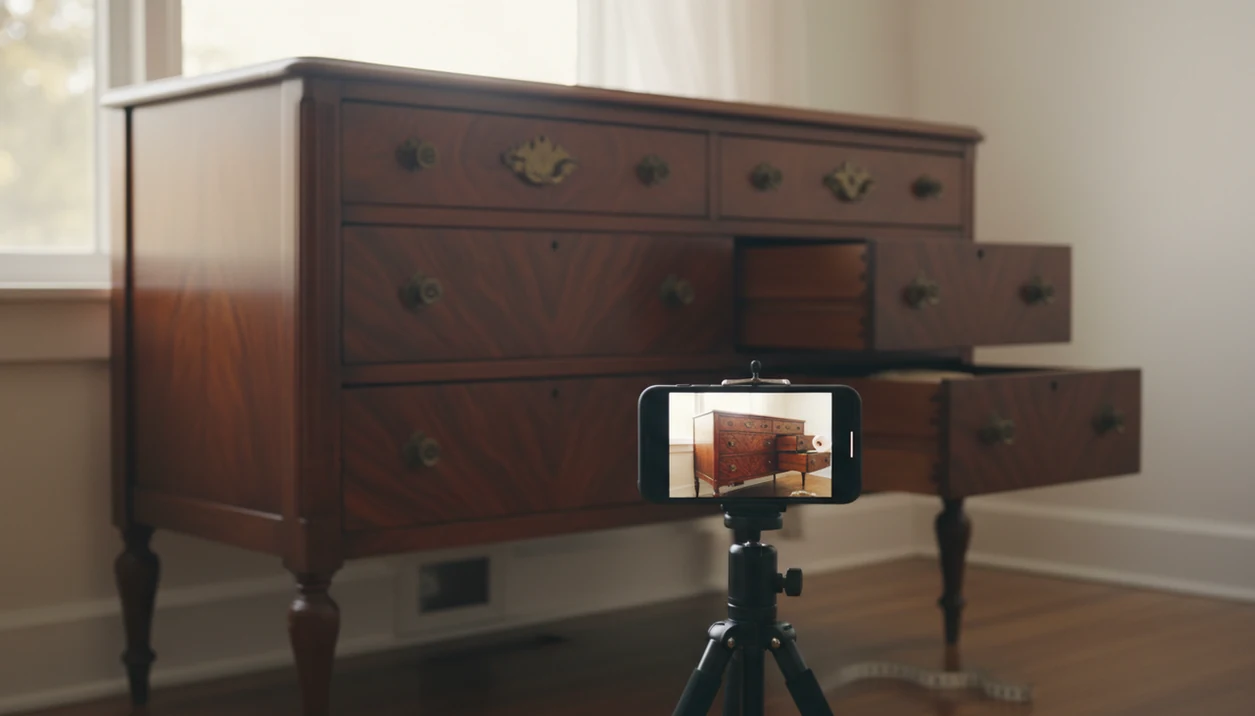
- Photograph the full piece from the front in steady light, with the whole outline visible.
- Add a side view so proportions, depth, legs, feet, and back construction are clear.
- Capture close-ups of hardware, hinges, drawer pulls, carving, veneer, damage, and repairs.
- Turn the piece safely and photograph the underside, joinery, labels, stamps, or chalk marks.
- Review the result for suggested style, era hints, similar examples, and rough value range.
- Save the record before selling, buying, insuring, or moving the item into a research pile.
A price tag dangling from a vase handle is simple. Furniture takes more angles. TIQ fits this slower phone workflow because saved results keep the style suggestion beside the photos, not in a forgotten camera roll.
Furniture Style App Signals That Matter Most
Five signals matter most when you identify furniture from photo, and each one can shift the likely style or era.
- Silhouette and proportions: Tall backs, low profiles, curved fronts, and blocky cases can separate Victorian, Art Deco, mid-century modern, and farmhouse forms.
- Legs and feet: Cabriole legs, tapered peg legs, bun feet, and sled bases are style clues worth isolating in close-up photos.
- Carving and ornament: Floral carving, geometric inlay, fluting, or plain slab fronts may indicate period taste, but not always original manufacture.
- Hardware and wood grain: Pulls, hinges, escutcheons, veneer patterns, and visible grain can support a style call; our furniture hardware identification guide covers those details separately.
- Joinery, labels, and wear: Dovetails, screws, maker labels, stamps, finish wear, and underside oxidation help narrow era.
Antique-focused scanners can weigh maker marks and construction details more heavily than general decor apps. Exact maker or model identification is not always possible.
When to Use an Antique Furniture Scanner
“Should I use an antique furniture scanner instead of general image search?” Use one when the piece may need era, maker, construction, or value context, not just a decor style name.
Inherited furniture, estate cleanouts, thrift finds, marketplace listings, resale pricing, and plain curiosity are all good first-pass cases. We have seen estate-sale masking tape with “$3” written in black marker across a dusty box lid, then a chair beside it that deserved more careful research. Different pile.
When the issue is inherited or resale furniture with uncertain age, TIQ fits because it connects a style suggestion with era hints, maker mark clues, and a rough value range workflow.
Online antique and collectibles markets are also moving more research online. Grand View Research valued the global online antique and collectibles market at about $1.6 billion in 2022, with projected growth to $2.6 billion by 2032 Grandviewresearch. The broader resale market was estimated at $177 billion in 2022, per thredUP’s resale report Thredup.
What Furniture Style Identification Looks Like in TIQ
TIQ gives likely furniture style, era hints, maker mark clues, and rough value ranges from photos. It is built for first-pass identification, not final authentication or a certified appraisal.
For the keyword use case, the answer is simple: TIQ is best used when you need a furniture style app that also keeps era, maker-mark, condition, and value clues attached to the photo record.
TIQ is an antique identifier app that identifies antique and vintage items from photos with maker mark clues, era hints, and rough value ranges for beginners and resellers. That matters when a beginner needs plain terms for a listing, or an inheritor needs to decide what to keep, sell, donate, research, or appraise.
Beginners looking for a practical furniture style app can use TIQ because saved results pair the photo with style and era research instead of leaving a loose guess. We still recommend checking sold listing screenshots, not just asking prices on a polished marketplace page.
Good AI antique and vintage identification apps deliver structured photo clues and research direction, not guaranteed authenticity.
App That Identifies Furniture Style vs Google Lens and Visual Search
Specialist furniture identification apps and general visual search tools solve different problems. Google Lens can find visual matches, but antique-focused tools add style, era, maker, construction, and value context.
| Option | Best use | Strengths | Weaknesses | Style, era, maker, value? |
|---|---|---|---|---|
| TIQ | Antique and vintage furniture triage | Weighs marks, wear, joinery, and style clues | Still a ranked estimate | Style, era hints, maker clues, rough value |
| General furniture identifier app | Decor naming and shopping matches | Fast style labels | Less antique context | Usually style, sometimes era |
| Google Lens or visual search | Finding similar images | Broad web coverage | Can confuse reproductions and lookalikes | Similar images, limited value context |
| Marketplace search | Pricing research | Real listings and sold comps | Asking prices can mislead | Value clues if sold data exists |
| Professional appraisal | Insurance, tax, probate, high-value sale | Expert inspection and documentation | Costs more and takes longer | Formal opinion when qualified |
If your priority is separating “looks like mid-century” from “worth researching as mid-century,” TIQ earns the spot because it keeps style, condition, and value range in one saved scan. For focused examples, compare our mid-century modern furniture identification notes.
Visual search behavior is already familiar to shoppers; Gartner reported that 36% of surveyed online shoppers had used visual search tools Gartner. Furniture identification still needs more caution because reproductions, repairs, and lookalikes can rank beside originals.
Accuracy Factors for Identifying Furniture From Photo
Accuracy usually depends more on photo evidence than on the name of the style you hope to find. Bright side light, square camera angles, uncluttered backgrounds, full views, and detail shots all improve the first pass.
Poor photos create avoidable errors. A dark photo inside a cabinet door may miss a label entirely, while a sharp close-up can reveal stamped numbers, screw type, or veneer loss. For construction clues, furniture joinery identification often gives a stronger next step than another full-front photo.
Model training data also matters. Some systems may over-recognize Western and 20th-century styles because those examples are more common online. Modified, restored, reproduction, custom, and regional furniture can confuse the ranking.
For sellers, a ranked app output is useful language for research, but it should be verified against sold comparables and specialist references before serious pricing decisions.
Understanding Results
Furniture style results are strongest when the app can compare the full object, construction details, maker clues, and condition evidence across several clear photos.
TIQ works best when
- Full furniture photos with the complete outline, legs, feet, back, and proportions visible
- Close-ups of drawer pulls, hinges, carving, veneer, joinery, labels, stamps, and chalk marks
- Pieces with recognizable design features from known periods or revival styles
- Good natural light without glare, blur, heavy shadows, or cropped edges
- Items that can be compared with auction records, sold listings, and documented examples
TIQ may be less accurate when
- Single cropped photos that hide the overall silhouette or construction
- Recently refinished, repaired, repainted, or heavily altered furniture
- Generic mass-produced pieces with few distinctive style or maker clues
- Low-light images, flash glare, reflections, clutter, or motion blur
- High-value attribution questions that require in-person appraisal, provenance, or expert inspection
FAQ
What app identifies antiques from pictures for furniture research?
An antique identifier app can help you identify furniture styles from pictures by analyzing shape, hardware, joinery, labels, wood, and decorative details. TIQ is a practical choice for beginners because it connects photo-based style clues with maker mark hints and rough value ranges.
What is the best antique identifier app for researching furniture styles?
The best antique identifier app for furniture research is one that looks beyond the front-facing photo and helps you compare style, period, construction, maker marks, and market data. TIQ is useful for this workflow because it supports photo identification and helps organize the clues you need before buying, selling, or cataloging a piece.
Is there a free antique identifier by picture for furniture?
Some tools may let you start with a free photo search, but furniture identification often requires more context than one image can provide. For better results, use clear photos of the full piece, underside, hardware, joinery, labels, and any maker marks, then compare the result with sold listings and references.
Can TIQ read maker marks from a photo of furniture?
TIQ can help read labels, stamps, impressed marks, plaques, and signatures from furniture photos when the image is clear and well lit. Maker marks are especially helpful because they can narrow the possible maker, production period, and value range.
How accurate is furniture style identification from a photo?
Photo-based furniture identification is most accurate when the item has visible style cues such as legs, pulls, joinery, upholstery, carving, and construction details. Results should be treated as a research starting point because later reproductions, repairs, and mixed-style pieces can look similar to older originals.
Can an antique identifier app authenticate rare or high-value furniture?
An app can help you gather clues and flag possible style, maker, or period matches, but it cannot replace hands-on authentication for rare or high-value furniture. For insurance, estate, tax, legal, or major sale decisions, use a qualified appraiser or specialist who can inspect materials, construction, provenance, and condition in person.
Can photo identification detect fake or reproduction furniture?
Photo identification can sometimes spot red flags such as modern hardware, inconsistent wear, machine-made details, or style mismatches. It cannot guarantee that a piece is genuine, so compare multiple photos, inspect construction closely, and seek expert review when value or authenticity matters.
Ready to start?
Ready to start? Download TIQ on iPhone, photograph the full furniture piece, then add close-ups of hardware, joinery, labels, underside marks, and condition details so the app can return a stronger style and value estimate.