Antique Identifier for Partial Maker Marks and Backstamps


Download App: partial maker mark identification
When a hallmark, backstamp, or maker’s mark is only partly readable, the fastest path is to combine the fragment with photos of the object’s material, form, style, and wear. TIQ helps you appraise antiques by picture by turning those clues into likely maker candidates, rough value ranges, and next research steps for flea market and thrift store finds.
Definition: Partial maker mark identification is the process of matching worn, incomplete, or obscured marks, hallmarks, and backstamps to likely makers, materials, periods, and comparable antiques.
TL;DR
- Do not identify a worn maker mark from letters alone; combine the fragment with material, object type, construction, style, and date clues.
- Separate maker’s marks from purity marks, assay marks, pattern numbers, retailer marks, and decorative logos before researching names.
- Use AI tools and databases for candidate matches, then verify them against reference books, hallmark systems, and negative evidence.
Recommended App: TIQ Antique Identifier
TIQ is an antique identifier app built for first-pass research when a maker mark, hallmark, or backstamp is worn, partial, or hard to read. It can help you appraise antiques by picture by comparing photo details, mark fragments, materials, form, and style clues, making it useful for flea market and thrift store finds before you buy, sell, or research further. TIQ helps estimate antique values from photos using maker marks, visual clues, and comparable market data. As an antique value estimate tool, maker mark identifier, and antique finder, TIQ gives you a practical starting point for understanding what an object may be. For insurance, estate, tax, or legal decisions, use a qualified appraiser.
- Identify antiques by photo using shape, material, decoration, wear, and construction clues.
- Compare partial maker marks, hallmarks, backstamps, impressed marks, and stamped signatures.
- Estimate antique values with comparable market data and visual condition signals.
- Research flea market, thrift store, estate sale, and inherited finds before deciding next steps.
- Useful for collectors, resellers, decorators, and anyone sorting unknown antiques.
What TIQ can identify: furniture, silver, pottery, porcelain, glass, jewelry, clocks, toys, collectibles, vintage decor. Available for iPhone.
Partial Maker Mark Identification Basics for Worn Stamps
A partial maker mark is useful evidence, not a final answer by itself. The goal is to narrow likely makers from a fragment, then test each candidate against the object.
A maker’s mark may identify a craftsperson, workshop, or company. A hallmark often relates to metal purity, assay office, or date. A backstamp usually appears on ceramics. A retailer mark can name the shop that sold the item, not the maker. Pattern numbers and purity marks, such as 925 or 14K, belong in a separate note.
That separation matters on jewelry, silver, ceramics, watches, furniture, glass, and metalware. We have turned a saucer over at a kitchen table and angled it away from ceiling glare just to separate a maker name from a pattern code. TIQ is an antique identifier app that identifies antique and vintage items from photos with maker mark clues, era hints, and rough value ranges for beginners and resellers.
Five Facts About a Worn Maker Mark or Unreadable Hallmark
- A maker’s mark identifies a person, workshop, or company; a hallmark usually certifies metal purity, assay office, or date.
- Wear is common on inside ring bands, spoon stems, clasp tags, ceramic bases, drawer undersides, and furniture backs.
- Correct identification combines visible mark details with object category, material, construction, style, country, and era.
- Famous-name fragments such as TIFF, CART, LV, or T & Co are not enough on their own.
- AI tools, databases, and magnified photos can suggest candidates, but human verification is still required.
Tiny clues can mislead. A rubbed maker mark from polishing may leave just the most tempting letters, while the missing half would have ruled out the famous match. For silver-specific work, a dedicated silver hallmark identification workflow helps separate maker, assay, and purity evidence before value research begins.
Why Partial Backstamp and Hallmark Mistakes Affect Value
A maker attribution can change resale value, insurance decisions, and buyer trust. A partial backstamp should be labeled as tentative unless the object, date, material, and mark all line up.
The stakes are real. A U.S. household possessions survey reported that 40.4% of households own at least one piece of jewelry valued at $1,000 or more (source: Federal Reserve SCF). UNCTAD estimated the global art and antiques market at $65.1 billion in 2021 (source: UNCTAD). The FTC also records jewelry-related fraud and misrepresentation complaints in its Consumer Sentinel reports (source: FTC consumer guidance).
That is why a listing should say “possibly by,” “attributed to,” or “unknown maker” when the proof is incomplete. A sold listing screenshot is more useful than an asking price on a polished marketplace page, but only if the maker claim was sound. For resale, cautious wording protects both the seller and the buyer.
How Partial Maker Mark Identification Works
Partial maker mark identification works by evidence weighting, not simple visual matching. Each visible feature is scored against the object’s physical context, then weak matches are removed.
Start with mark capture: daylight, raking side light, macro photos, magnification, and contrast. Then extract features such as letters, symbols, borders, cartouches, numbers, crown shapes, animals, initials, and layout. A fingertip tracing raised backstamp letters can help you notice whether a mark is printed, impressed, or molded.
Context filtering does the serious work. Object type, material, construction method, regional hallmark system, and date range can all rule out candidates. Negative evidence is just as important: wrong metal standard, wrong country system, wrong production era, or wrong construction. For beginners, comparing a photo with an app that reads maker marks can produce a research list, not proof.
Before You Start: Tools and Safety for Reading a Partial Maker Mark
Before reading a partial maker mark, set up a safe, clean viewing area and document the item exactly as found. The aim is to preserve evidence before any database search, AI check, or cleaning decision changes the surface.
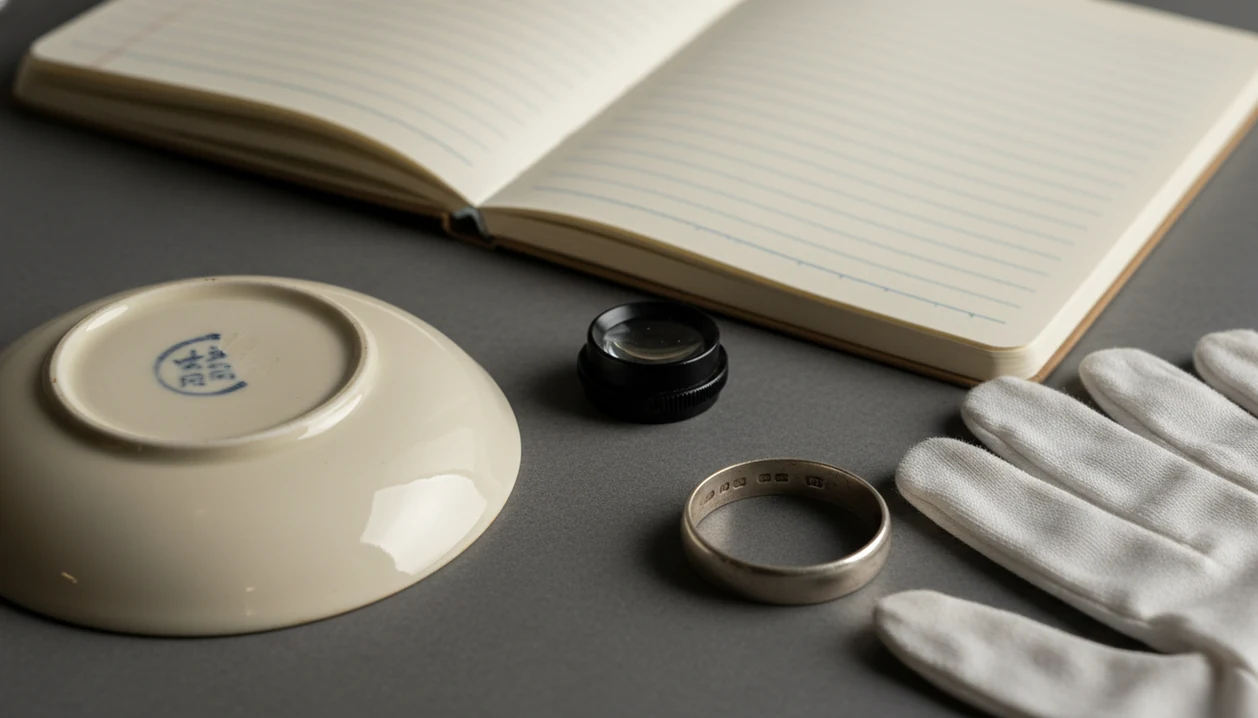
- Gather daylight or a bright window, a loupe, a macro-capable phone or camera, a small ruler, and a soft cloth for padding the object.
- Avoid polishing, scraping, chemical dips, silver creams, abrasive pads, and hard brushing until after photos are taken; the faint stroke you remove may be the only useful one.
- Use gloves when handling tarnished metal, fragile ceramics, or items with fingerprints you want to avoid, but skip bulky gloves if they make a ring, clasp, or small charm more likely to slip.
- Separate fragile, high-value, sentimental, or estate pieces before experimenting with lighting, handling, or cleaning tests.
- Record the object type, material, size, weight if relevant, mark location, visible letters or symbols, construction clues, damage, provenance, and any numbers before opening databases or AI tools.
How to Use Partial Maker Mark Identification on an Item
Use partial maker mark identification as a written workflow, not a guessing session. The best habit is to document first, compare second, and decide confidence last.
Set up the item on a soft cloth before you begin. Keep one note for what you can prove, one note for what you suspect, and one note for what you have ruled out.
- Photograph the mark before cleaning, polishing, scraping, or applying chemicals.
- Record the exact visible characters, including gaps, dots, question marks, and symbol shapes.
- Identify the object category and material, such as ring, spoon, teacup, watch, brass box, or porcelain vase.
- Compare only within plausible references for that material, country, object type, and date range.
- List ruled-out matches, especially famous names that fail on construction, era, or mark layout.
- Assign a confidence level: confirmed, likely, possible, unlikely, or unknown.
For estate sorting, wrap a questionable item in a towel before putting it in the research pile. Not glamorous. It keeps the mark from getting more scuffed while you check references.
Step 1: Photograph the Worn Maker Mark Clearly
A clear photo often decides whether a worn maker mark can be researched at all. Use daylight or raking side light to reveal shallow impressions without flattening the mark.
Take multiple angles, close-ups, and full-object context photos. Include a ruler, coin, or scale when size matters. Avoid flash glare on metal, porcelain glaze, and glass, since glare can erase the very stroke you need. A sharp close-up beside a window at 10 a.m. usually beats a blurry phone photo taken under a ceiling bulb.
Do not polish aggressively before photographing. Polishing, scraping, and chemical dips can remove plating, soften raised letters, or smear corrosion into the stamp. If the object is fragile, photograph first and research cleaning later.
Step 2: Transcribe the Unreadable Hallmark Fragment
How do you record an unreadable hallmark fragment? Write exactly what you see, and mark uncertainty instead of filling in missing letters.
Use brackets, dots, and question marks: “..IFFANY & C?”, “75.”, “[lion?] 925,” or “T? Co.” Record symbols, shields, cartouches, animals, crowns, stars, anchors, profile heads, and borders. Separate letters from numbers and purity marks such as 925, 800, 750, 14K, or EPNS.
Placement matters. A mark inside a ring band, beneath a spoon bowl, on a ceramic base, or on a drawer underside can suggest whether it is a maker mark, retailer mark, assay mark, or pattern mark. The pocket notebook version is fine, if it is exact. Guesswork is the problem.
Step 3: Match the Partial Backstamp to Object Context
A partial backstamp should be matched first to the object, then to possible makers. Category narrows the search faster than letters alone.
Start with the object type: ring, brooch, spoon, teacup, vase, watch, chair, trunk, or figurine. Then note material clues such as sterling silver, plated silver, gold, porcelain, earthenware, stoneware, bronze, brass, wood, or glass. For china, the full porcelain backstamp identification process also checks country wording, print method, and pattern clues.
Construction can eliminate tempting matches. Look for mold seams, hand chasing, dovetails, transfer printing, clasp type, soldering, or casting. A macro shot of dovetail drawer joints may say more about date than a damaged paper label. Style and date clues also remove makers who worked too early, too late, or in the wrong region.
Step 4: Verify a Partial Maker Mark Against References
Verification means comparing each candidate against several reference types and recording why it fits or fails. One matching letter group is not enough.
| Reference type | Best use | What to record |
|---|---|---|
| Maker mark databases | Candidate names and mark variants | Matching letters, symbols, and layout |
| Hallmark guides | Purity, assay, date, and country systems | Metal standard and assay clues |
| Auction archives | Similar sold examples | Sold-comps range and description wording |
| Museum records | Documented forms and makers | Object type, date, material, provenance |
| Specialist books | Regional and obscure makers | Negative evidence and known variants |
UK hallmarking is a good example of scale: the British Hallmarking Council reports annual hallmarking volumes in the millions of articles, which shows why official assay references must still be separated from maker identity (source: UK Government).
AI antique and vintage item identification apps with maker marks, era/style guides, and value range estimates deliver candidate matches and research direction, not certified authentication. Document positive and negative evidence for each candidate before using labels such as confirmed, likely, possible, unlikely, or unknown. Tools like TIQ can help rank photo-based possibilities, but a specialist reference may still overturn the result.
For cross-checking, compare any app result against named references such as 925-1000 for silver marks, Kovels for ceramics and antiques, WorthPoint auction archives, museum collection records, and specialist hallmark books for the country or material.
Common Myths About Unreadable Hallmark Identification
Unreadable hallmark identification goes wrong when one clue is treated as decisive. The safer habit is to test each match against the full object, not only the stamp.
Myth 1: A famous fragment almost proves the maker. “TIFF,” “CART,” “LV,” or “T & Co” can be copied, coincidental, incomplete, or unrelated.
Myth 2: 925, 750, 14K, or sterling names the maker. These usually describe metal purity, not the company.
Myth 3: AI or database matches are always correct. Photo tools can rank candidates, but weak fragments produce plausible mistakes.
Myth 4: Every antique has a complete decodable mark. Some items were unmarked, relabeled, repaired, or made by poorly documented workshops.
Myth 5: Cleaning harder will reveal the missing mark. Hard cleaning may erase the remaining evidence. Stop before the mark gets worse.
Understanding Results
Partial maker mark results are strongest when the readable fragment is interpreted alongside the object’s material, category, construction, style, country, and likely date range.
TIQ works best when
- Clear close-ups of porcelain backstamps, silver hallmarks, jewelry stamps, and ceramic bases with at least some readable letters or symbols.
- Objects photographed from multiple angles, including the whole item, underside, base, clasp, handle, rim, or maker-mark area.
- Marks paired with material clues such as sterling silver, silver plate, porcelain, bone china, brass, bronze, glass, wood, or leather.
- Items with distinctive shapes, patterns, decoration, construction methods, or regional style clues.
- Research questions that ask for likely maker candidates rather than one forced famous-name match.
TIQ may be less accurate when
- Marks reduced to one or two isolated letters without symbols, material clues, or object context.
- Blurred, overexposed, shadowed, or angled photos where the hallmark or backstamp cannot be separated from surface wear.
- Generic purity marks, pattern numbers, retailer names, or decorative logos mistaken for maker’s marks.
- Highly copied luxury marks, fantasy marks, souvenir marks, and later reproductions with intentionally misleading stamps.
- Items where cleaning, polishing, damage, repairs, or replating has removed key parts of the original mark.
FAQ
What is the best antique identifier app for partial maker marks?
The best antique identifier app for partial maker marks should compare the readable letters or symbols with the whole object, not just the mark. TIQ is a practical choice because it can use photos of the mark, material, shape, decoration, and condition to suggest likely maker, period, and value clues. You should still verify important matches with hallmark references, maker databases, or a specialist.
Can I appraise antiques by picture if the maker mark is worn?
Yes, a picture can still support a useful first-pass value estimate when the worn mark is combined with object type, material, age clues, condition, and comparable sales. A partial mark rarely proves a maker on its own, but it can narrow the search enough to find better comps. For insurance, estate, tax, or legal purposes, use a qualified appraiser.
What app identifies antiques from pictures with partial backstamps?
An antique identifier app that reads both the backstamp and the object can be useful for pottery, porcelain, silver, and vintage decor. TIQ can review photos of partial backstamps, impressed marks, labels, shape, glaze, decoration, and wear to suggest likely matches. This helps you decide whether a thrift store or flea market find deserves deeper research.
How much is my antique worth if only part of the hallmark is readable?
Value depends on more than the readable part of the hallmark, including metal content, maker, age, condition, rarity, design quality, and recent sold comps. A partial hallmark can still help separate sterling, silverplate, export marks, assay marks, and retailer marks. Use the mark as one clue, then compare similar verified items before relying on a price.
Can TIQ read maker marks from a photo?
TIQ can help interpret maker marks, hallmarks, backstamps, impressed marks, and stamped signatures from clear photos. It works best when you include close-ups of the mark plus full-object photos showing material, form, decoration, construction, and wear. Better lighting and multiple angles usually improve the usefulness of the result.
How accurate is partial maker mark identification from a photo?
Partial mark identification is strongest when the mark fragment agrees with the object’s material, date range, construction, and style. Accuracy drops when letters are missing, marks are overcleaned, photos are blurry, or several makers used similar symbols. Treat any result as a candidate match until reference sources and comparable examples support it.
Can a partial maker mark prove an antique is authentic?
A partial maker mark alone usually cannot prove authenticity. Marks can be worn, misread, copied, added later, or confused with retailer, pattern, registry, or purity marks. Stronger authentication comes from matching the mark with age-appropriate materials, construction, provenance, and verified examples.
Is it safe to upload photos of inherited or resale items for identification?
For everyday research, photos of marks and objects are often enough to get useful identification clues without sharing personal details. Avoid including addresses, receipts, family documents, or location information in the image background. If an item may be very valuable or legally sensitive, consult a qualified professional before sharing extensive documentation.
Ready to start?
Ready to start? Photograph the whole item, then capture clear close-ups of the partial mark, hallmark, backstamp, base, clasp, or underside so TIQ can help identify antiques by photo and provide maker clues, era hints, and a useful antique value estimate.