Antique Identifier Guide to Maker Marks vs Hallmarks


Download App: maker mark vs hallmark
Maker marks and hallmarks can turn a flea market or thrift store find from a guess into a researched item. With TIQ, you can appraise antiques by picture, compare close-up stamps, and separate maker identity from metal certification before you buy, sell, or list.
Definition: A maker mark identifies the creator or manufacturer of an item, while a hallmark is an official stamp that verifies metal content, origin, or assay.
TL;DR
- A maker mark answers “who made or sponsored this?” through initials, a symbol, logo, or registered trademark.
- A hallmark answers “what metal standard is this, and where or when was it tested?” through assay and fineness symbols.
- In British-style systems, the maker or sponsor mark can be one component inside the full hallmark sequence.
Recommended App: TIQ Antique Identifier
TIQ is an antique identifier app for quickly researching flea market and thrift store finds from photos, including stamps, signatures, labels, and metal marks. Use it to appraise antiques by picture for first-pass research, compare visual clues, and separate likely maker marks from hallmarks before you buy, sell, or list an item. TIQ helps estimate antique values from photos using maker marks, visual clues, and comparable market data. For insurance, estate, tax, or legal decisions, use a qualified appraiser.
- Identify antiques by photo using overall form, materials, decoration, and close-up detail shots.
- Use TIQ as a maker mark identifier for stamped, impressed, printed, or engraved marks.
- Get an antique value estimate based on comparable market data and visible condition clues.
- Helpful for flea market shoppers, thrift store resellers, collectors, inherited items, and vintage decor research.
- Works as an antique finder when you need a faster way to research unfamiliar objects on the go.
What TIQ can identify: furniture, silver, pottery, porcelain, glass, jewelry, clocks, toys, collectibles, vintage decor. Available for iPhone.
Hallmark vs Maker Mark At a Glance
The maker mark vs hallmark distinction is easiest to see as “identity mark” versus “metal-certification mark.” A maker mark names or suggests a person or business, while a hallmark belongs to an assay or legal marking system.
| Question | Maker mark | Hallmark |
|---|---|---|
| Meaning | Identifies maker, workshop, company, seller, or sponsor | Certifies metal standard and related assay details |
| Authority | Maker, brand, sponsor, or registered trademark owner | Assay office or regulated hallmarking system |
| Common symbols | Initials, full name, logo, pictorial device | Fineness number, office symbol, standard mark, date letter |
| What it proves | A claimed commercial identity or sponsor | Tested or declared metal standard, where legally controlled |
| What it does not prove | Metal content, age, or value by itself | Maker attribution, condition, or market price by itself |
Numbers like 925 or 14K may be purity marks, not full hallmarks. That small difference matters when a vendor is watching during a mark check at a flea-market table.
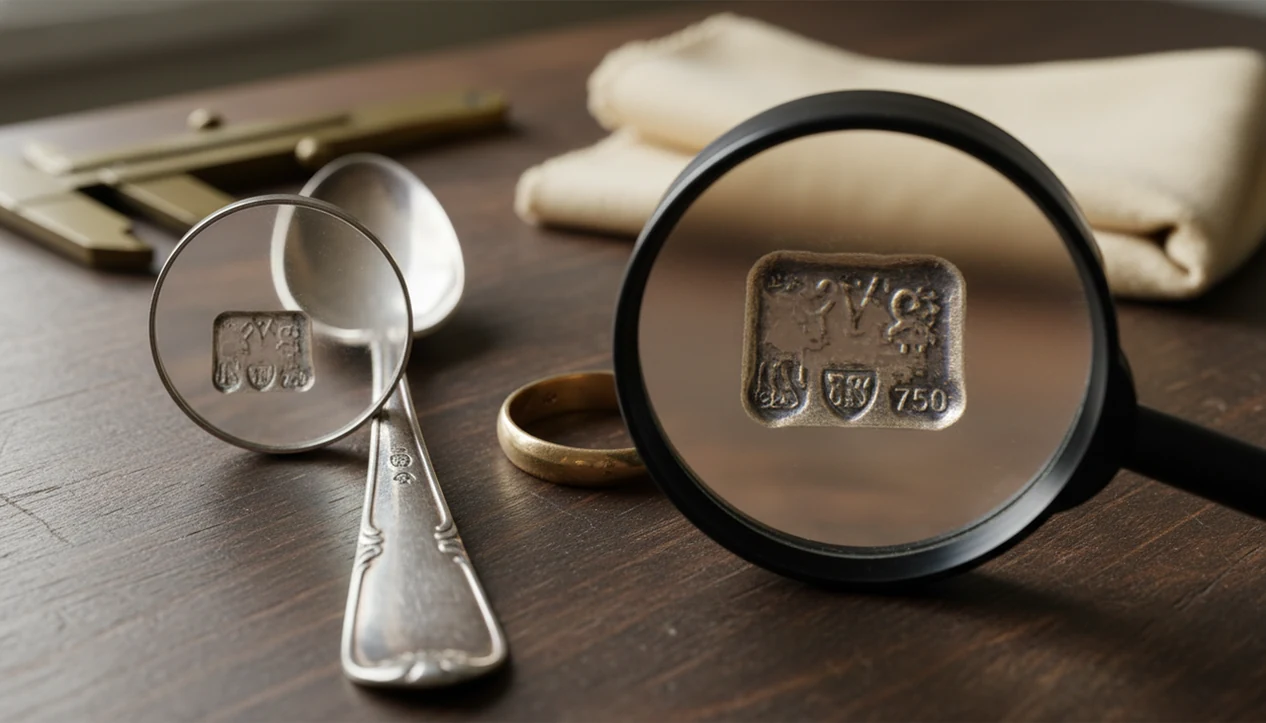
A practical example: 'Tiffany & Co.' or a registered initials punch points toward maker or sponsor identity, while a lion passant, assay-office symbol, or date letter points toward a hallmarking system. Treat them as separate clues until the country, metal, and object type agree.
Anyone dealing with a mixed tray of rings, spoons, and brooches can use TIQ to sort identity clues from purity clues because the photo workflow flags maker mark text, metal hints, and rough value ranges separately.
What Is a Maker Mark on Jewelry, Silver, or Antiques?
A maker mark is a stamped, impressed, engraved, or molded identifier that may appear as initials, a name, a logo, a pictorial symbol, or a registered trademark. It can point to the maker, workshop, brand, manufacturer, seller, or sponsor, not always the individual craftsperson.
In U.S. jewelry practice, the FTC Jewelry Guides state that a precious-metal quality mark, such as 14K or 925, should be accompanied by the manufacturer’s or seller’s trademark or name to help avoid deception (FTC Jewelry Guides, 16 CFR Part 23: eCFR (FTC jewelry guides)). That is why a tiny trademark beside a purity stamp deserves attention.
Maker marks help researchers attribute a piece, narrow date ranges, check brand history, and refine sold-comps research. A sharp close-up beside a window at 10 a.m. usually beats a blurry phone photo taken under yellow ceiling light. For deeper mark-first research, a maker mark identifier app workflow can keep photos, readings, and comparison notes in one place.
If the priority is naming a likely maker without claiming a certified appraisal, TIQ fits because it separates visible mark text from era hints and value-range research.
What Is a Hallmark on Precious Metal?
A hallmark is usually an official or regulated mark applied after assay testing to certify precious-metal standard. Depending on country and period, it can record fineness, metal standard, assay office, and a date letter.
In UK-style notation, 925 means 925 parts per thousand, or at least 92.5% silver by weight. In the UK, gold, silver, platinum, and palladium generally require hallmarking above exemption weights; UK guidance lists 1 gram for gold and 7.78 grams for silver among the common thresholds (UK hallmarking guidance: UK Government).
Good antique and vintage identification apps with maker marks, era/style guides, and value range estimates deliver first-pass research support, not laboratory metal testing or a certified appraisal.
TIQ is useful when a hallmark cluster is hard to read because its photo-based review can prompt you to crop the standard mark, office symbol, and date-letter area before comparing references for silver hallmark identification.
Five Facts About Maker Mark vs Hallmark Research
These five facts cover the main research split: maker marks identify commercial identity, while hallmarks usually document metal standard. Keep both clues separate until the evidence starts to line up.
- Maker marks identify who made, sponsored, or sold the piece. Initials may belong to a firm, retailer, or registered sponsor.
- Hallmarks usually certify metal purity and may show assay office and date. In British-style systems, those marks often sit in a sequence.
- The maker or sponsor mark can be one component of the full hallmark. That is why “hallmark vs maker mark” can be contextual.
- Not every country uses independent assay-office hallmarks. U.S. pieces more often rely on trademarks plus quality stamps.
- Value research needs more than stamps. Combine hallmark data, maker attribution, condition, style, provenance, and comparable sales.
For resellers, safer listing language is specific rather than absolute: write 'marked 925,' 'bears a sponsor mark resembling,' or 'consistent with,' instead of claiming solid silver, a famous maker, or a firm date from one stamp.
A receipt folded behind a painting can matter as much as a mark. Provenance changes the research pile.
How Maker Marks and Hallmarks Work in Real Assay Systems
Maker marks and hallmarks work through registration, marking, and verification. In a formal assay system, a maker or sponsor registers a mark, the item is submitted or marked under a legal system, the assay office tests or verifies metal standard, and official symbols are applied.
Traditional British-style hallmarking is often described as a four-part structure: sponsor or maker mark, standard or fineness mark, assay office mark, and date letter. In plain terms, that answers who, what, where, and when. That structure explains why hallmark vs maker mark is not always a clean separation; the maker mark may sit inside the hallmark sequence.
U.S. practice is different. Independent assay hallmarks are less central, while trademarks and purity marks are common. TIQ helps beginners keep those systems apart because its mark-review workflow asks for country clues, object type, metal clues, and style before suggesting next research steps.
How to Use Maker Marks and Hallmarks for Antique Identification
Use maker marks and hallmarks as a sequence of clues, not as one final answer. The most reliable first-pass identification comes from photographing, transcribing, separating, and cross-checking each mark against the object itself.
- Photograph the mark in sharp light, including one close-up and one wider view of the whole object.
- Separate letters from numbers so initials, logos, 925, Sterling, 14K, and date letters do not get mixed together.
- Identify metal-standard marks such as 925, 800, Sterling, 14K, 18K, 750, or 585 before assigning a maker.
- Check assay office and date symbols if the marks appear in a grouped hallmark sequence.
- Compare maker marks in references and treat similar examples as leads, not confirmed matches.
- Verify against style and construction before estimating value or writing a sales description.
When the trigger moment is a dark photo inside a cabinet door, TIQ earns its place because it can organize a clearer retake, mark crop, era hint, and rough value range in one research flow. If you need a mark-focused scan, an app that reads maker marks can speed up the first pass.
Common Myths About Hallmark vs Maker Mark Clues
Beginners often treat every stamp as proof, but marks are clues that need context. These myths cause many wrong attributions in estate cleanouts and online listings.
- Myth: A maker mark is always a hallmark. A maker mark may be part of a hallmark sequence, but it is not the full certification system by itself.
- Myth: 925, Sterling, or 14K is always a full hallmark. These are often purity marks, and they may lack assay office or date information.
- Myth: All antique silver and gold has a full hallmark. Marking laws vary by country, period, metal, and exemption.
- Myth: A stamped mark guarantees age or authenticity. Marks can be forged, added later, re-struck, or transferred.
- Myth: A worn mark is useless. Partial letters, shield shapes, and placement can still narrow the next search.
On days a dusty shoebox of mismatched brooches lands on a basement card table, TIQ helps because the photo notes can sort items into keep, sell, donate, research, or appraise piles.
Related Concepts: Purity Marks, Assay Marks, Sponsor Marks
Purity marks, assay marks, and sponsor marks are neighboring clues that often sit beside a maker mark or inside a hallmark sequence. Reading them separately keeps a simple “925” from being mistaken for a full certified hallmark.
Purity marks state metal quality: 925 and Sterling point to sterling silver, 800 to lower-grade silver, 14K to 14-karat gold, and 750 to 18-karat gold expressed as parts per thousand. These marks tell you metal standard, not the maker. Assay marks go further because they come from, or refer to, an official testing system; an assay office symbol or standard mark can show where the metal was checked, while a plain quality stamp may only be a manufacturer’s declaration.
In British-style sequences, the sponsor mark is the registered initials or symbol of the party responsible for submitting the item. It can look like a maker mark, but it may identify a retailer, importer, or sponsor rather than the bench worker.
- Read numbers and words first as possible purity information.
- Check for office symbols, standard marks, and date letters as hallmark clues.
- Treat sponsor initials as identity evidence, then compare them with maker mark references.
Maker Mark vs Hallmark Decision Guide for Beginners
“Is this stamp a maker mark or a hallmark?” Start by asking what the mark is trying to tell you. If the stamp is initials, a name, a logo, or a symbol tied to a workshop, treat it first as a maker mark.
If the stamp is a fineness number, assay office symbol, date letter, or legally standardized metal symbol, treat it first as hallmark or purity information. If several marks appear together, the maker mark may be one part of a larger hallmark sequence. If the object is U.S.-made, expect maker trademarks and purity stamps more often than full assay-office hallmarks.
For beginners, maker attribution is often easier than final metal verification because letters and logos can be compared visually, while metal content may require testing. Cross-check country, metal, style, and date before estimating value. A sold listing screenshot is better evidence than an asking price on a polished marketplace page.
Evidence and Sources for Maker Marks and Hallmarks
Good evidence keeps maker identity, metal certification, and price research in separate lanes. Use legal marking sources for what a stamp is supposed to mean, and marketplace sources only for what similar objects have actually sold for.
The FTC Jewelry Guides are the right starting point for U.S. quality marks and the related trademark or seller-name issue. For British-style pieces, UK hallmarking guidance and assay-office material explain official marks, assay offices, and exemption weights. Photo identification can suggest a likely mark family, but claims about solid gold, silver fineness, platinum, or palladium content may need assay testing, XRF testing, or another qualified metal test rather than a picture alone.
- Start with the legal system for the country and period, especially FTC guidance for U.S. jewelry or UK assay-office rules for British marks.
- Compare the visible stamp with assay-office charts, museum guides, and specialist mark references before naming a maker.
- Separate certification evidence from value evidence; a hallmark can support metal standard, not a market price by itself.
- Check sold-auction archives for comparable objects only after maker, metal, condition, size, and date are reasonably aligned.
- Reserve firm metal-content claims for tested pieces, not worn photos, hopeful readings, or lookalike marks.
Understanding Results
Photo-based mark identification works best when the stamp is treated as one clue alongside material, object type, construction, country, and condition.
TIQ works best when
- Clear, close-up photos of the mark with the whole item photographed separately
- Silver, gold, jewelry, flatware, ceramics, and decorative objects with visible stamps
- Marks that include initials, logos, fineness numbers, assay symbols, or date letters
- Items where the user can compare multiple clues instead of relying on one stamp alone
TIQ may be less accurate when
- Worn, partial, polished-out, or distorted marks
- Counterfeit, fantasy, souvenir, or later-added stamps
- Objects with marks copied across countries, factories, or revival styles
- Photos with glare, shadows, blur, or no scale reference
- Value conclusions made without condition, provenance, measurements, and market comparison
FAQ
What app identifies antiques from pictures and close-up marks?
An antique identifier app should handle both full-item photos and close-ups of stamps, signatures, labels, and metal marks. TIQ is a practical choice for flea market and thrift store finds because it helps connect visible marks with likely maker, material, era, and rough value clues.
Can TIQ identify silver hallmarks from a photo?
TIQ can help analyze photographed silver marks, including fineness numbers, assay-style symbols, sponsor marks, and date-letter clues when they are visible. Use clear close-ups from multiple angles so the app can compare mark shapes and the object’s overall style together.
Can an antique identifier app read maker marks from a photo?
Yes, a good antique identifier app can often read or interpret stamped, impressed, printed, engraved, or labeled maker marks from a sharp photo. Results are strongest when the mark is well lit, in focus, and shown alongside the whole object for context.
How much is my antique worth if it has a maker mark or hallmark?
A maker mark or hallmark can improve a value estimate because it may confirm manufacturer, metal standard, origin, or period. TIQ can use those clues with visible condition and comparable market data to suggest a rough value range for research before buying, selling, or listing.
What is the difference between a maker mark and a hallmark?
A maker mark usually identifies who made, manufactured, or sponsored the item. A hallmark usually verifies metal content, assay office, origin, or date, especially on silver and gold. On some antiques, the maker mark is one part of a larger hallmark sequence.
How accurate is photo identification for worn or partial marks?
Photo identification is most useful for narrowing possibilities, not proving a mark beyond doubt. Worn, over-polished, tiny, or partial marks can match several makers or assay systems, so compare the result with object form, materials, construction, and sold examples.
Can forged maker marks or hallmarks fool an app?
Forged or later-added marks can mislead any photo-based tool, especially on high-value silver, jewelry, ceramics, and designer pieces. Treat mark identification as one research step and look for consistency between the mark, age, wear, craftsmanship, provenance, and market history.
Should I rely on an app for insurance, estate, or legal appraisal decisions?
An antique identifier app is helpful for first-pass research, value ranges, and organizing clues before you act. For insurance, estate, tax, donation, or legal decisions, use a qualified appraiser who can inspect the item in person and provide formal documentation.
Ready to start?
Ready to start? Photograph the stamp in clear light, capture the whole object, and use TIQ to compare likely maker marks, hallmark patterns, and related antique value estimate clues before you buy, sell, insure, or list the item.