
How to Use an Antique Identifier App to Sell Online


Download App: how to sell antiques online
Definition: An antique identifier app for selling online helps research an item’s age, maker, style, and likely market value before creating a listing.
Before you list an older item, a simple research workflow helps you name it accurately, spot maker clues, and appraise antiques by picture so your price and description start from evidence. Use photo identification, sold comps, and condition notes to turn uncertainty into a buyer-ready listing.
> Selling antiques online means turning an older item into a trustworthy listing by identifying what it is, estimating market value from comparable sales, disclosing condition, and completing payment and shipping through an online marketplace.
- Identify maker, era, style, materials, dimensions, and condition before writing the listing.
- Use recent sold comps, not active asking prices, to set a realistic price range.
- Choose the platform based on buyer type, fees, shipping risk, and whether the item is better sold locally.
Recommended App: TIQ Antique Identifier
TIQ is an antique identifier app for collectors and beginners who want a practical research routine before selling online. It can help you identify antiques by photo, read visible maker marks, compare similar market examples, and appraise antiques by picture for first-pass research before you write a listing. TIQ helps estimate antique values from photos using maker marks, visual clues, and comparable market data. It works as an antique identifier, antique value estimate tool, maker mark identifier, and antique finder so you can sort promising pieces from items that need deeper research. For insurance, estate, tax, or legal decisions, use a qualified appraiser.
- Identify items by photo before drafting marketplace descriptions.
- Check maker marks, signatures, labels, stamps, and construction clues.
- Estimate values using comparable market data to guide asking prices.
- Build better research habits for online selling, collecting, and resale.
- Useful for beginners, collectors, vintage sellers, and families sorting inherited items.
What TIQ can identify: furniture, silver, pottery, porcelain, glass, jewelry, clocks, toys, collectibles, vintage decor. Available for iPhone.
Antique Selling At A Glance: The Online Workflow
The online antique selling workflow is identify, research, photograph, price, list, pack, and ship. Skipping the early research usually leads to weak titles, inflated prices, or buyer disputes after delivery.
Online buying is now routine, not niche. U.S. e-commerce retail sales reached $1.19 trillion in 2024, and e-commerce accounted for 16.2% of total U.S. retail sales in the fourth quarter of that year, according to Census Bureau data. Source: U.S. Census Bureau e-commerce retail sales data, U.S. Census Bureau. That scale helps sellers, but it also means buyers compare listings quickly.
At the kitchen table, turning a saucer away from ceiling glare can reveal a backstamp the first photo missed. Tools like TIQ can support that first-pass photo workflow with maker mark clues, era hints, style notes, and rough value ranges. It is not a certified appraisal.
How Selling Antiques Online Works
Selling antiques online works by turning an uncertain object into a searchable, evidenced listing that a buyer can trust. The marketplace supplies the audience, but the seller supplies the signals that make the item findable and believable.
Most platforms use search relevance, meaning how closely a listing matches a buyer’s words and filters. Titles, categories, photos, item specifics, and sometimes buyer behavior all help the system decide where a listing appears. Identification gives the listing its vocabulary: maker, material, era, pattern, style, and object type. Condition proof gives the buyer confidence: closeups of chips, repairs, hallmarks, labels, undersides, and scale. Sold comps add price discipline because they show what similar objects actually brought, not just what someone hoped to get.
A simple working order is:
- Identify the item enough to name it accurately.
- Document condition with photos and plain notes.
- Compare recent sold examples before setting price.
- Choose the platform by audience, fees, and shipping risk.
- Calculate net proceeds after packing, postage, insurance, returns, and commissions.
Market value is the likely resale price from comparable sales. Appraisal value is a professional opinion for a stated purpose. Insurance replacement value is what replacement may cost, often not your online selling price.
Antique Listing Trust: Identification, Condition, Price, And Shipping
Antique listing trust comes from four signals: accurate identification, clear condition disclosure, defensible sold-comps pricing, and believable shipping plans. Buyers need evidence before they accept a seller’s claim.
How antique selling online works is simple in theory. Marketplaces match buyer searches to listings through titles, categories, photos, item specifics, and demand signals. The practical work is harder: you must describe the object in words a buyer would search, then support those words with photo evidence. Search algorithms can surface a “sterling silver Art Deco spoon,” but they cannot fix a missing hallmark photo.
Market value is what similar items recently sold for in normal conditions. Appraised value or insurance replacement value may be different, especially for rare, documented, or professionally valued pieces. A rough value range helps set a listing price; it does not prove replacement cost or authenticity.
Small details matter. A lion passant on a silver spoon changes the research path.
Five Facts To Know Before You Sell Antiques Online
- Identification shapes trust. Maker, era, style, materials, and condition help buyers judge whether your listing matches what they collect.
- Sold comps beat asking prices. Recent completed sales show actual buyer behavior; active listings may be hopeful, stale, or copied from other sellers.
- Photos prevent arguments. Clear images of wear, repairs, chips, labels, and underside details reduce surprises after delivery.
- Platform choice changes the sale. eBay, Etsy, Facebook Marketplace, auction houses, and specialty sites differ by audience, fees, speed, and shipping expectations.
- Shipping can erase profit. A fragile vase with a low sale price may cost more to pack safely than the margin allows.
For beginner sellers, recent sold listings are often better than active listings because they show what buyers actually paid, not what sellers hoped to receive.
Before You Start: Supplies, Accounts, And Risk Checks
Before you start selling antiques online, set up the workspace, accounts, and risk filters first. This prevents a long photo session from turning into a pile of unusable listings.
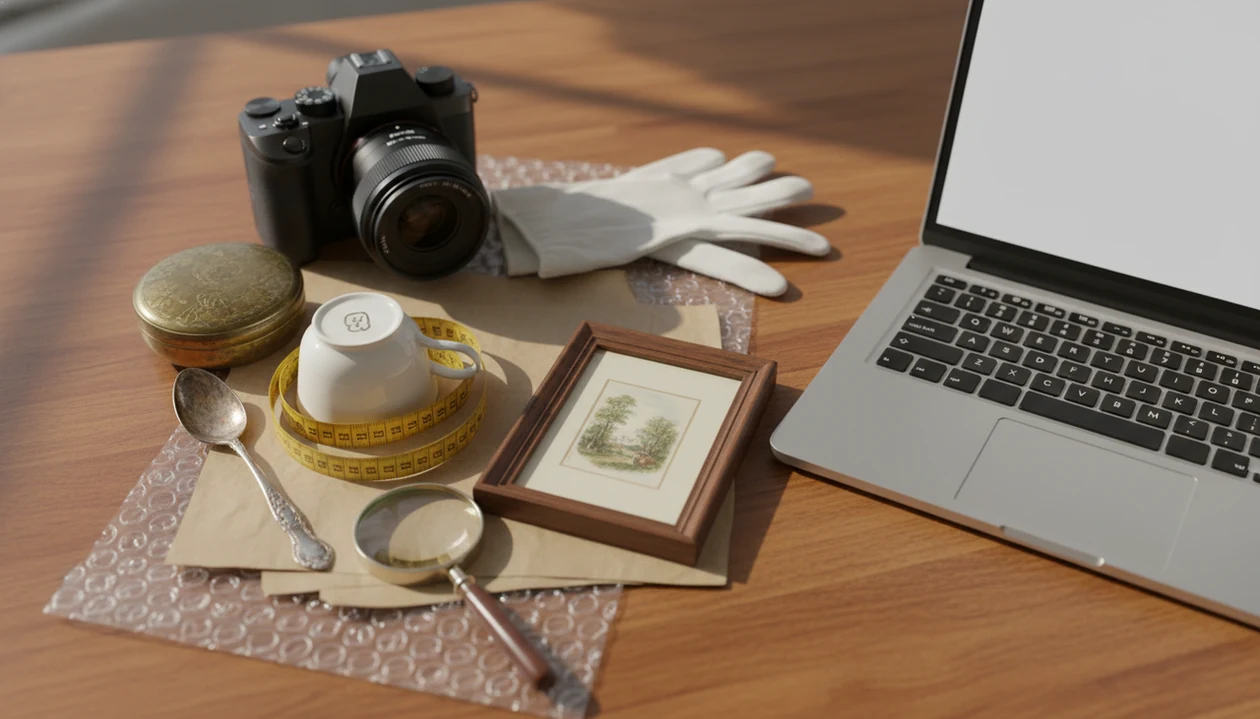
- Gather the practical tools before handling the first object: measuring tape, a reliable scale, soft window or lamp light, clean note paper or a spreadsheet, and packing supplies close enough to test box size.
- Create or confirm your marketplace accounts before photographing a large batch. Check payment setup, seller limits, return settings, and whether the category you need is available.
- Review platform rules for items that may be restricted or banned, especially weapons, ivory or ivory-like materials, certain animal parts, taxidermy, and anything with customs or carrier complications.
- Separate high-value, legally sensitive, or uncertain pieces into a review pile. Jewelry, rare art, cultural objects, unusual signatures, and heavily restored items may need an appraiser, specialist dealer, or auction-house opinion before listing.
- Label each item’s notes and photos as you go, so a chipped lid or missing screw does not get matched to the wrong listing later.
Antique Identification Workflow Before Listing
Use this workflow before you create the listing. It keeps the research pile separate from the “ready to sell” pile, which matters during estate cleanouts or reseller sorting.
- Photograph the object fully. Capture the front, back, base, underside, interior, maker marks, damage, scale, and construction details.
- Record the basics. Note dimensions, weight, materials, color, pattern, moving parts, odor, and any repairs.
- Scan the clues. Use a photo-based identification pass for maker mark clues, era hints, style notes, and rough value ranges.
- Compare similar examples. Check sold listings, auction archives, and specialty references before copying another seller’s wording.
- Escalate uncertain items. Ask a specialist about high-value, legally sensitive, heavily restored, or possibly misattributed pieces.
A sharp close-up beside a window at 10 a.m. usually beats a blurry phone photo taken under yellow room light. Not glamorous. Useful.
Step 1: Identify The Antique’s Maker, Era, Style, And Condition
What should I identify before selling an antique online? Start with maker marks, labels, signatures, hallmarks, pattern names, patent marks, country-of-origin marks, and any construction clues that narrow age or origin.
Write down dimensions, materials, visible repairs, chips, cracks, crazing, stains, missing parts, odors, replaced hardware, and looseness. A loose chair spindle under pressure is not a minor note if the buyer expects usable furniture. For inherited groups, an antique identifier for inherited items workflow can help separate keep, sell, donate, research, and appraise piles.
Use cautious wording when the evidence is incomplete. “Consistent with 1930s pressed glass” is safer than “rare Depression glass” if the pattern is not verified. Photo-based identification can help narrow likely era, style, marks, and a rough value range, but uncertain details still need cross-checking.
Step 2: Price Antiques Online From Sold Comps
Price antiques from recent sold listings, not from what similar items are currently asking. A polished marketplace page can show ambition; a sold listing screenshot shows market evidence.
Use eBay completed sales, Etsy sold data where available, auction archives, LiveAuctioneers, WorthPoint, Ruby Lane, 1stDibs, Replacements, or category-specific references. Compare only items with similar maker, age, condition, size, materials, completeness, and buyer demand. A chipped enamel sign behind the stall may look like a match, but size, graphics, and damage can change the price sharply.
Separate the terms. A rough value range is an estimate for listing strategy. Market value is based on real comparable sales. Appraised value is a professional opinion for a stated purpose. Insurance replacement value may reflect what it costs to replace the item, not what you can sell it for this week.
Step 3: Photograph Antique Listings For Buyer Trust
Good antique listing photos show the buyer what the item is and what is wrong with it. Use natural light or soft, even lighting against a plain background.
Include the full object, closeups, maker marks, underside, inside, scale, texture, hardware, joinery, labels, and damage. A thumbnail photo beside a measuring tape can settle size questions faster than a paragraph. Avoid filters, heavy contrast, or angles that hide cracks, stains, repairs, or missing parts.
Photo evidence matters because antique condition is often interpretive. One buyer may accept crazing as age-related wear; another may see it as damage. Clear photos reduce returns, support your description, and make it easier to answer buyer questions without handling the object repeatedly.
The measuring tape stays in the frame for a reason.
Step 4: Choose The Best Online Marketplace For Antiques
Choose the marketplace by buyer type, fees, shipping risk, and how much control you need over the listing. The best channel for a small collectible may be a poor fit for a dining table.
| Channel | Good fit | Watch for |
|---|---|---|
| eBay | Collectibles, parts, broad buyer reach | Competition, fees, shipping expectations |
| Etsy | Vintage decor, jewelry, design-conscious buyers | Style-driven search, listing maintenance |
| Facebook Marketplace | Bulky, fragile, low-margin local sales | Noisy inquiries, local pickup logistics |
| Specialty antique sites | Higher-end or category-specific pieces | Vetting, fees, slower sale pace |
| Local auction houses | Estates, groups, uncertain higher-value items | Commission, timing, less listing control |
| Consignment | Sellers who want help handling the sale | Lower net proceeds, acceptance standards |
eBay reported 132 million active buyers in 2024, and Etsy reported 95.1 million active buyers; see eBay investor annual reports at Ebayinc and Etsy annual reports at Etsy marketplace. Bulky, fragile, or low-margin antiques often do better locally because packing and parcel rates can consume the sale price.
Step 5: Write An Honest Antique Listing Description
Build the title from searchable facts: object type, maker, material, era, style, size, and one standout feature. “Vintage blue transferware platter, Johnson Brothers, 16 inch, floral border” is stronger than “beautiful old platter.”
The description should include exact dimensions, materials, condition notes, provenance if known, repairs, missing parts, uncertainty, shipping method, and return expectations. If a blue ribbon saved with a vase is part of the family paperwork, mention it as provenance, not proof of market value. For resellers handling mixed inventory, an antique identifier for resellers approach can keep notes consistent across many listings.
Avoid unsupported claims such as rare, museum quality, authentic, or investment grade unless you have evidence. Good AI antique and vintage item identifier apps with maker marks, era/style guides, and value range estimates can narrow research, not certify authenticity or guarantee a sale.
Step 6: Pack And Ship Fragile Antiques Safely
Plan packing before the item sells. Measure and weigh the packed box when possible, because the final dimensions can change the buyer’s shipping cost.
Use item-specific cushioning, edge protection, void fill, and double boxing for fragile goods. Glass, ceramics, framed art, clocks, and lamps need different supports. Wrap a questionable item in a towel before it joins the research pile, but use proper packing materials before shipping. USPS handled about 7.3 billion packages in fiscal year 2024, which shows how central parcel movement is to online selling; source: USPS FY2024 annual report, Usps.
Consider insurance, signature confirmation, local pickup, freight, and carrier restrictions. Heavy furniture, large mirrors, and delicate chandeliers may be better through local sale, blanket-wrap delivery, or auction pickup. For estate groups, an app to help sort estate items can help flag what should not be boxed casually.
Five Common Myths About Selling Antiques Online
Myth 1: Any old item is valuable. Age can help, but demand, maker, condition, rarity, style, and provenance shape price.
Myth 2: Current asking prices prove value. Asking prices may sit for months; sold comps are better evidence of buyer behavior.
Myth 3: Good photos replace condition disclosure. Photos support the description, but they do not replace written notes about cracks, repairs, odors, or missing pieces.
Myth 4: Free shipping always increases profit. Free shipping can help small, predictable items, but it can destroy margins on heavy or fragile antiques.
Myth 5: App identification equals authentication. A photo-based result can suggest likely maker, era, or style; specialist review is still needed for rare, expensive, or disputed pieces. For authenticity questions, the reproduction vs authentic antique distinction deserves separate attention.
Verification Checklist Before Your Antique Listing Goes Live
Before publishing, confirm the title, category, dimensions, condition, maker marks, photos, price, shipping cost, handling time, and return policy. This final pass catches the mistakes buyers notice first.
Check that the description does not overstate authenticity, rarity, age, or value. Replace “definitely 18th century” with “appears consistent with late 18th or early 19th century examples” if the evidence is incomplete. Confirm that your packaging plan is realistic before accepting a buyer, especially for framed glass, ceramics, clocks, and furniture.
Pause on legally restricted materials, rare objects, high-value jewelry, cultural items, weapons, taxidermy, ivory-like materials, and heavily restored pieces. Ask a qualified specialist, auction house, or appraiser before listing if the risk is beyond ordinary resale.
Understanding Results
Photo identification results are most useful when they are treated as structured research clues for listing, pricing, and disclosure rather than as a final appraisal.
TIQ works best when
- Clear photos of maker marks, signatures, backstamps, labels, or model numbers
- Distinctive forms, patterns, materials, decorative styles, and construction details
- Items with enough market history to compare against recent sold listings
- Multiple angles that show scale, base, interior, underside, and condition
- Common categories such as ceramics, glass, silverplate, jewelry, art, toys, and decorative objects
TIQ may be less accurate when
- Blurry, dark, cropped, or glare-heavy photos that hide key details
- Generic items with no mark, no distinctive design, and little visible construction evidence
- Restored, altered, reproduction, or assembled pieces that mix old and new parts
- Rare or museum-grade items that require expert inspection, provenance, or lab testing
- Value estimates when condition, size, regional demand, or authenticity cannot be confirmed
FAQ
What is the best antique identifier app for researching items before selling online?
The best antique identifier app for selling is one that helps identify the item, interpret marks, and connect findings to current market evidence. TIQ is a practical choice for beginners because it combines photo-based identification with maker mark clues and rough value ranges before you draft a listing.
What app identifies antiques from pictures for online listings?
An antique identifier app can help you turn photos into useful listing details such as object type, style, likely era, materials, and visible condition clues. For online selling, choose an app that supports multiple photos and helps you compare similar sold examples rather than relying on one image alone.
Is there a free antique identifier by picture for sellers?
Free image searches and marketplace research can help with basic clues, but they often miss maker marks, condition differences, and sold-price context. Sellers usually get better results by combining photo identification with recent sold comps and a careful review of labels, stamps, signatures, and construction details.
Can TIQ read maker marks from a photo for a listing?
TIQ can help interpret visible maker marks, hallmarks, labels, stamps, and signatures when the photo is clear enough. That can make your listing more searchable and credible because buyers often look for maker, pattern, origin, and period details.
How do I use photo identification to write a better antique listing?
Start by photographing the front, back, underside, close-up details, marks, damage, repairs, and scale. Use the identification results to write a factual title and description, then support your price with comparable sold listings for similar items in similar condition.
How accurate are antique identifier apps for online selling?
Antique identifier apps are most useful for first-pass research, narrowing possibilities, and organizing clues before you list. Accuracy improves when you upload sharp photos from multiple angles and include close-ups of marks, materials, joints, bases, backs, and damage.
Can an antique identifier app spot reproductions or fakes?
An app may flag visual clues that suggest a reproduction, later edition, repair, or mismatch, but it cannot guarantee authenticity from photos alone. For high-value items, suspected fakes, estate matters, or insurance decisions, get a qualified specialist or appraiser to inspect the piece.
Is it safe to upload antique photos before selling?
Use clear photos of the item, but avoid including personal documents, home addresses, receipts with private details, or location clues in the background. If you are selling a valuable piece, photograph it against a plain background and handle buyer communication through the marketplace until trust is established.
Ready to start?
Ready to start selling with more confidence? Photograph the object, maker mark, base, edges, damage, and scale, then use TIQ to organize identification clues and compare your item against realistic market references before you write the listing.