An Antique Identifier App for Silver Hallmarks


Download App: what app identifies silver hallmarks
When you find a marked spoon, tray, compact, or candlestick at a flea market or thrift store, an antique identifier app can help you appraise antiques by picture by connecting hallmark clues with item type, age, origin, and rough market value. TIQ is useful for first-pass research when you need more context than a mark dictionary alone provides.
Definition: An antique identifier app for silver hallmarks helps interpret stamped silver marks, maker marks, assay symbols, and item details from photos.
- Use TIQ when you want hallmark clues plus item type, era, style, and rough value range from photos.
- Use specialist silver mark databases when you need deep British, European, or maker-mark reference lookups.
- No app can prove metal content from a photo alone; serious buying, selling, or insurance decisions still need expert review or metal testing.
Recommended App: TIQ Antique Identifier
TIQ is an antique identifier app for researching silver hallmarks, maker marks, and other antique clues from clear photos, making it useful when you want to appraise antiques by picture for first-pass research at flea markets, thrift stores, estate sales, or at home. As a maker mark identifier and antique finder, TIQ helps connect visible stamps, form, material, and style with likely origins and comparable items. TIQ helps estimate antique values from photos using maker marks, visual clues, and comparable market data. For insurance, estate, tax, or legal decisions, use a qualified appraiser.
- Identify antiques by photo, including silver pieces with hallmarks, monograms, assay marks, and decorative details.
- Research maker marks, backstamps, symbols, and visual clues that may point to age, origin, or manufacturer.
- Estimate values using comparable market data alongside item condition, materials, and design features.
- Use it while checking flea market and thrift store finds before buying, selling, collecting, or cataloging.
- Helpful for collectors, resellers, heirs, estate organizers, and anyone sorting unknown antique or vintage items.
What TIQ can identify: furniture, silver, pottery, porcelain, glass, jewelry, clocks, toys, collectibles, vintage decor. Available for iPhone.
Best Silver Hallmark App Shortlist for Fast Mark Identification
The strongest silver hallmark app choice depends on whether you need a quick photo-based triage, a deep mark database, or official hallmarking rules. Start with the mark, then widen the search to item type, condition, and sold examples.
- Antique Identifier: Best for photo-based antique context, maker mark clues, era hints, and rough value ranges. It helps when a tray, spoon, box, or brooch needs more than one symbol decoded.
- Dedicated silver mark references such as 925-1000.com, SilverCollection.it, or region-specific Silver Hallmarks apps: Best for dedicated hallmark lookup, especially when you already know the object is likely silver.
- Official assay office tools such as Help with Hallmarks: Best for UK hallmark basics and legal hallmark structure Theassayoffice.
- Online Encyclopedia of Silver Marks: Useful as a broad web cross-check when an app result looks close but not confirmed.
- Google Lens or generic image search: Helpful for common marks, but weaker on obscure, worn, partial, or polished stamps.
A quick aisle scan of pottery bottoms is one thing; silver marks usually need slower work.
At-a-Glance Comparison of Sterling Mark Identifier Options
A sterling mark identifier is most useful when it matches your skill level and the kind of decision you need to make. Beginners usually need interpretation and context; dealers often need narrower reference databases.
| Option | Best for | Strengths | Watch-outs |
|---|---|---|---|
| TIQ | Beginners, inheritors, thrifters, resellers | Photo-based item ID, maker mark clues, era hints, rough value ranges | Does not certify metal content |
| Dedicated silver hallmark database apps | Dealers and advanced collectors | Deep mark-by-mark lookup for many makers and regions | Less help with object type or demand |
| Official assay office apps | UK hallmark basics | Clear assay, date, and fineness education | Narrower than worldwide references |
| Online encyclopedia sites | Browser cross-checking | Useful on desktop, iPhone, Android, or iPad browsers | Requires patient comparison |
| Generic image search | Fast common-mark checks | Easy first pass | Poor on worn or partial marks |
If your priority is sorting a mixed estate box, TIQ covers the first-pass identification step because it combines mark photos with item category and value-range prompts.
How We Chose These Silver Hallmark Apps
We chose these silver hallmark apps by weighing practical mark coverage, how useful the photo workflow is, and the quality of the sources behind each result. The goal is not to crown one tool for every object, but to separate fast triage from deeper reference work.
- Check whether the tool covers the marks people actually meet: sterling, 925, EPNS, assay symbols, date letters, maker punches, and regional systems.
- Judge photo usefulness by how well it handles close-ups, cropped marks, full-object context, and worn or curved surfaces.
- Prefer official assay information and specialist references over generic image-search matches, because legal hallmark structures and curated databases reduce look-alike errors.
- Separate beginner help from dealer depth: a newcomer may need plain-language item context, while a dealer may need a narrower maker database.
- Exclude metal-content promises from the scoring, since no app here was treated as a certification tool for sterling, plate, or authenticity.
Value features were also judged cautiously. A rough range is only useful when it points toward sold-comps research; active asking prices can show ambition, not market proof.
Five Facts Before You Trust a Silver Plate Mark App
A silver plate mark app can flag useful clues, but it should not be treated as a metal test. The most reliable workflow combines photo results, reference checking, and cautious wording in listings.
- No single app covers every country, era, maker, retailer, and pseudo-mark.
- Apps identify visible marks and clues; they do not see hidden metal composition under plating.
- Clear macro photos strongly affect recognition quality, especially on rubbed spoon bowls and curved handles.
- Value ranges are research estimates, not professional appraisals for insurance, probate, or tax use.
- British and European marks are often easier for apps than obscure regional marks, American coin silver, or mis-struck punches.
- Under UK law, silver items over 7.78 grams, with exemptions, generally need hallmarking when described as silver UK Government.
Good antique identifier apps deliver mark clues and research direction, not a guarantee that a bright object is solid silver.
What Makes a Good Silver Hallmark App?
A good silver hallmark app combines broad mark coverage with careful interpretation. It should help you narrow a mark, explain why a match is uncertain, and remind you when a second source or physical test is needed.
Look for coverage across country systems, makers, assay offices, date letters, and fineness marks, not just a few common sterling stamps. The app should also accept both tight mark close-ups and full-object photos, because a teapot, buckle, spoon, or souvenir box can change the meaning of the same-looking punch. Strong tools explain confidence in plain language, show similar marks that could be confused, and separate sterling clues from silver plate, pseudo-marks, export marks, and retailer stamps.
- Start with the app’s database scope and make sure it covers the regions and eras you handle most.
- Test it with one cropped mark photo and one whole-object photo.
- Read the uncertainty notes before accepting a maker or date.
- Check whether it explains plate and pseudo-mark traps.
- Cross-check important results before buying, selling, insuring, or calling an item sterling.
How Silver Hallmark Apps Work Behind the Camera
Silver hallmark apps work by matching mark images against databases, guiding the user through reference charts, or using AI comparison to connect mark shapes with item context. In plain terms, the app is comparing what the camera sees with known examples.
The usual data flow is photo capture, crop or zoom, symbol recognition, database match, then suggested matches or confidence-style guidance. Common fields include maker, assay office, date letter, country, fineness, pattern, item type, and possible era. Image embeddings may be used in AI systems; that means the software turns visual details into comparable patterns.
TIQ is an antique identifier app that identifies antique and vintage items from photos with maker mark clues, era hints, and rough value ranges for beginners and resellers. We still turn a saucer, spoon, or small box away from ceiling glare before trusting the photo.
For broader stamped-object research, a maker mark identifier app can help connect silver clues with marks found on ceramics, metalware, jewelry, and decorative objects.
How to Use a Silver Hallmark App on Worn Marks
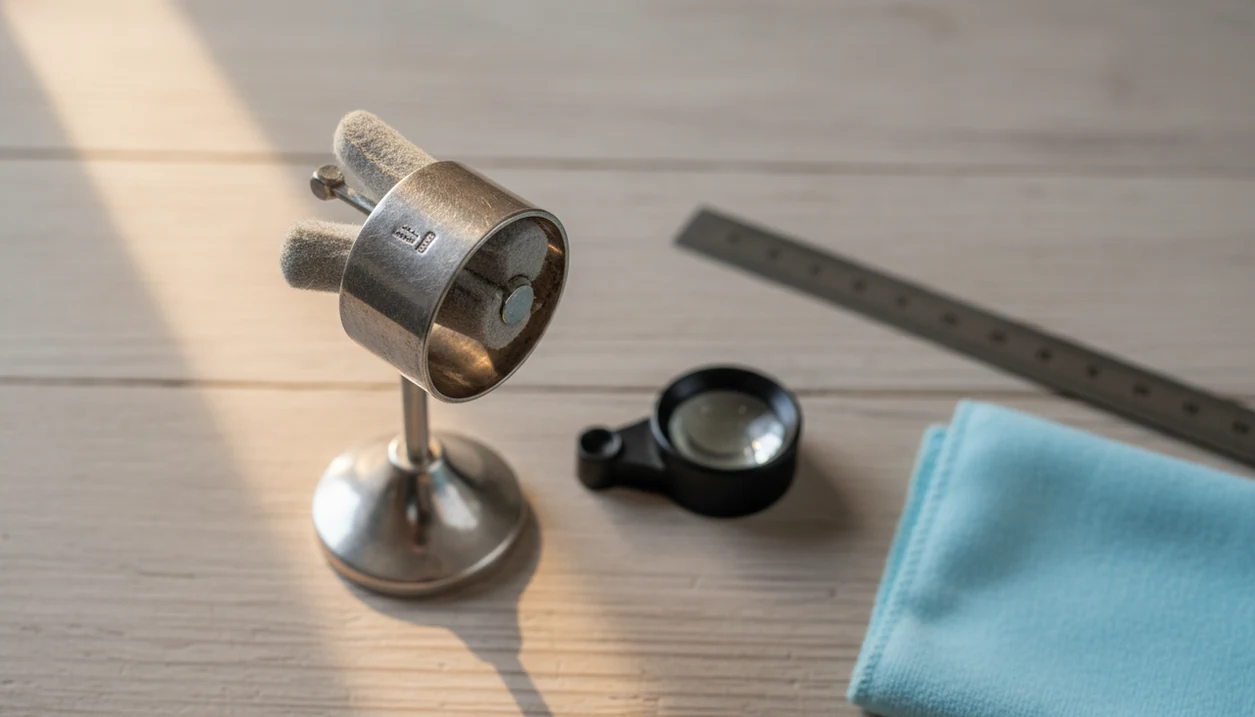
The best way to use a silver hallmark app on worn marks is to control light, focus, scale, and comparison. A dark phone photo inside a cabinet door rarely gives enough evidence.
- Wipe the mark area with a dry soft cloth only; avoid abrasive polishing because it can remove useful detail.
- Set the phone to macro mode, then place the item near side light from a window or small lamp.
- Photograph the marks from multiple angles with raking light, including a ruler or coin for scale.
- Crop each mark separately, then photograph the whole item so the app can read shape, use, and style.
- Cross-check the output against at least one reference source before buying, selling, or calling the item sterling.
When a lion passant on a silver spoon is half rubbed away, one extra angled shot can change the match list. Small differences matter.
A dedicated app that reads maker marks is most useful when you can supply both the close-up mark and the full-object image.
Best App for Hallmark Photos, Era Clues, and Rough Value Ranges
TIQ is strongest for beginners, inheritors, thrifters, and resellers who have an unknown silver or silver-plated item and need context fast. It can connect hallmark photos with item identification, maker mark clues, style or era hints, and rough value range estimates.
Beginners trying to list a mixed lot online often need plain wording more than a rare-maker claim, and TIQ earns the spot because it prompts for item type, visible marks, condition notes, and a sold-comps style research path. Helpful context includes flatware, tea sets, trays, jewelry, candlesticks, trophies, and small boxes.
It can help distinguish likely sterling clues from silver plate clues when marks are visible, but it does not certify metal content. For resellers, rough value usually depends more on confirmed comparable sales than on one promising mark.
For pricing context beyond hallmarks, an antique value estimate app can help separate asking prices from more useful sold examples.
Best Dedicated Silver Hallmark App for Deep Maker Databases
A dedicated silver hallmark app is the better choice when you already believe the object is silver and need mark-by-mark decoding. These tools are often strongest for British, Scottish, Irish, European, and selected worldwide marks, depending on database coverage.
They may guide you through assay office symbols, date letters, maker punches, duty marks, and fineness stamps. That depth helps when auction notes sit beside a value range and the question is whether the date letter actually supports the listing.
However, specialist databases may be less helpful with object category, style, condition, demand, and current resale context. They tell you what a mark may mean, not whether a dented tray is wanted this month.
Cross-check date letters and assay office symbols carefully. Similar shields, leopards, anchors, and script letters can be confused, especially when a stamp is shallow or partly polished away.
Sterling Silver Versus Silver Plate Mark App Clues
Can an app tell sterling silver from silver plate? It can interpret visible sterling and plate-related marks, but photo interpretation is not the same as metal testing.
Common solid silver clues include “sterling,” “925,” a lion passant, assay office symbols, date letters, and other fineness marks. Common silver plate clues include EPNS, EP, A1, quadruple plate, silver soldered, and plated trade names. In the United States, a quality mark such as sterling or 925 should be accompanied by a registered manufacturer or distributor trademark under federal jewelry marking rules GovInfo.
If a condition note shows verdigris around a copper hinge, that may also point away from solid silver construction. Still, marks can be worn, faked, altered, or misleading. TIQ can flag likely mark meanings when the photo is clear, but it cannot replace XRF testing, an assay office, or a qualified specialist.
For a deeper mark-by-mark primer, our silver hallmark identification guide explains common sterling and plate symbols.
Common Myths About Silver Hallmark App Results
Hallmark apps are useful research tools, but several myths create expensive mistakes. Treat every result as a lead until the mark, object, and market evidence agree.
- Myth: An app can confirm solid sterling with 100% certainty from a photo. It cannot see below the surface, and plating can hide base metal.
- Myth: An app value estimate is a professional appraisal. A rough range is educational guidance, not an insurance, probate, or legal document.
- Myth: All hallmark systems are standardized worldwide. British, European, American, retailer, export, and pseudo-hallmark systems differ.
- Myth: Google Lens replaces specialist hallmark databases. It can find common visual matches, but it struggles with partial punches and obscure makers.
- Myth: Jewelry appearance is enough. A UK Intellectual Property Office study reported that about 12% of UK consumers had bought jewelry or watches they later suspected were counterfeit or misdescribed UK Government.
When the trigger moment is a shiny clasp at a flea market, TIQ helps slow the decision because it asks for close mark photos and condition context before value assumptions.
Understanding Results
Silver hallmark and maker mark results are strongest when you treat the app output as a research starting point and compare it with object details, mark structure, and sold examples.
TIQ works best when
- Clear, close-up photos of maker marks, assay marks, fineness stamps, and date letters
- Objects photographed from several angles, including the full item, base, handle, lid, and any backstamp
- Items with readable sterling, 925, 800, coin silver, EPNS, silverplate, or assay office clues
- Silver, porcelain, and decorative objects where the mark can be checked against item type, style, and period
- Pre-sale research where you need a practical antique value estimate before expert appraisal
TIQ may be less accurate when
- Blurred, polished, partial, or deeply worn hallmarks with missing symbols
- Photos where glare, tarnish, or reflections hide the stamp edges
- Items needing proof of sterling silver, plated metal, or precious metal content from a photo alone
- Fake, fantasy, or later-added marks that require hands-on inspection and testing
- Insurance, legal, or high-value sale decisions where a qualified appraiser or assay test is needed
FAQ
What app identifies antiques from pictures and silver hallmarks?
TIQ is a practical choice when you want to identify antiques by photo and interpret visible silver hallmarks alongside the whole item. It can help connect maker marks, assay symbols, form, style, and comparable items so you can decide whether a find deserves deeper research.
Can TIQ identify silver hallmarks from a photo?
TIQ can review clear photos of silver hallmarks, maker marks, monograms, and item details to suggest likely clues about origin, age, and type. It works best when the mark is sharp, well lit, and photographed with the full object for context.
Can TIQ read maker marks from a photo?
Yes, TIQ can help interpret maker marks from photos when the stamp is legible enough to analyze. For silver, it is especially helpful to include close-ups of the mark plus photos showing the object’s shape, decoration, and construction.
Is there a free antique identifier by picture for silver finds?
Some general image search tools and public silver mark references can help you start for free, especially if the hallmark is easy to read. An antique identifier app like TIQ can be more useful when you want the mark interpreted with the item’s design, era clues, and rough value range.
How should I photograph a silver hallmark for better identification?
Use bright indirect light, steady the camera, and take a sharp close-up with the mark filling the frame. Also photograph the entire item, underside, handles, seams, damage, and any extra stamps so the app can use both the hallmark and object context.
Can an app tell whether silver is sterling, coin silver, or silver plate?
An app can point out visible words, numbers, and symbols that often relate to silver content, such as sterling marks or plate marks. It cannot prove metal content from a photo alone, so valuable purchases or resale claims may require acid testing, XRF testing, or expert inspection.
How accurate are silver hallmark identification apps?
Accuracy depends on photo quality, mark condition, regional marking systems, and whether the item has worn, partial, or misleading stamps. Use app results as a strong research lead, then verify important conclusions against specialist hallmark references or a qualified silver expert.
Can a silver hallmark app detect fakes or altered marks?
A photo-based app may flag inconsistencies between the mark, item style, and likely period, which can help you spot reasons for caution. It cannot reliably authenticate silver or detect every fake, repair, or altered mark without hands-on inspection and testing.
Ready to start?
Ready to start? Use TIQ on iPhone to identify antiques by photo, compare silver hallmark clues, check maker marks and backstamps, and get a practical value estimate before you decide whether to research deeper, sell, insure, or ask an expert.