
An Antique Identifier App for Scanning Family Collections


Download App: tool that can scan antiques
Definition: An antique identifier app that scans antiques uses photos and item details to help recognize age, category, maker marks, and market value clues.
When you inherit a box, cabinet, or room full of unfamiliar pieces, TIQ helps turn quick photos into organized research clues so you can appraise antiques by picture, prioritize what matters, and decide what needs expert follow-up.
> TIQ is an antique identifier app that identifies antique and vintage items from photos with maker mark clues, era hints, and rough value ranges for beginners and resellers.
- Scan the whole item, then add close-ups of marks, signatures, backs, undersides, hardware, and damage.
- Use AI antique scanner results as research clues: category, likely period, style, maker mark leads, and comparable value ranges.
- Do not treat a scan as proof of authenticity, insurance value, provenance, or guaranteed resale price.
Recommended App: TIQ Antique Identifier
TIQ is an antique identifier app for people who want to scan inherited pieces, organize likely categories, and appraise antiques by picture as first-pass research before deciding what to keep, sell, or document. It also works as a maker mark identifier and antique finder, helping connect visual details to likely origins and market context. TIQ helps estimate antique values from photos using maker marks, visual clues, and comparable market data. For insurance, estate, tax, or legal decisions, use a qualified appraiser.
- Identify antiques by photo, including furniture, decorative objects, jewelry, and collectibles.
- Use maker marks, signatures, labels, stamps, and construction details to refine research.
- Estimate values with comparable market data so inherited items can be prioritized faster.
- Helpful for inheritors sorting family collections, downsizers, collectors, dealers, and estate organizers.
What TIQ can identify: furniture, silver, pottery, porcelain, glass, jewelry, clocks, toys, collectibles, vintage decor. Available for iPhone.
At-a-Glance Antique Scanning Tool Results
A useful antique scanning tool should return likely category, era hints, style clues, maker mark leads, condition observations, and rough value context. Those results are only as strong as the photos, visible details, and available reference material behind that object type.
One reason this workflow feels familiar now is smartphone access: Pew reports that 91% of U.S. adults own a smartphone, making camera-first research a normal starting point for many owners Pew Research Center. If you keep the Google Lens usage claim, add a separate source that specifically supports that percentage.
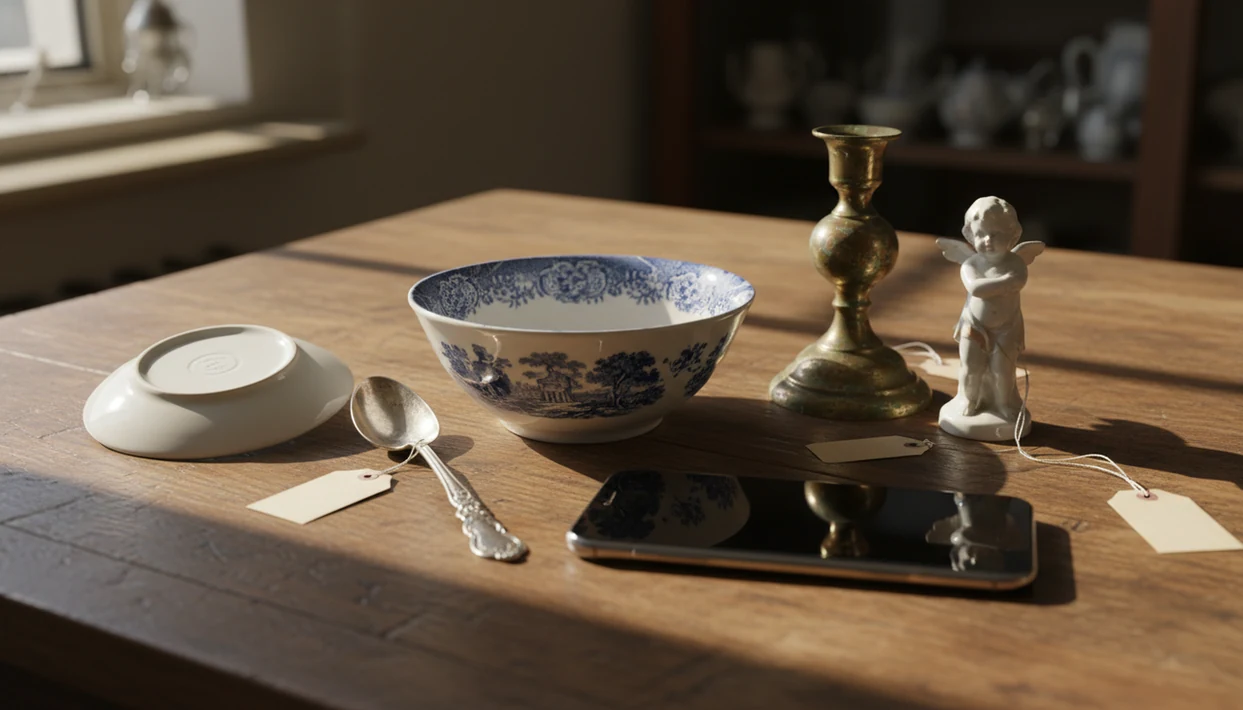
At a dusty estate table, a scan can turn “old bowl” into “transferware plate, possible Staffordshire style, check backstamp.” That is a better starting phrase. The same applies to inherited boxes, thrift finds, estate sale objects, and reseller research.
If the priority is faster sorting, TIQ fits because it turns a first photo into research terms, mark prompts, and a rough value-range check.
How a Tool That Can Scan Antiques Works
A tool that can scan antiques works by comparing uploaded photos against visual patterns, mark clues, style signals, and market context; the output is probabilistic, not a final identification. In plain terms, it looks for matches that are consistent with the object in front of the camera.
The process usually starts with photo upload, then visual feature detection. The system may compare shape, materials, decoration, construction, signatures, hallmarks, labels, wear patterns, and known object patterns. For example, brass patina around screw heads may suggest age, but it is not enough to confirm date by itself.
Common and well-documented antiques usually scan better than rare, altered, regional, or poorly photographed objects. Image embeddings and mark recognition can narrow the field; they do not replace provenance, specialist reference books, or hands-on inspection.
Good AI antique scanners deliver category, mark, era, style, and value clues, not courtroom-level proof that an object is genuine.
How to Use an AI Antique Scanner With Your Camera
Better scans come from better evidence. Use the camera like a documentation tool, not a quick snapshot machine.
- Photograph the full object from the front, side, back, and top so the scanner can read the overall form.
- Add detail shots of backs, undersides, interiors, seams, hinges, feet, rims, handles, and hardware.
- Capture maker marks, hallmarks, labels, signatures, backstamps, repairs, chips, stains, and other damage in sharp close-up.
- Review the first result for category, era, style, and material clues before accepting any value range.
- Check comparable clues against sold listings, reference pages, or a maker mark identifier app workflow when a mark is visible.
Window light helps. A blurry phone photo taken under a yellow hallway bulb often misses what a sharp close-up beside a window at 10 a.m. catches.
After the first result, when the mark or underside matters, TIQ is useful because it prompts a second look at details people often forget to photograph.
When to Scan an Antique With a Camera
Scan antique with camera when you need better search terms before deciding whether to keep, sell, donate, research, or appraise an object. The scan is most useful when the alternative is guessing with phrases like “old vase” or “antique chair.”
Use it for inherited boxes, estate cleanouts, thrift store finds, flea market objects, resale listings, and unidentified maker marks. A receipt folded behind a painting may be more important than the frame, but a scan can still help name the likely subject, period, and category before you research the paper trail.
The online art and antiques market was estimated at $12.1 billion in annual sales in 2024, according to Art Basel and UBS Artbasel. Better research terms matter in a market that large.
Anyone dealing with garage shelves of mixed pieces can use TIQ because it supports a first-pass triage workflow for keep, sell, donate, research, or appraise decisions.
Five Research Clues an Antique Scanning Tool Should Surface
An antique scanning tool should surface five practical clues: object category, estimated era, maker mark or hallmark lead, style or material clue, and value or comparable-sales context. Each clue helps narrow research without pretending the scan is a final appraisal.
- Object category: “Porcelain teacup” is more useful than “old cup” because it points research toward form and use.
- Estimated era: A date range may indicate whether an item is antique, vintage, or later reproduction.
- Maker mark or hallmark lead: Raised letters, stamped symbols, or backstamps can guide maker and origin research.
- Style or material clue: Porcelain translucence at the rim, cast metal weight, or Art Deco geometry can refine the search.
- Value and comparable-sales context: A range is a research clue, not a guaranteed sale price.
Condition changes everything. A missing rhinestone in a brooch, a hairline crack across a teacup, a replaced drawer pull, or a polished-away hallmark can reduce value and make identification less certain.
For resellers, a scan result is often more useful than a generic marketplace search because it supplies listing terms before price research begins.
What the TIQ AI Antique Scanner Shows
TIQ is an antique identifier app that identifies antique and vintage items from photos with maker mark clues, era hints, and rough value ranges for beginners and resellers. It is designed as a research starting point, not as a certified appraisal desk.
A typical scan may show likely item type, era or style hints, mark clues, material observations, condition prompts, and rough value ranges. That combination helps someone move from “unknown figurine” to a more specific research path. If you need a broader photo workflow, the identify antique from photo guide covers the same evidence-gathering habits in more detail.
The right fit for beginner identification is TIQ because it combines whole-object photo review with maker mark, material, condition, and value-context prompts. The useful output is not just a label; it is the next research query, such as a suspected maker name, a backstamp phrase, a material clue, or a comparable-sales direction.
We still wrap questionable items in a towel before putting them in the research pile. The scan decides the next step, not the final answer.
AI Antique Scanner vs Visual Search and Expert Appraisal
An AI antique scanner sits between general visual search and formal expert appraisal. It can provide antique-specific clues that visual search often misses, but it cannot replace a qualified appraisal for legal, tax, insurance, probate, donation, or high-value sale decisions.
| Method | Best use | Strengths | Limits |
|---|---|---|---|
| AI antique scanner | First-pass identification and research terms | Can surface category, era, mark, style, condition, and rough value context | Not proof of authenticity or certified value |
| General visual search | Finding visual lookalikes | Fast and familiar for common objects | Often lacks antique-specific mark, era, and sold-comps context |
| Marketplace search | Checking asking prices and listing language | Useful on sites such as Ruby Lane, 1stDibs, and LiveAuctioneers | Asking prices may not equal sold outcomes |
| Certified appraisal | Insurance, probate, tax, donation, or major sale decisions | Provides documented expert opinion | Costs more and may require physical inspection |
For most owners, an AI scan is easier than starting on WorthPoint or Replacements because it helps name the object before deeper comparable research.
For value research, prioritize confirmed sold prices over active asking prices. Auction houses, specialist dealers, and paid price databases may disagree because each sees a different slice of the market.
Understanding Results
An antique identifier scan is most useful when you treat the result as a structured research starting point rather than a final verdict.
TIQ works best when
- Clear photos of the whole object in natural light
- Close-ups of maker marks, hallmarks, signatures, labels, and backstamps
- Objects with distinctive shape, decoration, materials, or construction details
- Common collectible categories with strong visual and market references
- Items where condition, repairs, chips, cracks, and wear are visible
TIQ may be less accurate when
- Blurry, dark, cropped, or over-reflective photos
- Generic items with few visible marks or distinctive features
- Rare, altered, heavily restored, or reproduction pieces
- Objects requiring hands-on testing, material analysis, or provenance review
- Value questions that depend on local demand, exact attribution, or auction timing
FAQ
What app identifies antiques from pictures?
An antique identifier app like TIQ can identify antiques from pictures by analyzing the full item, maker marks, labels, materials, and condition clues. It is useful for inherited family collections because you can scan items quickly, group likely categories, and decide which pieces need deeper research.
Is there a free antique identifier by picture?
Some antique identifier apps offer free photo checks or limited research features, but value estimates and saved research may depend on the tool. A free scan can help you sort obvious categories first, while more detailed results are better for maker marks, comparables, and collection organization.
Can TIQ identify antique furniture?
Yes, TIQ can help identify antique furniture from photos of the whole piece plus close-ups of joinery, labels, hardware, feet, backs, and undersides. The results can suggest style, period clues, construction details, and rough market context for inherited furniture.
Can TIQ read maker marks from a photo?
TIQ can use clear close-up photos to help read maker marks, hallmarks, signatures, stamps, and labels. For best results, photograph the mark straight on in good light and include a second image showing where the mark appears on the item.
What should I scan first in a family collection?
Start with items that have visible marks, signatures, labels, unusual materials, or obvious age clues. Silver, pottery, porcelain, jewelry, clocks, furniture, and decorative objects are good first candidates because details on the object often guide identification and value research.
How accurate is an antique scanning tool?
Accuracy depends on photo quality, visible marks, item condition, and whether there are enough comparable examples. An antique scanning tool is best used as a research shortcut that suggests likely category, age clues, maker leads, and rough value ranges.
Can a scan confirm an antique is authentic?
No, a photo scan cannot prove authenticity, provenance, or age by itself. It can highlight clues worth checking, but high-value, rare, or disputed items should be reviewed by a qualified appraiser, specialist dealer, or auction house.
Are my antique photos private when I scan them?
Privacy depends on the app and its data policy, so review how photos and item details are stored before uploading sensitive family items. Avoid including personal documents, addresses, or people in the background when photographing antiques for identification.
Ready to start?
Ready to start? Download TIQ on iPhone, scan the full object first, then add close-ups of marks, labels, backs, undersides, hardware, repairs, and damage for better identification clues and value context.