
How to Read Antique Identifier Confidence Scores


Download App: confidence scores antique apps
Quick answer: confidence scores antique apps show uncertainty, not truth: they tell you how closely your photo matches the app’s known images, marks, shapes, and style patterns. A high score is a useful lead, but poor photos, rare objects, restored pieces, and lookalike matches can still make the result wrong.
Definition: Antique identifier confidence scores are app-generated match signals that indicate how closely a photo result fits known objects, maker marks, styles, and market records.
TL;DR
- A 90% or 95% confidence score is not a certified authentication, appraisal, or guarantee.
- Low confidence usually means weak evidence, unclear photos, conflicting style clues, or limited database coverage, not that the item is fake or worthless.
- The best way to improve antique app confidence is to rescan with clear photos of the whole object, maker marks, construction details, damage, scale, and any signatures or hallmarks.
Scope note: This guide explains how to interpret identification confidence, not how to certify authenticity, set an insurance value, or make tax, estate, or legal decisions. For expensive, disputed, inherited, or insured items, use app confidence only as a research starting point before consulting a qualified appraiser or category specialist.
Recommended App: TIQ Antique Identifier
Confidence scores help resellers decide which antique identifier results are strong enough to research further before pricing a listing. Use them to appraise antiques by picture more efficiently, then verify important details with better photos, maker marks, and comparable sales.
- Identify antiques by photo and rescan from different angles when confidence scores are mixed.
- Check maker marks, signatures, backstamps, labels, and hallmarks against visual matches.
- Estimate values with comparable market data before pricing reseller listings for sale.
- Use TIQ as an antique finder to connect similar objects, categories, and style clues.
- Helpful for resellers, collectors, inheritors, thrifters, and vintage dealers doing first-pass research.
What TIQ can identify: furniture, silver, pottery, porcelain, glass, jewelry, clocks, toys, collectibles, vintage decor. Available for iPhone.
What Confidence Scores Antique Apps Actually Mean
An antique app confidence score is a match-strength signal, not a factual ruling about an object. It reflects how closely the scan resembles patterns the system has learned from images, maker marks, backstamps, silhouettes, materials, and style labels.
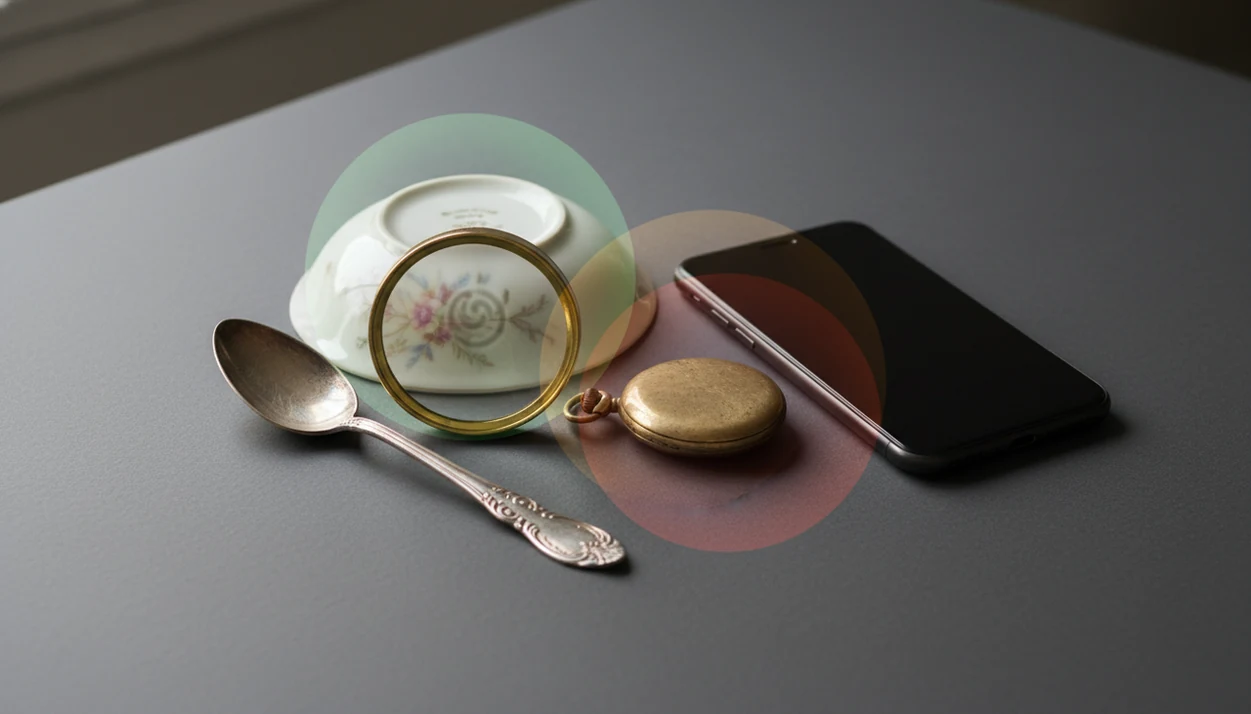
A 92% match may mean the photo looks very similar to known examples. Medium confidence may mean the app sees the right form but uncertain decoration. A low confidence antique scan often means the evidence is thin. We see this when a saucer is turned over at a kitchen table and the backstamp is half lost in ceiling glare.
The score does not authenticate age, prove provenance, assign an appraisal, or confirm market value. For disputed age claims, the separate question of why an antique identifier confidence score is not authentication needs stronger evidence than a percentage.
Five Facts About Antique App Confidence Scores
- A high antique app confidence score can still be wrong when two makers used similar shapes, decals, mounts, or case designs.
- Low or medium confidence often reflects unclear photos, missing maker marks, odd angles, glare, or conflicting design cues.
- Identification confidence and value estimate confidence are separate; knowing “what it resembles” is not the same as knowing “what it will sell for.”
- Apps tend to perform better on common, well-documented categories such as popular porcelain marks, standard hallmarks, and widely traded furniture styles.
- Multiple photos and outside cross-checking make results more useful, especially when you compare sold listings rather than asking prices.
Good AI antique and vintage item identifier apps with maker marks, era/style guides, and value range estimates deliver research leads, not certified authentication or guaranteed appraisal conclusions.
A screenshot is not provenance.
How Antique App Confidence Scores Work Behind The Scan
Antique app confidence scores work by comparing photo features against labeled examples and reference patterns. The system may read silhouette, decoration, material cues, maker marks, hallmarks, labels, joinery, screws, bases, backs, and broad style-period clues.
Behind the scan, computer vision models create image embeddings. In plain terms, the app turns visual features into comparable data points, then looks for nearby examples. A mantel clock beside funeral cards may give useful scale and context, but the scan still needs clear images of the dial, case, works, and maker label.
General computer-vision benchmarks can perform strongly on clean, labeled datasets, but antique scans are harder because objects are restored, regional, damaged, and unevenly photographed; if benchmark accuracy is mentioned, cite the benchmark directly, such as ImageNet/ILSVRC: ImageNet. Antique objects are messier. Restorations, regional makers, and poor photos reduce the strength of the comparison. For a broader reliability discussion, are antique identifier apps accurate covers the issue category by category.
High, Medium, And Low Confidence Antique Scan Readings
Score ranges vary by app, so 90% in one tool is not automatically equal to 90% in another. Treat the label as a practical instruction for your next step.
| Reading | What it usually means | Practical action |
|---|---|---|
| High confidence | Strong visual or mark similarity to known examples | Use it as a research lead, then verify marks, age clues, and sold comps. |
| Medium confidence | Some clues match, but others are weak or mixed | Compare several possible makers, styles, or periods before listing. |
| Low confidence | The scan lacks enough usable evidence | Reshoot the item, add marks, and broaden the query. |
Overconfident AI can report numbers that sound firmer than they are. Calibration research has shown that modern neural networks can be overconfident, meaning a displayed probability may sound firmer than the model’s real-world accuracy supports; cite Guo et al., 2017: Mlr. That matters when a polished result says 90%, but the photo is still a cropped, shadowed side view.
How To Use Antique App Confidence Scores
Use antique app confidence scores as a triage tool: they tell you what to check next, not what to believe automatically. The label matters more than the raw percentage because each app may calculate and display certainty differently.
- Start with the label, such as high, medium, or low confidence, before reacting to the percentage. A “high” result is a strong lead; a “low” result is a prompt to gather better evidence.
- Check the main photo to make sure the whole object is visible, upright, well lit, and not cropped at the rim, feet, handle, frame, or back.
- Add close-ups of maker marks, hallmarks, signatures, labels, damage, scale, undersides, backs, joints, screws, seams, and construction details.
- Compare the result with sold listings, auction archives, mark guides, museum records, and reference books rather than relying on active asking prices.
- Escalate the item to a qualified appraiser, dealer, conservator, or category specialist when value, authenticity, inheritance, insurance, or a dispute is involved.
A useful scan is the beginning of a research trail, not the end of one.
Photo Quality, Maker Marks, And AI Identification Uncertainty
Why did the confidence score change after a new photo? Because lighting, blur, glare, crop, background clutter, scale, and angle can change the evidence the model sees.
A sharp close-up beside a window at 10 a.m. usually gives better evidence than a blurry phone photo taken under a yellow bulb. Photograph the whole item first. Then add close-ups of maker marks, hallmarks, signatures, patent numbers, labels, damage, construction details, joins, screws, backs, bases, and undersides.
Small clues matter. Porcelain translucence at the rim may support one material guess. Faint impressed pottery numbers can shift a result from “decorative vase” toward a researchable maker or factory. Smithsonian work on collection images has also emphasized that standardized photography improves the usefulness of computer-vision analysis.
For privacy-sensitive items, use safe upload antique photos before including address labels, family papers, or documents in the frame.
Sources Behind This Confidence Score Guidance
This guidance is based on general AI reliability research, computer-vision benchmark context, and museum-style object photography practice. It does not claim that published AI benchmarks prove antique-specific accuracy.
Use the evidence in layers:
- Treat AI confidence as a probability-style signal with limits; calibration research shows that neural networks can sound more certain than their real-world accuracy supports, especially outside clean test settings.
- Read computer-vision benchmarks as background only. Datasets such as ImageNet/ILSVRC help explain why labeled image matching can work, but they are not antique appraisal tests.
- Photograph objects consistently, following the same logic used in museum and digitization workflows: whole object, stable lighting, clear scale, and separate detail shots for marks or damage.
- Separate cited evidence from TIQ product guidance. The sources support cautious interpretation of AI and photos; the app advice explains how to make a scan more useful.
- Assume some evidence is general rather than antique-specific. Overconfidence, image quality, and benchmark limits apply broadly, while maker, age, condition, provenance, and value still need category expertise.
Common Myths About Low Confidence Antique App Results
Myth 1: A 95% score must be correct. A high score means the app found strong similarity, but lookalikes and copied designs can still mislead the model.
Myth 2: Low confidence means fake, worthless, or modern. Low confidence usually means uncertain evidence. A rare regional object may scan poorly because the database has few comparable images.
Myth 3: One score covers maker, age, condition, value, and authenticity. Most simplified labels blend several signals. A scan may identify a pattern while missing a repair, replacement part, or later mark.
Myth 4: An app replaces a professional appraiser or specialist dealer. It doesn't. High-value items still need human review, especially when insurance, tax, estate, or auction decisions are involved.
A price tag dangling from a vase handle tells you nothing by itself. The scan, mark, condition, and sold-comps range all need to line up.
When To Trust Antique App Confidence And When To Check Again
Trust an antique app confidence result more when the item is common, well photographed, clearly marked, and consistent across several clues. A legible backstamp, matching shape, correct decoration, and similar sold listing together make a stronger first-pass identification.
Check again when the item is rare, high-value, damaged, restored, handmade, regional, or internally contradictory. A silver mark that suggests one country and a style that suggests another should go into the research pile. Wrap the questionable item in a towel before moving it, then document it properly.
Compare multiple sources: eBay sold listings, LiveAuctioneers archives, WorthPoint records, Google Lens lookalikes, museum collection databases, mark guides, auction catalogs, and specialist opinions. Tools like TIQ can offer photo-based identification, maker mark clues, era hints, and rough value ranges, but not certified appraisals. If family history matters, learn how to document antique provenance before details get separated.
When To Ask A Qualified Appraiser
Ask a qualified appraiser when the result could affect money, ownership, insurance, taxes, donation paperwork, an estate, or a legal decision. An app confidence score is a lead, not a certificate, and it should not be the only reason you sell, insure, donate, or divide an object.
Specialist review also matters when the piece is rare, heavily damaged, restored, altered, disputed by family members, or outside the app’s strongest categories. A repaired chair leg, replaced clock movement, overpainted signature, or suspicious hallmark can change the conclusion even when the scan sounds confident.
- Gather clear photos of the whole object, close-up marks, backs, bases, undersides, damage, repairs, and scale.
- Record measurements in a simple note, including height, width, depth, weight, and any material clues you can observe safely.
- Bring provenance details such as family notes, receipts, auction records, old appraisals, labels, and prior research.
- Ask for the right specialist rather than a general opinion when the object is jewelry, silver, fine art, coins, textiles, or regional furniture.
- Wait before selling if one high-confidence app result is the only evidence you have.
Understanding Results
Antique identifier confidence scores are most useful when you treat them as match-strength signals and review the evidence behind the result.
TIQ works best when
- Clear photos of the full object from multiple angles
- Readable maker marks, backstamps, hallmarks, signatures, or labels
- Common categories with many visual comparables, such as ceramics, glass, silverplate, clocks, toys, and furniture styles
- Items with distinctive shapes, decoration, materials, or construction details
- Rescans that include scale, condition issues, repairs, and close-up details
TIQ may be less accurate when
- Blurry, dark, cropped, or glare-heavy photos
- Rare, regional, handmade, heavily restored, or altered objects
- Lookalike designs shared by several makers or later reproductions
- Items missing maker marks, labels, provenance, or construction evidence
- Questions that require legal, insurance, tax, estate, or certified appraisal decisions
FAQ
What app identifies antiques from pictures and explains confidence scores?
An antique identifier app should do more than name a likely match; it should show visual clues, maker marks, category hints, and value context so you can judge the result. TIQ is a practical choice for resellers because it helps connect photos, marks, and comparable market data before you price a listing.
Is there a free antique identifier by picture for checking confidence?
Some antique identifier tools offer free scans or limited photo checks, which can be useful for quick sorting. For resale decisions, compare the confidence result with maker marks, condition, scale, and sold comps before relying on it.
How should resellers use antique identifier confidence scores before pricing?
Use the score as a triage signal: high confidence may justify deeper comp research, while low confidence means you should rescan and verify more details. Resellers should confirm category, maker, age clues, condition, and recent sold prices before setting a listing price.
Can TIQ read maker marks from a photo to improve confidence?
TIQ can use clear photos of maker marks, hallmarks, signatures, labels, and backstamps as part of its identification process. A readable mark can strengthen the result, but it should still be checked against the object’s style, materials, age, and comparable examples.
How accurate are antique app confidence scores?
Confidence scores are useful research signals, not proof of identity or value. Accuracy depends on photo quality, database coverage, object rarity, condition, restorations, and whether the item has strong identifying details like marks or distinctive construction.
Can confidence scores help spot reproductions or fakes?
They can flag mismatched clues or weak visual evidence, which may prompt closer inspection. A score alone cannot confirm a reproduction or fake, so valuable or disputed items should be reviewed by a qualified specialist.
Are my antique photos private when using an identifier app?
Check the app’s privacy policy before uploading photos, especially if the item is valuable, inherited, or tied to personal records. Avoid including addresses, documents, or people in the frame when you only need object details for identification.
Ready to start?
Ready to start? Use TIQ on iPhone to scan clear photos, compare likely matches, review confidence signals, and save your antique value estimate as a research starting point.