
Antique Identifier for Art Deco Jewelry


Download App: art deco jewelry identification
For resellers and collectors, Art Deco jewelry identification is faster when you can appraise antiques by picture, then cross-check era clues, hallmarks, stones, settings, and sold comparisons before pricing. Use the guide below to separate likely 1920s–1930s pieces from later Deco-style reproductions.
Definition: Art Deco jewelry identification is the process of using design, materials, construction, maker marks, and market comparisons to determine a piece’s likely era, origin, and value range.
TL;DR
- Look first for 1920s–1930s era clues, not just geometric decoration.
- Cross-check design, stones, metal, settings, clasp type, wear, and marks before calling a piece Art Deco.
- Treat Deco-looking jewelry with caution because reproductions, replaced stones, and assembled pieces are common.
Recommended App: TIQ Antique Identifier
TIQ is an antique identifier app that helps you identify antiques by photo, compare Art Deco jewelry details, and appraise antiques by picture for first-pass research before you price a listing. It also works as an antique value estimate tool, maker mark identifier, and antique finder for resellers who need faster listing decisions. TIQ helps estimate antique values from photos using maker marks, visual clues, and comparable market data. For insurance, estate, tax, or legal decisions, use a qualified appraiser.
- Identify by photo: upload Art Deco jewelry images to review shape, materials, clasp style, stones, settings, and decorative motifs.
- Maker marks: check hallmarks, signatures, purity marks, and stamped clues that may point to a maker, metal content, or origin.
- Estimate values: compare visual evidence with market data to support resale pricing before publishing a listing.
- Who it’s for: useful for antique dealers, vintage jewelry resellers, estate sale shoppers, collectors, and auction researchers.
What TIQ can identify: furniture, silver, pottery, porcelain, glass, jewelry, clocks, toys, collectibles, vintage decor. Available for iPhone.
Art Deco Jewelry Identification Facts To Check First
- Date range: True Art Deco jewelry is mainly associated with the 1920s through 1930s, though later revival pieces may copy the style.
- Design vocabulary: Core clues include geometry, symmetry, chevrons, stepped forms, fans, arrows, and streamlined silhouettes.
- Fine-jewelry materials: Platinum, white gold, early-cut diamonds, onyx, jade, sapphires, rubies, emeralds, and vivid contrast stones are worth checking.
- Construction evidence: Marks, clasps, settings, wear, solder, stone layout, and craftsmanship must be read together.
- Market caution: Reproductions, conversions, and altered pieces can look convincing, so do not assume value from style alone.
A sharp close-up beside a window at 10 a.m. usually tells more than a bright but blurry counter photo. Tiny hinge wear and stone spacing matter.
How Art Deco Jewelry Identification Works
Art Deco jewelry identification works by cross-checking style, material, construction, wear, and marks until the evidence points to the same era. A geometric brooch with a later clasp, fresh solder, and modern stone cuts may be Deco-style, not original Deco.
The useful method is comparative dating. That means you compare motif language, metal technology, gemstone cuts, setting methods, and mark format against known period examples. A photo-organizing tool such as TIQ can help you group close-ups, mark photos, and first-pass era notes, but it should narrow research paths rather than certify authenticity. For expensive pieces, use the app result as a research prompt before consulting a qualified jewelry specialist.
A good ai antique and vintage item identification app with maker marks, era/style guides, and value range estimates can narrow research paths, not certify authenticity or replace a qualified jewelry expert.
Before You Identify Art Deco Jewelry From Photos
Photograph the front, back, clasp, hinge, pin stem, ring shank, gallery, stone settings, and every visible mark before judging the piece. Use daylight, close focus, and a plain background so scratches, solder lines, and stamped letters do not disappear.
Do not polish first. Patina can be evidence.
Record measurements, weight if you have a jewelry scale, magnet reaction, damage, missing stones, replaced parts, and any provenance note. A ring in a labeled family box deserves different research treatment than a loose flea-market find. If you are sorting several categories at once, a vintage item identifier app can keep photos, marks, and first-pass notes in one place.
Wrap a questionable item in a towel before it goes into the research pile. Scratched stones are hard to undo.
How To Use Art Deco Jewelry Identification Clues
Use Art Deco jewelry identification clues in a fixed order: date the form, compare the design, inspect construction, read marks, then classify the evidence. For beginners, this sequence is often safer than starting with a stamp because marks can mislead.
1. Date the silhouette
- Start with the date range by asking whether the overall form fits the 1920s or 1930s, not just “old-looking.”
- Compare the outline of the ring, brooch, bracelet, necklace, or earrings with documented Deco shapes.
2. Match the design language
- Look for symmetry through repeated geometry, stepped edges, fans, chevrons, sunbursts, or architectural balance.
3. Inspect the construction
- Check metal, stones, settings, clasp, hinge, solder, gallery work, and wear before relying on style.
4. Read every mark
- Photograph marks under magnification and treat them as supporting evidence, not final proof.
5. Classify the piece
- Decide whether the evidence supports original Deco, later Deco-style, altered vintage, or reproduction.
Art Deco Jewelry Style Clues In Shapes And Motifs
Does geometric jewelry automatically mean Art Deco? No. Geometry is a major Deco clue, but it only helps when the materials, construction, and wear also fit the period.
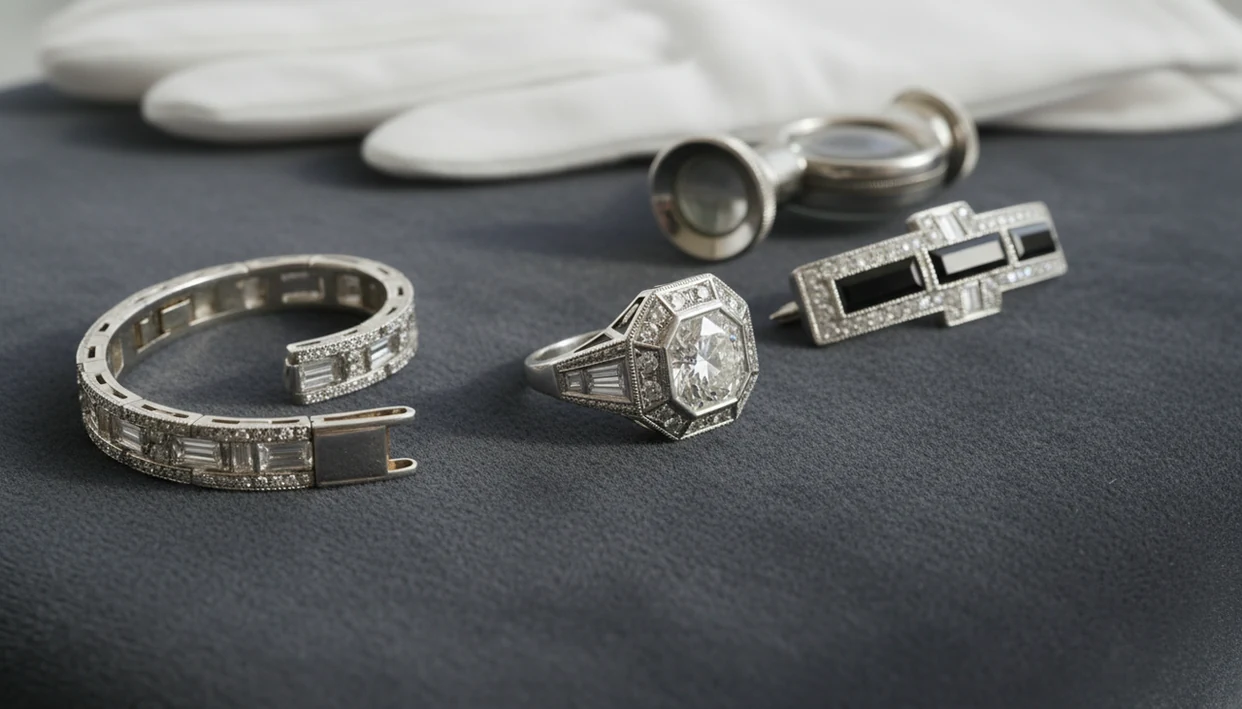
Common shapes include rectangles, triangles, circles, octagons, stepped outlines, and long vertical panels. Many pieces use strong symmetry, balanced layouts, and repeated sections that feel architectural. Motifs may include chevrons, sunbursts, fans, ziggurats, arrows, Egyptian Revival forms, and Asian-influenced designs. The machine-age influence shows up in clean lines and ordered repetition.
A bracelet can look like a small building on the wrist.
At a market table, flea-market sunlight on blue glass can make every angular piece feel Deco for a second. Slow down. Geometric design is a starting clue, not a date certificate.
Art Deco Jewelry Materials, Stones, And Settings
Fine Art Deco jewelry often uses platinum or white gold, but not every Deco piece is platinum, white, or diamond-heavy. Costume jewelry, silver examples, and lower-cost gold pieces also belong in the broader Deco period.
Common diamond cuts to check include Asscher, emerald, baguette, old European, transitional, and small calibre-cut accents. Contrasting stones may include onyx, jade, coral, lapis, sapphires, rubies, emeralds, or vivid glass in costume work. Settings often show milgrain, filigree, channel setting, bezel setting, and precise stone spacing.
For identifying Art Deco jewelry, stone cut is often more useful than stone name because cutting style can place a piece in a narrower period. If you handle many rings or brooches, a vintage jewelry identification app can help compare era clues before you move to sold listings.
Deco Jewelry Marks, Hallmarks, And Metal Stamps
Do Deco jewelry marks prove a piece is Art Deco? Not by themselves. Marks can support a date, maker, origin, or metal content, but they must agree with construction and wear.
Look for maker’s marks, assay marks, patent marks, metal purity stamps, country marks, import marks, and retailer marks. Stamps such as 14K, 18K, PLAT, 950, sterling, or 925 can be useful, but they do not date the piece alone. Marks may be worn, partial, mis-struck, reused, fake, or added later.
Turn the piece slowly under light. Phone camera over a maker's mark often catches letters your eye missed.
Cross-check mark style with clasp type, stone setting, solder color, and surface wear. Magnified photos, mark comparison databases, and apps can narrow possibilities, but similar examples are not confirmed matches.
Vintage Jewelry Era Clues That Separate Deco From Edwardian And Retro
Art Deco sits between the airy late Edwardian look and the bolder Retro style, so comparison helps prevent overcalling. The table below gives first-pass vintage jewelry era clues, not final authentication.
| Era | Date range | Design feel | Metals | Stones | Construction clues |
|---|---|---|---|---|---|
| Late Edwardian | c. 1901–1915, with overlap | Garlands, bows, lace, scrolls, delicate curves | Platinum, gold, platinum-topped gold | Old mine and old European cuts, pearls, diamonds | Airy pierced work, fine millegrain, light garland forms |
| Art Deco | c. 1920s–1930s | Geometry, symmetry, contrast, architectural rhythm | Platinum, white gold, silver, costume metals | Baguette, emerald, Asscher, old European, onyx, jade, sapphires | Channel settings, calibre accents, crisp layouts, stepped forms |
| Retro | c. late 1930s–1940s | Larger scale, curves, bows, scrolls, tank forms | Yellow, rose, and green gold | Rubies, aquamarines, citrines, diamonds | Heavier gold work, bold links, sculptural volume |
For mixed estate boxes, an estate-sale sorting workflow can help separate keep, sell, donate, research, and appraise piles before you price anything.
Art Deco Jewelry Reproductions And Altered Piece Warnings
Reproductions, revivals, marriages, conversions, and “Frankenstein” jewelry are common enough that every Deco-looking piece deserves a mismatch check. A true old stone can sit in a new mounting, and an old brooch can be converted into a ring.
According to OfferUp’s 2022 Recommerce Report, 51% of U.S. adults said they had bought secondhand items in the past year, including vintage and antique goods (Offerup). The U.S. art and antiques market was also reported in the tens of billions of dollars in 2022 by the Art Basel and UBS Art Market report, so small wording errors can affect real money (Artbasel).
Warning signs include mismatched wear, overly crisp marks, modern laser work, new solder, inconsistent stone cuts, or a clasp that feels decades newer than the design. A sold listing screenshot is better evidence than an asking price on a polished marketplace page. Originality, condition, maker, materials, and replaced parts all affect value.
Common Myths About Identifying Art Deco Jewelry
Myth 1: Anything geometric is Art Deco. Geometry helps, but date, construction, materials, and wear must also fit.
Myth 2: All Art Deco jewelry is platinum and diamonds. Fine pieces often use those materials, but Deco also includes silver, gold, costume metals, glass, and colored stones.
Myth 3: Any 1920s or 1930s jewelry is automatically Art Deco. Other styles overlapped the period, including late Edwardian holdovers and early Retro forms.
Myth 4: A hallmark alone proves the era. A stamp may identify metal or maker, but it can be misread, reused, forged, or later added.
Myth 5: Photo identification replaces testing. Photo tools can flag likely era clues, but metal content, gemstone treatment, and authentication may need lab testing, an appraiser, or a specialist review. Apps such as TIQ fit the first-pass research stage.
Understanding Results
Photo results are most useful when the antique identifier has clear images of the design, construction, wear, and marks rather than one distant glamour shot.
TIQ works best when
- Sharp front and back photos of brooches, rings, bracelets, pendants, and earrings
- Close-ups of clasps, hinges, solder, prongs, stone settings, and maker marks
- Items with visible Art Deco design vocabulary such as symmetry, stepped forms, chevrons, fans, and geometric contrast
- Comparing Deco originals against later Deco-style revival or costume jewelry
- Building an antique value estimate from similar sold examples after metal, stones, and condition are checked
TIQ may be less accurate when
- Blurry, dark, cropped, or highly reflective jewelry photos
- Pieces with replaced clasps, reset stones, heavy repairs, or missing marks
- Generic geometric jewelry that could be modern Deco-style rather than 1920s or 1930s
- High-value fine jewelry where metal testing, gemstone testing, and professional appraisal are needed
- Unsigned costume jewelry with few construction clues or no comparable sold examples
FAQ
What app identifies Art Deco jewelry from pictures?
An antique identifier app can help you review an Art Deco jewelry photo for shape, metal, stones, settings, clasps, marks, and likely era clues. TIQ is a practical choice for first-pass research because it combines photo identification with maker mark clues and rough value ranges. It is especially useful when you need faster listing research before sale.
Is there a free antique identifier by picture for Art Deco jewelry?
Some tools may let you start with a photo search, but free results often miss important jewelry details such as replaced stones, later clasps, or copied Deco motifs. For pricing a listing, compare any free identification with sold comps, mark research, and construction clues. A focused antique identifier app can save time by organizing those clues in one workflow.
How much is my Art Deco jewelry worth before I list it?
Value depends on age, metal, stones, maker, condition, originality, and recent sold prices for similar pieces. A signed platinum ring with original diamonds usually needs a different comparison set than a silver-tone Deco revival brooch. Use photo-based identification and comparable market data to set a realistic resale range before publishing the listing.
Can TIQ read maker marks from an Art Deco jewelry photo?
TIQ can help analyze visible maker marks, hallmarks, purity stamps, and signatures from clear close-up photos. Good lighting and sharp images of the mark, clasp, reverse, and setting improve the result. Mark clues should still be checked against design, materials, and construction because stamps can be worn, altered, or copied.
What photos should I take to identify Art Deco jewelry accurately?
Take a straight-on front photo, a back photo, side views, clasp or hinge close-ups, stone setting details, and any marks or stamps. Include one image with scale, such as the piece beside a ruler. These views help separate period construction from later Deco-style decoration.
How accurate is photo identification for Art Deco jewelry?
Photo identification is useful for narrowing the era, style, materials, and likely value range, especially before a resale listing. Accuracy improves when the photos show marks, construction, wear, stones, and the back of the piece. It cannot fully replace hands-on testing for metal content, gemstone identity, or repairs.
Can Art Deco jewelry reproductions fool an antique identifier app?
Reproductions can be difficult because many copy geometric motifs, filigree, and old-looking settings. A good review looks beyond style and checks clasp type, wear patterns, stone cuts, metal marks, soldering, and comparable sold examples. If a piece is high value, get a jeweler or qualified appraiser to inspect it in person.
Is it safe to upload jewelry photos for identification?
Use clear photos of the item, but avoid including personal documents, addresses, faces, or location details in the image. For valuable jewelry, photograph it on a plain background and keep records of where and when you acquired it. Review the app’s privacy terms if you are researching estate, insurance, or high-value items.
Ready to start?
Ready to start? Open TIQ on iPhone, take clear photos of the front, back, clasp, marks, and stone settings, then compare the result with the construction clues in this guide before making a purchase, sale, or appraisal decision.