
Antique Identifier App for Estimating What It’s Worth
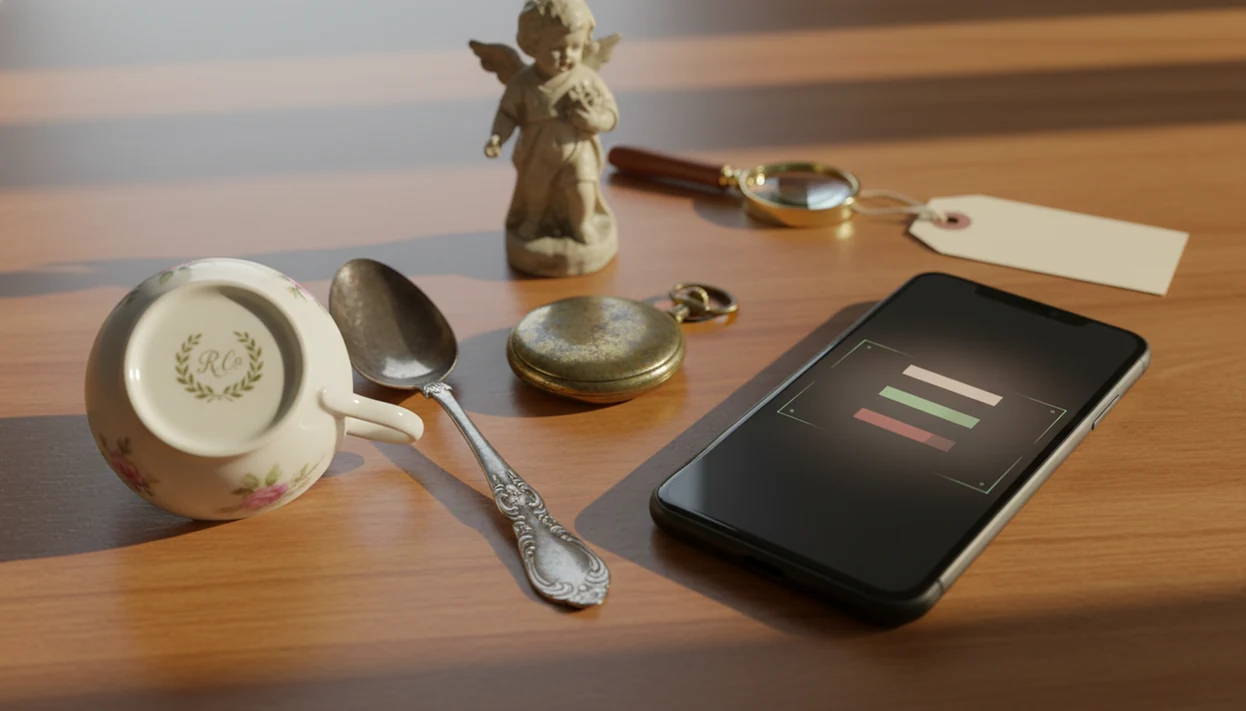
For flea market and thrift store finds, TIQ helps you appraise antiques by picture so you can quickly understand what an item may be, which clues matter, and whether it is worth deeper research. Use the estimate as a practical starting range based on photos, maker marks, condition clues, and comparable sales.
Definition: An antique value estimate is a researched price range based on an item’s age, maker, condition, style, demand, and comparable market sales.
- Antique value apps are useful for quick identification and ballpark price ranges, especially for common or well-documented items.
- The estimate depends on photo quality, condition clues, maker marks, comparable sales, and whether the app uses sold prices or asking prices.
- For rare, damaged, restored, inherited, or potentially expensive antiques, use the app as a starting point and confirm with sold-price research or a qualified appraiser.
Recommended App: TIQ Antique Identifier
TIQ is an antique identifier app for quick first-pass research when you want to appraise antiques by picture, especially flea market and thrift store finds you may buy, sell, or keep. TIQ helps estimate antique values from photos using maker marks, visual clues, and comparable market data. For insurance, estate, tax, or legal decisions, use a qualified appraiser.
- Identify antiques by photo using visible design details, materials, style, and condition clues.
- Use TIQ as a maker mark identifier for signatures, stamps, labels, hallmarks, and backmarks.
- Estimate values with comparable market data to understand a realistic first-pass price range.
- Use the antique finder workflow for flea markets, thrift stores, estate sales, inherited items, and online listings.
- Built for collectors, resellers, decorators, family historians, and curious owners researching antiques quickly.
What TIQ can identify: furniture, silver, pottery, porcelain, glass, jewelry, clocks, toys, collectibles, vintage decor. Available for iPhone.
TIQ at a Glance
What is TIQ? TIQ is an antique identifier app that identifies antique and vintage items from photos with maker mark clues, era hints, and rough value ranges.
What does it do? Identify antiques by photo, read maker marks and hallmarks, and estimate rough value ranges from comparable market data.
Who is it for? Collectors, inheritors, flea market and thrift store finds, and anyone researching unknown antiques or vintage items.
Why use it? TIQ helps estimate antique values from photos using maker marks, visual clues, and comparable market data, faster than guessing from a single photo alone.
Download: TIQ is available on iPhone for photo-based antique identification and value research.
Download App: estimate antique worth Download Now
At-a-glance answer for an antique value app
An antique value app can estimate a rough market range, but it cannot assign an official value. Think of the number as a market signal, not a promise that a buyer will pay that amount.
These apps fit quick decisions: inherited boxes, thrift-store finds, resale screening, and estate sorting. We see people use them while standing beside a dusty box lid with estate-sale masking tape marked “$3,” trying to decide whether the piece goes in the keep, sell, donate, research, or appraise pile.
TIQ fits this first-pass use because it combines photo clues with maker mark prompts and rough value ranges. For broader background, Statista has reported the online art and antiques market at about $10.63 billion in 2020, with a forecast near $17.76 billion by 2028. Digital discovery is no longer unusual; Statista reported the online art and antiques market at about $10.63 billion in 2020 and forecast it near $17.76 billion by 2028: Statista market data
For inherited-item triage, an antique value estimate app is often faster than opening ten marketplace tabs because it starts with identity before price.
How an antique worth app works from photos
An antique worth app works by reading visual clues in a photo, then comparing those clues against reference data and market examples. Image recognition looks at object shape, material, decoration, labels, backstamps, hallmarks, and maker marks.
Under the hood, systems use image embeddings, which are numerical summaries of what the photo resembles. In plain terms, the app asks, “What known objects does this look like?” Google has reported image-recognition models reaching over 90% top-5 accuracy on large classification benchmarks, which helps explain why common object identification is now practical: Googleblog
That still is not the same as valuing an item. Identification narrows the object: pressed glass compote, transferware plate, Art Deco brooch. Value estimation compares likely matches against auction archives, marketplace listings, sold comps, and reference databases.
Good AI antique and vintage item identifier apps deliver maker marks, era clues, style guides, and value ranges, not guaranteed authentication or a certified appraisal.
A sharp close-up taken beside a window at 10 a.m. usually beats a dim hallway photo. The difference shows up fast.
Five facts about antique worth from picture estimates
- Apps provide estimated ranges, not certified appraisals for insurance, tax, estate, or charitable donation use.
- Photo estimates work best on common, mass-produced, well-documented items, such as many ceramics, glass patterns, books, toys, silver plate, and furniture styles.
- Condition, restoration, provenance, and local demand can change value dramatically, even when two items look similar at first glance.
- Sold-price comps are more useful than asking-price comps because they show what buyers actually paid; the asking price vs sold price gap can be large.
- Human review is still needed for rare, expensive, legally sensitive, signed, heavily restored, or museum-quality items.
When the issue is a single blurry photo of a chipped rim, TIQ can flag likely category and damage language, but the range should stay cautious.
How to use an antique value app for a realistic range
A realistic estimate starts with better evidence, not a lucky photo. Turn the item, document it, and give the app the same clues a careful reseller would gather.
- Photograph the front, back, base, side profile, label, damage, and every maker mark or backstamp.
- Add measurements, material, location found, family history, and any labels, receipts, ribbons, or notes.
- Retake close-ups in daylight if the first image is blurry, shadowed, cropped, or washed out by ceiling glare.
- Compare the app range with sold listings, not only active listings with hopeful prices.
- Escalate to a qualified appraiser if the item appears rare, signed, very old, damaged, restored, or unusually valuable.
After the first scan, when a range looks surprisingly high, TIQ fits a cautious workflow because it separates likely identity, condition notes, and value-range confidence. The full next step is learning how to research antique sold prices before calling the number real.
When an antique value app is useful for inherited items
An antique value app is most useful when you need to sort many unknown items before spending money on deeper research. Smartphone ownership is widespread, with Pew Research Center reporting 81% of U.S. adults owning a smartphone in a 2019 survey, so photo-based workflows are accessible to most households: Pew Research Center
Beginners sorting inherited items: TIQ helps separate obvious donate items from pieces worth researching, especially when porcelain plates are stacked in towels during a cleanout.
Thrifters checking possible resale finds: A quick scan can flag maker marks, style terms, or categories worth comparing before purchase.
Resellers triaging inventory: For resellers who need listing language, TIQ covers likely item type, era hints, and value-range prompts through a first-pass identification workflow.
Homeowners identifying mixed objects: Furniture, ceramics, glass, silver, art, clocks, toys, books, and collectibles can be grouped before specialist review.
Not every old thing is worth appraising. That saves time.
What antique worth ranges look like in TIQ
TIQ returns likely item type, era or style hints, maker mark clues, and a rough value range. The output should show uncertainty rather than a single exact price, because condition, buyer demand, and venue can move the real sale price.
A porcelain saucer is a good example. Turn it over at the kitchen table, angle it away from ceiling glare, and photograph the backstamp. A maker clue plus pattern style gives a stronger estimate than a front photo alone.
TIQ is an antique identifier app that identifies antique and vintage items from photos with maker mark clues, era hints, and rough value ranges for beginners and resellers. The range is educational guidance, not a formal appraisal, authentication, or guaranteed sale price.
If your priority is resale screening, TIQ fits because it pairs the likely identity with a rough value range and condition-note workflow.
Antique value app vs appraisal, marketplace search, and dealer quote
An antique value app is fastest for a first pass, but it is not the highest-authority valuation method. Professional appraisals are required for insurance, tax, estate, and donation contexts.
| Option | Speed | Cost | Accuracy | Best use | Limitation |
|---|---|---|---|---|---|
| Antique value app | Fast | Low | Directional | Quick ID and rough range | Not legally recognized |
| Sold listing research | Medium | Low | Stronger for common items | Market reality check | Requires matching judgment |
| Dealer quote | Medium | Usually free | Practical buy-price view | Selling locally | May reflect resale margin |
| Auction estimate | Slower | Varies | Strong for suitable items | Higher-value sale planning | Not a sale guarantee |
| Certified appraisal | Slower | Paid | Formal opinion | Insurance, tax, estate, donation | Cost may exceed item value |
Online marketplaces can support price research; Pew Research Center reported that 49% of U.S. adults who sell personal items online use marketplaces such as eBay or Facebook for secondhand goods: Pew Research Center
For tax, insurance, or estate paperwork, when to get antique appraisal matters more than the fastest estimate.
Common myths about an antique worth app
Does an antique worth app give an official appraisal? No. It gives a rough estimate unless a qualified appraiser produces a formal report under the required standards for that use.
Myth one is that the app result is official. It is not. Myth two is that a listed range is the guaranteed sale price. A cold brass candlestick in one hand at a flea market may scan well, but venue, shipping, polish, maker, and buyer demand still matter.
Myth three is that AI can always detect fakes, reproductions, and repairs from one photo. It can flag suspicious clues, but it cannot feel weight, inspect tool marks, or verify provenance documents.
Myth four is that all antiques can be priced accurately from a picture. Asking prices can inflate expectations when they are not balanced with sold comps, especially on polished marketplace pages. TIQ is useful here because it encourages comparison rather than treating one listing as proof.
Understanding Results
Antique value estimates are most useful when the app can clearly identify the object and compare it with similar sold examples.
TIQ works best when
- Items with clear maker marks, backstamps, labels, signatures, hallmarks, or model numbers.
- Common antiques and collectibles with many sold comps, such as ceramics, glassware, clocks, silverplate, toys, tools, and decorative objects.
- Photos that show the full item, close-up details, scale, damage, repairs, and underside or back views.
- Resale screening, estate sorting, thrift-store decisions, and deciding whether an item needs deeper appraisal research.
- Objects where condition is visible and the user can describe chips, cracks, restoration, missing parts, or wear.
TIQ may be less accurate when
- Rare, museum-quality, heavily restored, or one-of-a-kind antiques with few reliable sold comps.
- Items photographed in poor light, from only one angle, or without maker marks and condition details.
- Fine art, high-value jewelry, important silver, and estate assets that may require specialist authentication.
- Objects where asking prices are mistaken for sold prices, because listing prices often do not reflect actual market value.
- Insurance, tax, probate, divorce, donation, or legal valuation situations that require a certified appraisal.
How much is my antique worth?
An antique’s worth depends on age, maker, material, condition, rarity, demand, and recent comparable sales. TIQ gives a first-pass antique value estimate from photos, maker marks, visual clues, and market data so you can decide what to research next.
Can I appraise antiques by picture?
Yes, you can use photos for a practical first-pass estimate. TIQ reviews images, maker marks, style details, and comparable market data, but high-value, legal, insurance, estate, or tax decisions should be confirmed by a qualified appraiser.
What is the best antique identifier app?
The best antique identifier app should combine photo identification, maker mark research, value estimates, and comparable market context. TIQ is designed for that workflow, helping users identify antiques, estimate worth, and research flea market and thrift store finds.
Can TIQ identify maker marks?
Yes. TIQ can help read and interpret maker marks such as stamps, signatures, hallmarks, backmarks, labels, and impressed marks, then connect those clues to an antique identification and value estimate.
FAQ
What app identifies antiques from pictures and estimates worth?
An antique identifier app should help match photos to likely item types, makers, eras, materials, and market clues. TIQ is a practical choice for quick first-pass research because it combines photo identification, maker mark clues, and rough value ranges for common antique and vintage finds.
Is there a free antique identifier by picture for thrift store finds?
Some tools offer limited free photo identification, but value research often depends on better images, mark reading, and comparable sales context. For thrift store finds, the most useful app is one that helps you decide quickly whether an item is worth buying, researching further, or leaving behind.
Can TIQ read maker marks from a photo?
TIQ can help interpret visible signatures, stamps, labels, backmarks, and hallmarks from clear photos. Good lighting, close-up images, and multiple angles improve the chance of getting useful maker or origin clues.
Can TIQ identify silver hallmarks?
TIQ can help research silver hallmarks when the marks are visible and photographed clearly. It can point you toward possible makers, silver standards, regions, and date clues, which can then support a rough value estimate.
How should I use an antique value estimate at a flea market?
Use the estimate as a quick decision tool, not as a guaranteed resale price. Compare the app’s rough range with the seller’s price, visible condition issues, maker clues, and whether similar items have actually sold.
How accurate is an app that tells antique worth?
Accuracy depends on photo quality, item rarity, condition, maker information, and the quality of comparable market data. Apps are strongest for common or well-documented antiques and less certain for rare, altered, restored, or misattributed items.
When should I get a professional appraisal instead of using an app?
Use a qualified appraiser for insurance, estate, tax, donation, legal, or high-value sale decisions. An app can help you organize clues and decide whether an item deserves expert review, but it does not replace a formal written appraisal.
Ready to start?
Ready to start? Take clear photos of the item, maker marks, labels, signatures, and condition details, then use TIQ to identify the antique and review a practical value estimate before deciding whether to sell, keep, research further, or contact a qualified appraiser.