
Home / Marks and hallmarks
Limoges porcelain marks: Haviland, T&V and GDA
Limoges porcelain marks identify the factory that made a French porcelain blank, and sometimes the company or studio that decorated it. Start by deciding whether each mark is under or over the glaze, then read the initials, wording, and colors. Haviland, T&V, and GDA each used several stamps, so dates from a backstamp are approximate.
Looking at shape and material...
While you wait: the TIQ app gives more accurate results, keeps your scan history and runs a reverse image search for similar items.


 Scan with your phone
to download
How to read Limoges porcelain marks
"Limoges" is a place of manufacture, not the name of a single factory. Numerous firms around Limoges made hard-paste porcelain, sold undecorated blanks, ran decorating departments, or supplied retailers. A useful identification therefore needs more than the word itself.
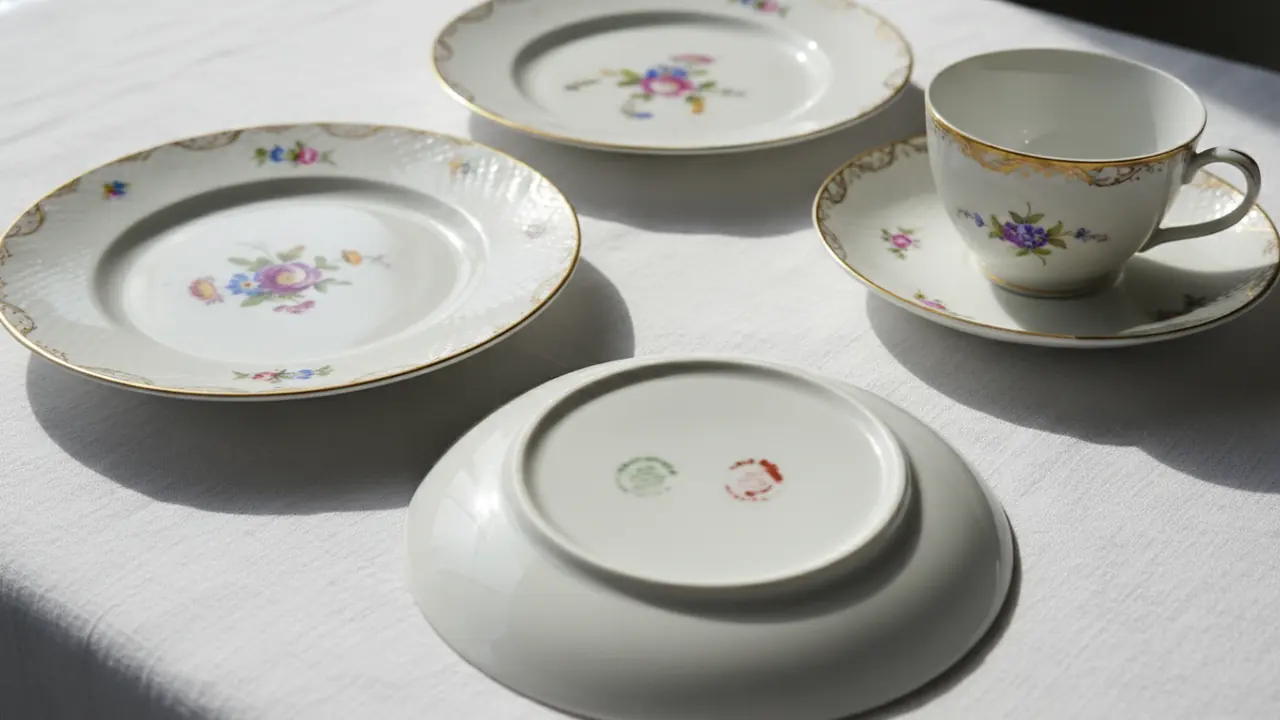
Begin with the mark's position in relation to the glaze. A factory or whiteware mark was usually applied to the porcelain body before glazing. It looks sealed beneath the glassy surface. A decorating mark was applied after the glazed firing; it sits on the surface and may have rubbed edges.
| What you see | Likely meaning | What it identifies |
|---|---|---|
| Green or black mark beneath the glaze | Factory or whiteware mark | The maker of the porcelain body |
| Red, blue, purple, brown, or gold mark on the glaze | Decorator, studio, retailer, or factory decorating mark | The organization connected with the decoration |
| Impressed letters or numbers | Mold, shape, blank, or production code | Usually requires a factory-specific reference |
| Handwritten initials, numerals, or symbols | Painter, gilder, decorator, or workshop notation | Meaning varies by factory and period |
A green factory mark beside a red decorating mark is normal. One company made the blank; another may have painted and sold it. Beginners often reject such pieces because the names differ, yet the pair can be exactly what period production would produce.
- Photograph the entire underside in indirect daylight.
- Take a close view straight above the stamp, then another with light crossing the surface from the side.
- Record every mark, including faint numbers and painter's signs. Do not crop out foot rims, mounting holes, or hardware.
- Check whether the stamp lies beneath the glaze. Use a magnifier; do not scratch it.
- Compare the body, shape, decoration, and wear with the proposed factory and date.
For more on the terminology, see the distinction between maker marks and hallmarks and this guide to porcelain backstamp identification. A hallmark usually concerns precious-metal content or control marks; the printed stamp on a Limoges plate is a maker or decorator mark.
If the lettering is incomplete, photograph the whole object as well as the stamp. TIQ's antique identifier app can use both views to suggest a maker and comparable examples. For rough antique appraisal from photos on Android, the same team's Lens app is the available option. Photo results are starting points, since a backstamp image cannot reveal later decoration or every repair.
Haviland, T&V and GDA marks
The initials are the fastest route to a factory, but each firm used multiple variants. Letter arrangement, surrounding wording, glaze position, and any accompanying decorator stamp all count.
| Firm or line | Marks to look for | Typical use | Dating caution |
|---|---|---|---|
| Haviland & Co. | H&Co., H & Co L, Haviland, or related wording | Late 19th-century factory marks are often green and underglaze; Haviland decoration may have a separate red mark | There are many variants, and a decorating stamp may cover a different period from the whiteware stamp |
| Charles Field Haviland | CFH, Ch. Field Haviland, or CFH combined with GDM | Factory or decorating marks associated with the Charles Field Haviland line and successor businesses | The Haviland name on a decorating mark does not by itself identify who made the blank |
| Gérard, Dufraisseix & Abbot | GDA, often with Limoges or France | Commonly a green underglaze factory mark; the firm's own decorating mark is documented in red | A documented green GDA mark dates about 1900 to 1941, but later GDA marks also exist |
| Tressemann & Vogt | T&V or T&V LIMOGES FRANCE | Often green on the whiteware blank, sometimes paired with a separate decorating mark | The firm operated from the early 1890s to 1907, while the mark continued into the Raynaud era |
Haviland and H&Co.
David Haviland established porcelain manufacture in Limoges in 1842. Later 19th-century Haviland factory stamps commonly contain "H&Co." A mark such as "H & Co L" is usually associated with the porcelain body. A second red Haviland stamp can identify factory decoration.
The family and company history produced a large mark vocabulary. Charles Field Haviland marks belong to a related line. After the business passed to Gérard, Dufraisseix and Morel, some stamps combined CFH and GDM. Read the full arrangement; a loose search for "Haviland mark" mixes different businesses, departments, and periods.
GDA and its earlier names
The firm became Gérard, Dufraisseix and Abbot around 1900. Its familiar factory stamp has GDA in green under the glaze. A Canadian government collections reference records one such mark at approximately 1900 to 1941.
That range applies to a documented variant, not every object bearing GDA. The company used a later mark after 1941. It also continued using an earlier Charles Field Haviland decorating mark until about 1941, when that mark was sold to Charles Field Haviland. A GDA blank with Charles Field Haviland wording can therefore have a legitimate period explanation.
T&V
Tressemann & Vogt marks are commonly abbreviated T&V, sometimes followed by LIMOGES FRANCE. The green stamp generally identifies the whiteware factory. A red or differently colored stamp nearby may name an outside decorator, retailer, or decorating department.
Collectors often use 1892 as a working start date for T&V, but exact dates for individual stamp designs are uncertain without a factory record. The operating period of the business and the use period of a particular stamp are not always identical.
For an unfamiliar monogram, compare its exact letter shapes through a structured maker mark search. General pottery references can also help separate French porcelain marks from pottery marks and backstamps used on earthenware and stoneware.
Dating a mark without overclaiming
A Limoges mark usually gives a date range, not an exact year. Factories retained old stamps after ownership changes, used several stamps at once, and marked the body before another workshop decorated it. Published charts do not always agree on the use dates for minor variants.
Work through the evidence in this order:
- Identify the factory stamp and its documented working range.
- Identify any decorator or retailer stamp separately.
- Check whether the porcelain shape fits that period. Handles, finials, rims, feet, and lid construction can expose a bad date.
- Examine the decoration. Transfer outlines, hand painting, raised paste, gilding, and enamel colors should make sense for the proposed workshop and period.
- Look for restoration, replacement components, or later overdecoration.
Suppose a green GDA mark fits an early 20th-century range, but the painting and gold look much later. The blank may still be genuine GDA porcelain. The decoration could have been added decades afterward. In that case, dating the finished object solely from the underglaze mark would be misleading.
Country wording is supporting evidence. "France" can fit an exported French piece, but it proves neither factory nor age on its own. The same applies to crowns, fleur-de-lis devices, and ornamental script. Compare the entire backstamp with documented examples, including spacing, borders, and letter forms.
Reference points used for these ranges include Limoges Antiques, the Canadian Heritage collections reference, and The Spruce Crafts mark directory. Even good references may assign slightly different dates to a stamp, so describe uncertain dates as "circa" or give a range.
Patterns, numbers and painter's marks
Most factory stamps do not identify the pattern. Numbers can refer to a mold, shape, blank, service, decorator's formula, inventory entry, or production batch. Calling a reverse number a date requires documentation for that factory's numbering system.
Pattern names need similar care. Names such as "French Roses" appear in auction and dealer descriptions of Haviland wares, but some names came from retailers, collectors, or later sellers. A period catalog, factory archive, museum record, or a body of consistently documented pieces is much better evidence.
Look for relationships between the marks:
- A printed factory stamp identifies the porcelain body.
- A colored overglaze stamp may identify decoration or retailing.
- Handwritten initials can belong to a painter or gilder, but many remain unidentified.
- Painted numbers may link a lid to its base or identify a decorating pattern inside a workshop.
- Impressed numbers often concern the mold or blank.
"Peint main" is a claim that the decoration was hand painted. It is not a factory identity or a date. Examine the decoration under magnification: brushwork and small variations can support the wording, while identical printed details may indicate transfer decoration with some hand-applied color.
When researching a faint stamp, preserve the original photograph and try alternate crops or side lighting. The method in identifying an antique from photos explains which angles help with marks, construction, and condition.
Fake marks, reproductions and later decoration
Authentic Limoges porcelain has evidence that agrees across the mark, body, construction, and decoration. A convincing stamp cannot rescue an implausible object. Marks can be copied, altered, or added to genuine unmarked porcelain.
Warning signs include:
- "Limoges" with no credible factory name or accompanying information, especially on bright, new-looking decorative ware.
- Misspelled factory names, distorted initials, or vague phrases such as "Limoges China."
- A fleur-de-lis, crown, or gold script used as the only supposed proof of Limoges manufacture.
- A factory-style mark visibly sitting on top of the glaze, especially on an otherwise undecorated piece.
- A stamp color, typeface, or border that differs sharply from documented versions.
- Decoration whose technique or style conflicts with the claimed period.
- Artificial wear around the base while protected surfaces remain fresh.
None of those signs condemns a piece alone. For example, a worn red mark can be a normal overglaze decorator stamp. A single green mark can also be legitimate because factory-decorated porcelain did not always receive a second stamp.
Body tests add information, with limits. Thin hard-paste porcelain often transmits light at a rim, and an intact piece may produce a ringing tone when lightly tapped. Neither identifies a factory. Avoid tapping cracked, repaired, mounted, or lidded objects; the test is too weak to justify damage.
Later decoration is a frequent source of confusion. A genuine Haviland, T&V, or GDA blank might have been painted by an independent studio well after manufacture. The underglaze factory mark remains authentic, while claims about the decoration need separate evidence. Inspect gilding wear, paint over old scratches, and decoration that crosses damaged or stained areas.
Replacement parts create another mixed object. A tureen lid and base may carry different numbers because they came from different services, or a damaged original lid may have been replaced. Check fit, porcelain color, translucency, and decoration alignment before assigning the marks to the complete object.
A broad maker mark and backstamp comparison may narrow the factory, but authentication from one underside photograph is unsafe when added marks and overdecoration are possible.
What affects Limoges porcelain value
The word "Limoges" alone does not imply a high price. Common Haviland and T&V dinnerware may draw less interest than an unusual form, a rare decoration, or a piece tied securely to a named artist or workshop.
Value usually depends on the following evidence:
- Secure attribution to the factory and, where possible, the decorator.
- Quality and complexity of painting, enameling, or gilding.
- Rarity of the shape, pattern, size, or intended use.
- Completeness of a dinner, tea, dessert, or serving set.
- Documented ownership, exhibition, or collection history.
- Condition, including chips, hairlines, cracks, staining, rubbed gold, repaired handles, missing finials, and restoration.
Count every piece in a service and note exact sizes. Buyers may need place settings or serving pieces that match a specific blank and border, so a complete set can have a different market from a stack of unrelated plates.
Use dated sold results for the same maker, form, decoration, size, and condition. Asking prices and isolated auction listings do not show what buyers paid. The guide to working out an antique's value explains how to choose comparables and account for damage.
For a sale, insurance schedule, donation, or disputed attribution, retain an appraiser who handles European ceramics. Supply clear photographs of both sides, dimensions, mark close-ups, a condition report, and any receipts or family records.
Questions people ask
Why does my Limoges plate have two different marks?
The underglaze mark usually identifies the factory that made the porcelain blank, while the overglaze mark may identify its decorator or retailer. Two different names can be entirely consistent with period Limoges production.
Does a green Limoges mark mean the piece is antique?
No. Green was commonly used for underglaze factory marks, but color alone cannot establish age, and later pieces can also have green stamps.
What does a red mark on Limoges porcelain mean?
A red mark is often an overglaze decorator's stamp applied after the glazed firing. Its wording and relationship to the factory mark must be checked before assigning a decorator or date.
Is porcelain marked only "Limoges" genuine?
It may be, but the word alone is weak evidence because Limoges was a production center used by many firms. Check the porcelain body, mark placement, construction, decoration, and provenance.
Can a number on Limoges porcelain identify the year?
Usually not by itself. Reverse numbers may identify a shape, mold, blank, decorating scheme, service, or inventory entry, and they need a factory-specific reference.
Are Haviland Limoges dishes valuable?
Some are valuable, but familiar tableware patterns can be modestly priced. Rare forms, accomplished painting, strong gilding, complete services, documented provenance, and good condition tend to attract more collector interest.