
Home / Marks and hallmarks
Antique crocks value: marks, makers and condition
When estimating antique crocks value, start with the complete maker's mark, capacity, glaze, decoration and condition. A clear Red Wing or Western Stoneware mark can help, but cobalt artwork, unusual form and an intact body often have more influence than the name alone. Structural cracks, drilled holes, repairs and missing lids can cut demand sharply.
Looking at shape and material...
While you wait: the TIQ app gives more accurate results, keeps your scan history and runs a reverse image search for similar items.


 Scan with your phone
to download
What to check first
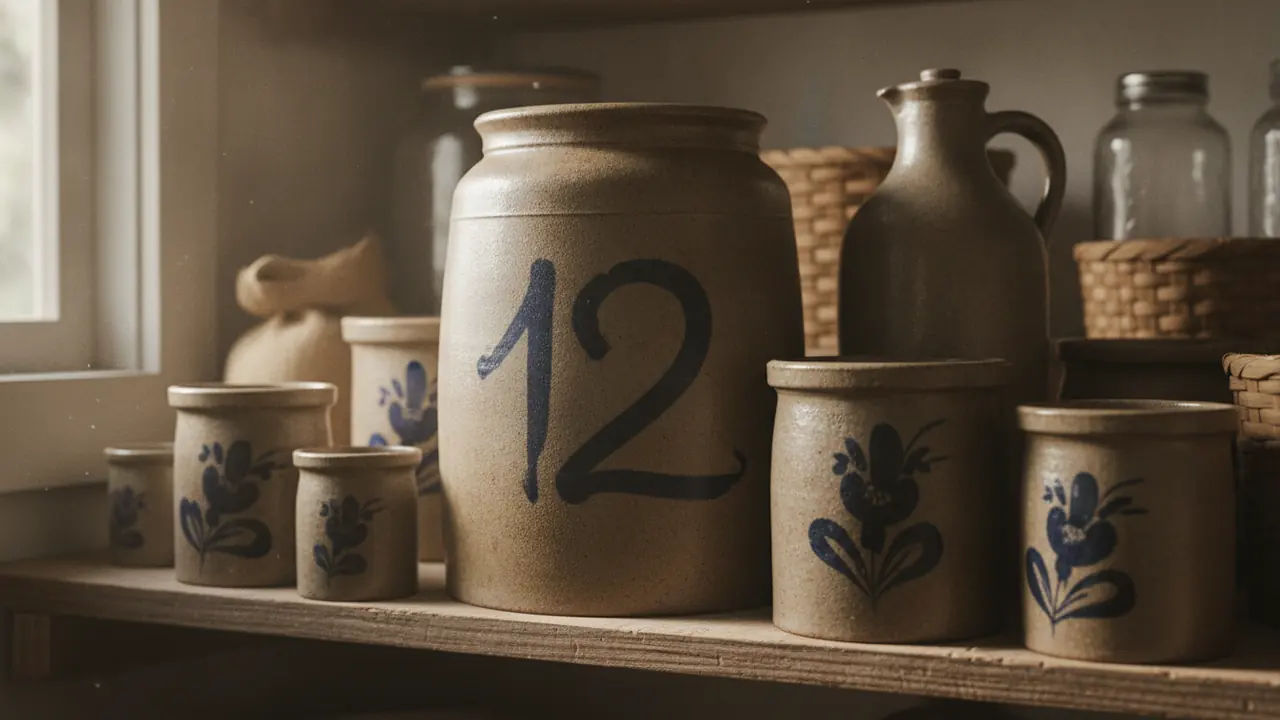
Read the whole crock before trying to price it. A large blue number catches the eye, but it usually tells you capacity. It rarely identifies the maker by itself. Turn the crock slowly under side lighting and inspect these areas in order:
- Photograph the front, back, base, rim, handles and interior.
- Copy every word, number and punctuation mark exactly. Record whether each mark is impressed, incised, stamped, painted or transfer-printed.
- Identify the glaze and body color. Look for a pebbled salt-glazed surface or a smoother white or cream glaze.
- Study the cobalt decoration. Note whether it is brushed, slip-trailed, stenciled or printed.
- Check the rim, handle attachments and wall for cracks, chips, filled losses and grinding.
- Measure the height and widest diameter. Confirm whether a lid is present and fits correctly.
Marks, clay, glaze and form need to make sense together. A familiar logo on a body unlike documented examples deserves more research. For help reading an incomplete stamp, compare it with references for pottery marks and backstamps and the broader guide to finding antique maker marks.
Photographs taken straight on are useful, but raking light often reveals impressed lettering and hairlines that disappear under overhead light. A wet-looking glaze can also hide a repaired crack in a seller's photograph. Ask for dry, close views of both sides of any suspicious line.
Gallon numbers and other numerals
A prominent 2, 4 or 5 normally gives the crock's approximate capacity in gallons. The number may be impressed into the clay, stamped or painted in cobalt; its style and position vary among factories and periods.
| Number or mark | Likely meaning | What to verify |
|---|---|---|
| Large isolated numeral | Usually gallon capacity | Does the physical size make sense for that capacity? |
| Numeral beside a company logo | Possibly capacity or a plant designation | Compare its placement with documented examples from that maker. |
| Small impressed number on base | Could be a mold, inventory or production number | Do not assign a gallon capacity from the number alone. |
| Number within advertising text | May be an address, product number or capacity | Read the entire inscription before interpreting it. |
Very large crocks exist. References report Red Wing capacities reaching 60 gallons, although size by itself doesn't establish rarity. Large crocks are harder to ship and may sell mainly to local buyers. An unusually small size can be desirable too, provided comparable pieces show that the form is genuinely scarce.
Red Wing and Western Stoneware marks
Red Wing and Western Stoneware used several marks, so the complete wording is more useful than a wing, leaf or cobalt number viewed alone.
| Mark or logo | Identification clue | Dating caution |
|---|---|---|
| Minnesota Stoneware Co. / Red Wing, Minn. | Documented Red Wing, Minnesota wording found on salt-glazed pieces | Use glaze, form and decoration to narrow the period. |
| Red Wing Stoneware Co. | Reported Red Wing company mark | The wording alone does not give an exact production year. |
| Red Wing Union Stoneware Co. | Another recognized Red Wing company name | Check the complete stamp and associated emblem. |
| Red-wing emblem | A useful Red Wing identifier when paired with compatible factory wording and construction | Wing size and style are approximate dating clues. |
| Red Wing Potteries or Red Wing USA | Reported on later, post-1936 production | Available references do not document every transition or intermediate mark. |
| Western Stoneware Co. with maple leaf | Reported Western Stoneware wording and logo | A nearby plant number needs separate interpretation. |
Some secondary references place larger early Red Wing emblems broadly around 1906 to 1912 and suggest the factory's salt-glaze period ended around 1915. Those dates are leads, not a complete factory chronology. Specialist Red Wing references are needed before assigning a narrow year.
Western Stoneware marks may include a plant number. Its position, typeface and relationship to the maple-leaf logo help distinguish it from capacity. There is no reliable complete plant-number key in the available material, so a precise date based only on that number is hard to defend.
Unmarked period stoneware exists. An absent maker's stamp weakens a specific attribution, and it is also a reproduction warning when other details look new. Compare clay, glaze, form and decoration before deciding. A photo search can help locate similar examples; the guide to identifying antiques from photos explains how to frame marks and construction details for a useful comparison.
Glaze and cobalt decoration
Salt glaze and cobalt decoration can support an early date, but neither proves age or maker on its own. Earlier utilitarian crocks commonly have gray stoneware bodies with a salt-glazed surface. The texture is often pebbled or orange-peel-like, with natural kiln variation and occasional glaze pooling.
Salt glaze was created by introducing salt into the kiln atmosphere. The resulting surface belongs to the firing; it shouldn't look like a clear modern coating sitting above the clay. Minor runs, skips and kiln marks may be manufacturing irregularities. A crack passing through the body is a different condition problem.
Smoother white or cream Bristol-type glazes generally occur on later production. That is a broad sequence, since factories changed materials and methods at different times. Glaze has to agree with the maker's mark and crock form.
What cobalt work can tell you
Hand-applied cobalt may appear as capacity numbers, flourishes, leaves, flowers, birds, animals, houses or figures. Recognized Red Wing decorative types include leaf, butterfly and elephant-ear designs. Brushed or slip-cup decoration often varies in thickness and may bleed slightly into the surrounding glaze.
Figural and scenic decoration tends to attract more collector interest than a plain capacity numeral. Originality is the hard part. Many factories used cobalt, and modern decorators copy old motifs. Paint with mechanically uniform edges or color visibly sitting over a finished glaze calls for caution.
- Look where cobalt crosses glaze irregularities. Fired decoration should relate naturally to the surface beneath it.
- Compare repeated leaves or flourishes. Some variation is normal in hand-applied work.
- Inspect worn areas. Surface wear, glaze wear and handling should have a consistent pattern.
- Read the mark separately. A wing-like flourish doesn't make a crock Red Wing.
Reproductions and altered crocks
Reproductions often fail when the mark, surface and construction are considered together. Perfectly repeated lettering, an incorrect logo proportion, newly applied decoration or an implausible combination of name and glaze can expose a later piece.
Old-looking dirt is weak evidence. Dirt can be added to recesses in minutes. Genuine age is more likely to produce related signs across the whole object: softened contact points, wear around handles, kiln variation, grime in protected areas and compatible aging on the base. Even that combination requires comparison with documented pieces.
Check for alterations as carefully as reproductions. Decorative crocks are sometimes drilled for drainage or lamps. Chips may be ground smooth, handles rebuilt, and cracks filled with tinted material. Shine a flashlight across the wall, then inspect the same line inside. A repair may change color or sheen under angled light.
Smell, magnets and black lights don't authenticate stoneware. They may produce observations, but the available references supply no authoritative pass-fail test based on them. Typography, construction, glaze and documented comparisons carry more weight.
If you want a second set of image comparisons, TIQ's antique value tool for iPhone can identify a photographed item and suggest comparable examples. On Android, the same team's antique identifier app, Lens, can identify objects from photographs. Photo results are starting points; authentication still depends on the physical crock.
Cracks, chips, lids and repairs
Condition can move a crock from a strong collector piece to a decorative object. Hairlines usually reduce value substantially, while long body cracks, replaced sections, drilled holes and repaired handles are more serious. The location counts: damage through a decorated face or maker's stamp is especially distracting.
| Condition | How to recognize it | Likely effect on demand |
|---|---|---|
| Glaze-only firing line | A superficial line confined to the glaze, with no continuation through the wall | Usually less serious, though buyers will still want clear photographs. |
| Structural hairline | A fine line visible inside and outside, sometimes producing a duller sound nearby | Substantial reduction compared with an intact example. |
| Rim chip | Loss along the top edge; may expose fresh-looking clay or old stained clay | Effect depends on size, visibility and whether the lid still seats. |
| Body crack or break | A line through the wall, displaced section or adhesive residue | Major condition issue, especially if long or unstable. |
| Filled or painted repair | Different texture, color, sheen or hardness around the damaged area | Must be disclosed and compared with other restored pieces. |
| Drilled hole | Usually found in the base or lower wall | Permanent alteration that limits collector interest. |
| Missing original lid | Open crock sold without its matching cover | Completeness and value may suffer when the form originally had a lid. |
A repaired crock can remain collectible when the mark, form or cobalt scene is scarce. Compare it with repaired examples. An intact price is a poor benchmark for a crock with a glued handle and a filled body crack.
Don't scrub first and inspect later. Abrasives can change the surface, while strong cleaners may affect old decoration or repaired areas. Start with a soft dry brush. If further cleaning is necessary, test a lightly dampened cloth on a small plain area and avoid soaking a cracked or restored crock.
How to estimate antique crocks value
A defensible value comes from recent realized sales for crocks matching the maker, size, decoration and condition. Dealer prices and auction estimates show expectations. They don't show what a buyer paid.
Search sold records using the full mark first, then narrow by gallon capacity, glaze and decoration. Compare dimensions when capacity is uncertain. Read every condition report and inspect photographs; a listing title may omit a hairline disclosed farther down the page.
- Find several sold examples from the last few years, when possible.
- Separate plain crocks from decorated, advertising, figural and scenic pieces.
- Match condition. Intact examples belong in a different comparison group from repaired ones.
- Check whether the stated result includes a buyer's premium, and account for shipping or local pickup.
- Give greater weight to close matches than to a famous maker with different decoration or size.
The historical figures below show why broad internet ranges need labels and dates. They are not current price quotes.
| Published evidence | Amount | What it actually supports |
|---|---|---|
| Morphy Auctions example, reported sold in 2012 | $240 | One auction result; the available summary omits specifications needed to apply it broadly. |
| Undated secondary guide for five-gallon salt-glazed, hand-painted crocks with handles | $200 to $1,250 | A guide estimate, without a sale-by-sale dataset. |
| Secondary Red Wing guide | $40 to $70 for a five-gallon small-wing crock; $75 to $170 for a large-wing example | Guide estimates with broad dating claims, not identified realized sales. |
| Secondary cobalt-decoration guide | About $100 to $400 for simple designs; $500 to $5,000 for figural or scenic work | Unsourced guide ranges that cannot establish a specific crock's market value. |
For a current estimate, prioritize clear maker marks, confirmed age, scarce form, original cobalt decoration, intact rims and bodies, matching lids, provenance and recent sales. Regional advertising can bring strong local interest even when the maker is less famous. The guide to working out what an antique is worth covers comparable-sale research in more detail.
Morphy Auctions, Proxibid and HiBid catalogs are useful for individual examples, but each catalog entry records one object and one sale context. Save screenshots or citations for the closest matches. New collectors may also want the basic buying and condition advice in the antique collecting guide before purchasing a large crock online.
Questions people ask
Are antique crocks with no markings valuable?
Yes, an unmarked crock can have value if its age, glaze, decoration, form and condition are convincing. Lack of a mark makes maker attribution harder and usually calls for stronger comparable-sale evidence.
How old is a crock with a blue number?
A blue number alone cannot date a crock; it usually indicates gallon capacity. The maker's mark, glaze, body, decoration and construction provide better dating evidence.
Does a hairline crack make an antique crock worthless?
No, but a structural hairline usually lowers value substantially. Scarce decoration or an unusual mark may preserve collector interest, especially when the crack is stable and fully disclosed.
What is a five-gallon Red Wing crock worth?
Its value depends on the exact Red Wing mark, wing style, glaze, cobalt decoration, lid and condition. Current realized sales for closely matched five-gallon examples give a sounder estimate than a generic price guide.
Is every Western Stoneware number a plant number?
No. A number may indicate capacity, a plant or another production designation, depending on its position and relationship to the maple-leaf company mark.
Are large antique crocks always more valuable?
No. Large size can increase interest when the form is scarce and intact, but shipping difficulty and local demand affect the sale; documented rarity is more useful than size alone.