
Home / Item types
Old marbles value and identification guide
Old marbles value depends first on manufacturing method, type, condition, size, and a defensible maker or pattern attribution. A pontil can support handmade identification, while opposite cut-off marks often indicate machine production. Sulphides, onionskins, and some named factory patterns may bring collector interest, but chips, polishing, weak attribution, and common designs can cut value sharply.
Looking at shape and material...
While you wait: the TIQ app gives more accurate results, keeps your scan history and runs a reverse image search for similar items.


 Scan with your phone
to download
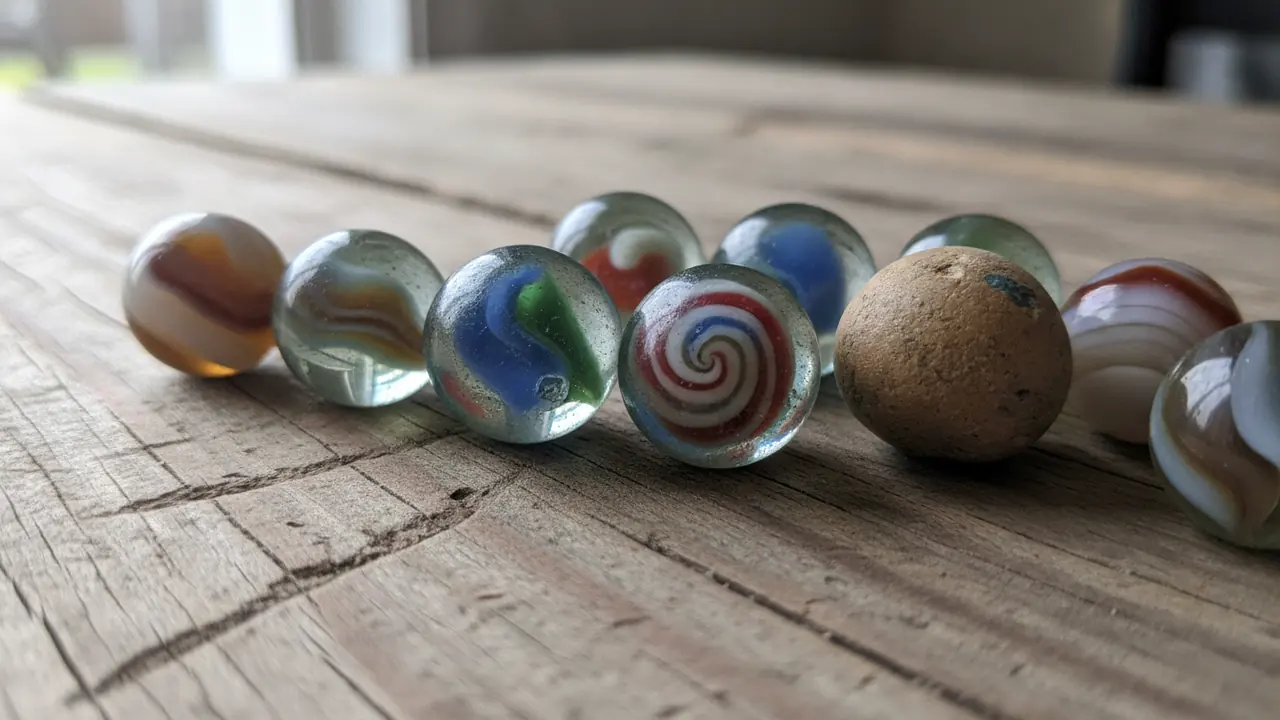
There is no useful single price range for old marbles. A worn common machine-made marble and a large, undamaged handmade sulphide occupy entirely different markets. Identify the marble, measure it, grade its condition, then compare it with recent completed sales of genuinely similar examples.
Start with handmade versus machine-made
The first useful split is handmade or machine-made. Ignore color for a moment. Look at both poles, the internal pattern, and the way the glass was separated during manufacture.
| Feature | Handmade glass marble | Machine-made glass marble |
|---|---|---|
| Pole marks | May have a rough, melted, faceted, flattened, or ground pontil at one or both poles | Often has small cut-off marks at opposite poles; some are faint or partly hidden by the pattern |
| Internal pattern | Can have cane-built swirls, layered strands, ribbons, mica, or an enclosed figure | Flowing ribbons and color patches formed during automated production; geometry may repeat from pole to pole |
| Shape | May be slightly out of round | Often quite round, though age, factory process, and damage affect shape |
| Dating clue | Construction may support a broad period; it seldom gives an exact year | Maker and pattern references are needed for a useful production range |
| Common trap | A chip or worn flat spot mistaken for a pontil | A machine cut-off mistaken for a handmade pontil |
Machine-made glass marbles appeared by the late nineteenth century. Martin F. Christensen patented an automated marble machine in 1905, an important point in American production history. Christensen, Akro Agate, Peltier, Vitro, and Marble King are among the names encountered in machine-made collecting, though a company name should never be assigned from color alone.
Age terms also cause trouble. Sellers often use old, vintage, and antique loosely; the distinctions are explained in this guide to vintage and antique age terms. Marbles also sit within the wider field of collectible toy identification, where original packaging and documented groups can be as informative as the object itself.
What a pontil can tell you
A pontil is a manufacturing scar where hot glass was detached from a cane, rod, or punty. It supports a handmade or hand-finished attribution. It is not a maker's signature and cannot, by itself, prove a nineteenth-century date or high value.
Examine both poles with a loupe under light coming from the side. Rotate the marble slowly. A genuine pontil may appear rough and textured, partly melted, crisply faceted, or deliberately ground. Handmade marbles can have one visible pontil, two pole marks, or a pole polished enough that the original scar is hard to recognize.
Several things fool beginners:
- A fresh chip usually has sharp edges and exposes a different surface below the surrounding wear.
- A bruise is subsurface damage, often crescent-shaped, and may show internal stress around an impact point.
- A machine cut-off tends to relate to the pattern's poles and may have a corresponding mark opposite it.
- Grinding can be original pole finishing or later alteration. Heavy polishing may erase evidence needed for identification.
- A flattened wear spot has abrasion consistent with the rest of the surface and lacks a clear detachment structure.
One photograph of a rough spot isn't enough. A useful photo set includes each pole, the equator, and several views through the glass. Dirt can hide marks, but abrasive cleaning can remove original surface evidence. Begin with a dry soft cloth; leave mineral deposits and stubborn residue alone until the marble has been assessed.
Sulphides, onionskins, Akro Agate, and other types
Type names describe construction, pattern, maker, or collector usage, and those categories can overlap. Match the whole structure before attaching a valuable name.
| Type or name | What to look for | What commonly goes wrong |
|---|---|---|
| Sulphide | Clear or lightly colored glass enclosing a pale figure, commonly white, gray, or silver in appearance | Bubbles, foil, mineral fragments, painted decoration, and modern inserted objects are misidentified as figures |
| Onionskin | Closely packed feathered or layered colored-glass strands stretched around a core; generally associated with handmade production | Every layered swirl gets called an onionskin, even when strand construction and pole treatment do not match |
| Akro Agate corkscrew | Two or more spirals running from pole to pole without intersecting, according to collector descriptions | A spiral pattern or familiar color combination is accepted as proof of Akro manufacture |
| Cat's-eye | Internal vanes arranged within clear glass; commonly machine-made | Ordinary later examples are sold under broad antique claims |
| Other machine-made swirls | Colored ribbons, patches, flames, or seams tied to factory production | Pattern nicknames are applied without checking base glass, dimensions, poles, or factory references |
A sulphide's name is historical collector terminology. The pale insert may be clay, porcelain, or a related material; its silver look does not prove elemental sulfur. Value depends on the figure's subject, clarity, centering, visibility, size, glass condition, and credible attribution. The figure should be enclosed within the glass. A surface decal, paint, or loose object is a warning sign.
Onionskins are broadly placed around circa 1860 to 1920 in secondary collecting references. That span is approximate. Inspect the density and direction of the colored strands, the core, both poles, and any mica. Chips, fractures, heavy wear, and lost surface luster affect desirability.
Akro Agate was associated with Clarksburg, West Virginia, and operated broadly from the 1910s into the 1950s. That company range cannot date an individual marble. The term corkscrew describes pattern geometry; base glass, color, size, pole treatment, and comparison with known factory examples still need to agree. Terms such as oxblood also need specialist references because color-name attribution is often disputed.
If the glass construction itself is unfamiliar, the methods used for identifying glass patterns can help you record color, transparency, internal structure, and manufacturing marks without jumping to a maker.
Measure size and grade condition closely
Record diameter with calipers in both millimeters and inches. Descriptions such as shooter, large, or giant are too loose for a serious value comparison, and a slightly out-of-round handmade marble may need measurements across more than one axis.
Sizes found in sale and collector material include 11/16 inch, 13/16 inch, 1 inch, about 1.48 inches, and 2 inches. These examples are not universal factory standards. Large size can add interest when the type is scarce and the condition is good; diameter alone does not create rarity.
| Condition issue | How to recognize it | Effect on evaluation |
|---|---|---|
| Chip | Missing glass with a distinct edge or impact point | Often a major deduction, especially near a pontil or figure |
| Bruise | Subsurface impact damage, sometimes crescent-shaped | Can be more serious than it appears in a front-lit photo |
| Hairline or fracture | Fine line within or through the glass | Raises stability concerns and can sharply reduce collector interest |
| Surface wear | Scattered scratches, haze, or dullness from play and handling | Light wear may be expected; severe wear obscures pattern and luster |
| Polishing | Unnaturally even gloss, softened marks, reduced diameter, or altered pole texture | May improve appearance while reducing originality and confidence |
Use a loupe and side lighting. Backlighting reveals internal fractures and the depth of swirls, but it can hide shallow surface damage. Examine the marble against both dark and light backgrounds. Condition labels vary among sellers, so a written damage description and sharp photographs are more useful than a grade word by itself.
How to estimate old marbles value
A sound estimate comes from completed sales matched by type, size, attribution, and condition. Current asking prices show what owners hope to receive. They do not establish what buyers have paid.
- Decide whether the marble is probably handmade, hand-finished, or machine-made. Record uncertainty.
- Measure the diameter accurately and note whether it is out of round.
- Photograph both poles, the equator, the strongest pattern view, and every chip, bruise, or fracture.
- Write the narrowest defensible description. For example, use handmade layered swirl with one ground pole if an onionskin attribution remains uncertain.
- Search completed auction records for the same construction and pattern. Match size closely.
- Compare condition. An intact example is weak evidence for pricing one with a large chip or internal crack.
- Record the sale date, venue, lot description, realized amount, and whether the figure includes a buyer's premium.
For a group, do not divide the lot price evenly across every marble. A single sought-after example may account for most of the result. Original boxes can help when labels, dividers, and contents agree, though a replaced box or mixed group has less evidentiary value.
There are no verified auction records in the supplied research that support a responsible blanket price chart. Broad online ranges often mix reproductions, asking prices, damaged marbles, and unrelated types. The fuller method in determining what an antique is worth explains how venue, timing, fees, and attribution affect a comparison.
When a pattern search stalls, TIQ, an antique appraisal app for iPhone, can use a photo to suggest identity clues, maker-mark guidance, and an estimated range from comparable examples. For a rough antique value on Android, the same team's Lens app can identify objects including antiques. These results are educational estimates, so unusual sulphides and costly handmade examples still call for specialist examination.
Reproductions, altered surfaces, and photo checks
Reproductions are best caught by checking construction as a whole: poles, pattern depth, wear, diameter, and the way any figure sits inside the glass. A convincing color palette is weak evidence on its own.
- Inspect both poles for consistent manufacturing marks. A supposed handmade marble with unexplained seams or regular machine cut-offs needs more study.
- Look through the marble from several angles. Genuine internal strands and figures have depth; paint and decals remain on the surface.
- Compare wear across high and protected areas. Uniform dulling, packed residue, or scratches of the same depth can indicate artificial aging.
- Be suspicious of an unusually perfect antique paired with generic claims such as estate find, rare, or 1800s and no collection history.
- Check dimensions and pole treatment against a recognized collector catalog or specialist auction archive.
Photographs can support identification, but reflections often disguise chips and make a ground pontil look rough. Use indirect daylight or diffused lamps, clean backgrounds, and close focus. Include a caliper reading in one frame. A photo-identification workflow is covered in identifying antiques from photographs.
Provenance helps when it is documented: an old inventory, labeled collection box, dated photograph, or auction record tied to the same marble. A seller's unsupported family story has little weight. If the marble appears rare, do not polish it before a specialist sees it.
For a first collection, catalog every marble before sorting by value. Assign an item number, diameter, probable type, pole description, condition notes, and photo set. The habits in this beginner's guide to antique collecting also help prevent labels and ownership records from becoming separated from the objects.
Reference trail: secondary material from WorthPic and Attic Capital was compared with the Deseret News account of marble collecting history. Exact prices and firm pattern dates were omitted where named auction records or factory documentation were unavailable.
Questions people ask
How can I tell if my old marbles are worth money?
Check manufacturing method, exact diameter, pattern, condition, and possible maker, then compare the marble with recent completed sales of the same type. Scarcity and condition usually carry more weight than age alone.
Does a pontil make a marble valuable?
No. A pontil supports handmade or hand-finished production, but common patterns and damaged handmade marbles may have modest collector value.
Are bigger old marbles always worth more?
No. Unusual size can increase demand when the pattern, attribution, and condition are also desirable, but a large common or damaged marble may remain inexpensive.
Should I polish an antique marble before selling it?
Avoid abrasive polishing because it can remove surface evidence, alter pontils, reduce diameter, and lower collector interest. Use a soft dry cloth for loose dust and seek advice before treating deposits.
How do I know if a sulphide marble is real?
The figure should appear enclosed within the glass and have natural depth when viewed from several angles. Surface paint, decals, loose inserts, seams, or inconsistent artificial wear warrant closer examination.
Can an old machine-made marble be collectible?
Yes. Collectors seek certain makers, factory patterns, colors, sizes, and well-preserved examples, including machine-made marbles from companies such as Akro Agate and Peltier.