
Home / Item types
How old is this bottle? A glass bottle dating guide
To work out how old a bottle is, start with its side seams, lip finish and base. A seam that continues over the lip usually indicates machine manufacture after about 1900; a genuine pontil scar commonly points to the mid-19th century or earlier. Embossing, patent wording and maker marks can then narrow the range, but rarely identify one exact year.
Looking at shape and material...
While you wait: the TIQ app gives more accurate results, keeps your scan history and runs a reverse image search for similar items.


 Scan with your phone
to download
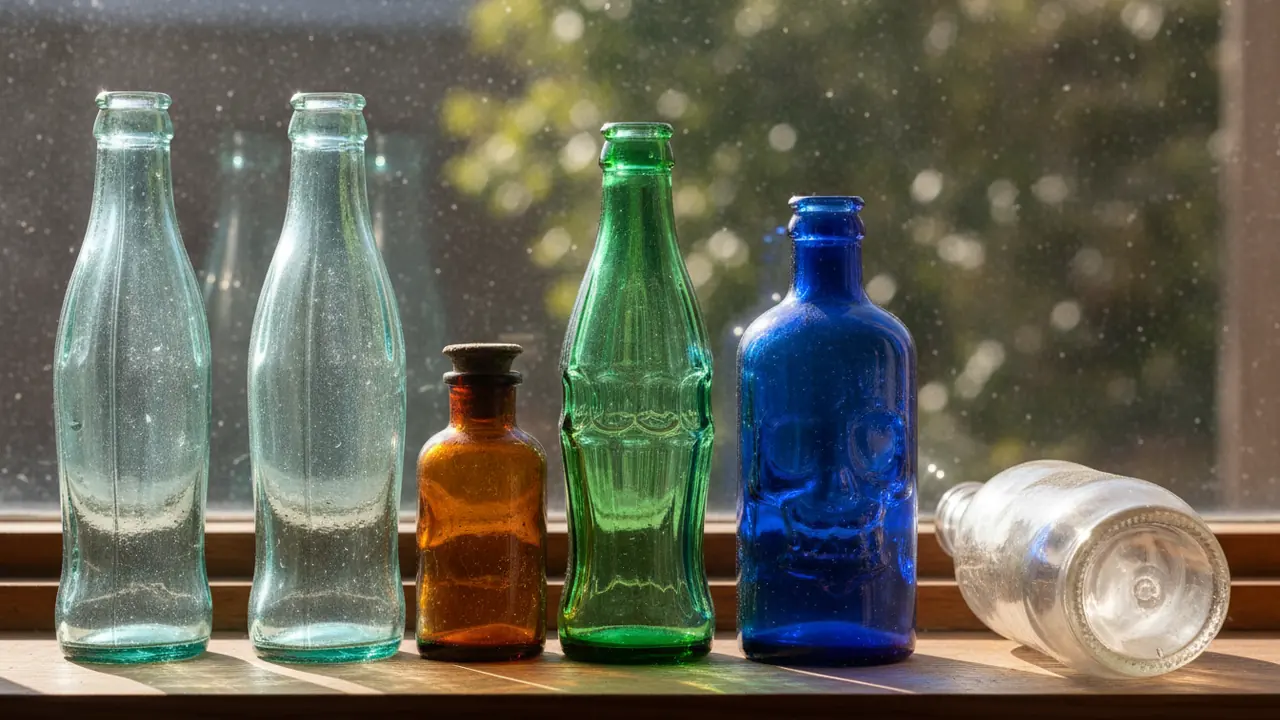
Start with the manufacturing method
The first useful division is mouth-blown versus machine-made. It cuts the possibilities from several centuries to a more manageable period, though no single seam rule dates every bottle.
Hold the bottle under angled light and trace each vertical mold seam from the heel toward the mouth. Rotate the bottle as you work. Dark glass, surface wear and molded decoration can hide a seam that looks obvious from another direction.
| Where the side seam ends | Broad date association | What it suggests |
|---|---|---|
| Shoulder or low neck | Often before about 1860 | An early mold process, including some dip-molded bottles |
| Just below the finish | Roughly 1860-1880 | Mouth-blown bottle with a separately worked lip |
| Enters the finish but stops below the lip | Roughly 1880-1900 | Later mouth-blown production |
| Continues through the finish to the top | Commonly after 1900 | Machine-made construction |
These ranges are screening dates. Bottle factories adopted equipment at different times, older methods lingered, and some mold seams are hard to interpret. The Society for Historical Archaeology rates some mold-seam evidence only moderately reliable, so check the finish and base before settling on a range.
A dip-molded bottle may have a change in surface or a slight blow-over line where the mold ended near the shoulder. Free-blown bottles lack regular body mold seams, but an apparent absence of seams is weak evidence until you have checked the heel, neck and finish closely.
Read the pontil, lip and base together
A true pontil scar is strong evidence of mouth-blown manufacture, especially on an ordinary utilitarian bottle. Such bottles generally date to about the American Civil War era or earlier and are almost always from before the early 1870s. Specialty and artisan bottles continued to use pontils later, so report a range unless other evidence is conclusive.
What a pontil scar looks like
A blowpipe pontil can leave a hollow, sharp-edged ring roughly similar in diameter to the neck. A solid pontil rod may leave an irregular or fragmented circular scar where the rod broke away. The scar usually interrupts the base surface and looks like attached glass was torn away.
Beginners often call any circle on the bottom a pontil. Mold rings, glassmaker emblems, valve marks and ordinary production irregularities can all resemble one. A circular valve or ejection mark is evidence of press-and-blow machine manufacture, not a removed pontil rod.
| Finish or base clue | Usual interpretation | Caution |
|---|---|---|
| Cracked-off lip | Rough mouth left after separation | It may have been fire-polished or ground afterward |
| Burst-off finish | Seen chiefly in the second half of the 19th century | Some use continued into the early 20th century |
| Ground wide-mouth lip | Common on jars and other stoppered containers | Use was declining by the 20th century, but the lip alone gives no narrow date |
| Folded, flanged or everted finish | A separately worked mouth-blown finish may be present | Match the exact form to the bottle type |
| Continuous seam through lip | Machine manufacture | Check for later finishing or damage around the mouth |
| Valve or ejection mark | Press-and-blow machine manufacture | Do not label it a pontil |
The lip can be more informative than bubbles or color. Examine it from the side and above: is it rough, ground flat, hand-tooled, threaded or molded in one operation with the neck? Also check whether the side seam disappears beneath a separately applied or tooled finish.
Use embossing and base marks without overdating them
Embossing narrows a date only when you know when that exact wording, trademark or company name was used. Record every letter, number and punctuation mark before searching. A change from "Co." to "Company," a town name, or a revised trademark can separate molds that otherwise look alike.
Search the company history and the glassmaker separately. The embossed brand may identify the contents, while a small symbol on the heel or base identifies the glasshouse. The guide to maker marks and labels explains how to record partial marks and distinguish a manufacturer from a retailer.
An isolated base number is not automatically a year. It may indicate the mold, plant, bottle style, capacity or production sequence. A number such as 7, 12 or 52 needs a manufacturer-specific reference before it can carry any dating weight. Patent dates have the same limitation: they establish legal or design history, and production may have continued for years afterward.
Compare exact molds. Letter height, punctuation, panel shape, heel wording, capacity and base codes are more useful than a generic photograph of a bottle with the same brand. This same close-match method is used for identifying glassware patterns, where small molded details often separate related designs.
Color helps after identification. Aqua, amber, olive and colorless glass all span long periods and many products. Bubbles and waviness can support a mouth-blown assessment, but neither proves a date before 1900.
Dating Coca-Cola bottles
Coca-Cola bottle dating depends on bottle form, patent wording, bottler information and factory codes. The familiar contour shape was patented on November 16, 1915, but that date does not mean every contour bottle was made in 1915.
Early cylindrical and Hutchinson bottles
Some early Coca-Cola bottles are cylindrical and use a Hutchinson-style finish for a spring stopper. The Hutchinson patent dates to 1879. These stoppers were generally discontinued by 1912, although some associated bottles were made as late as 1920. Bottler names and cities are especially useful because local franchises ordered their own bottles.
Contour or hobble-skirt bottles
The contour design, also called the hobble-skirt bottle, entered the patent record in 1915. Examine the wording on the skirt. Before the Patent Act of 1927, patented articles were required to display the patent date; after the act, the date was replaced by a patent number. That legal change helps place the marking system, though it does not prove the manufacture year of one bottle.
A third contour patent bottle is embossed "BOTTLE PAT. D-105529." That design patent was granted on August 3, 1937, following a March 24, 1937 application by Eugene Kelly of Toronto and assignment to The Coca-Cola Company. A bottle carrying this wording must fit the later patent period, but production dates still vary by plant.
| Coca-Cola clue | What it can establish | What it cannot establish alone |
|---|---|---|
| Hutchinson finish | An early closure type associated mainly with the late 19th and early 20th centuries | A single production year |
| November 16, 1915 patent date | The legal history of the contour design | That the bottle was made in 1915 |
| "BOTTLE PAT. D-105529" | A design patented in 1937 | The bottle's plant and exact year |
| One- or two-digit number on skirt or base | Possibly a mold, date or plant code | A year without a code reference |
| City or bottler embossing | A regional lead for research | A full date unless the bottler's history is documented |
Plant research can narrow the result. For example, a regional study reports use of D-105529 bottles in Phoenix from around 1939, with skirt dates from 1939 onward. That finding applies to the studied regional production and should not be extended to every Coca-Cola bottle carrying the same patent number.
Signs of a reproduction or misleading bottle
A convincing date requires the construction, wording and closure to agree. A bottle that copies an 1860s form but has a seam running over the lip and a machine valve mark has conflicting evidence.
- Inspect unusually crisp embossing. Sharp lettering can be genuine, but on a supposedly worn, early bottle it deserves closer comparison.
- Check patent wording against the claimed date. An anachronistic patent number or trademark is a warning.
- Compare the finish with the intended closure. A Hutchinson bottle, crown-top soda bottle and screw-cap bottle require different mouth forms.
- Look for artificial wear, staining or surface texture. Modern glass can be made uneven, and dirt can be added.
- Match dimensions, punctuation, mold lines and base details to a documented example. Similar brand names are not enough for a rare mold.
Roughness is not proof of age. Likewise, clean glass does not make a bottle modern; an old bottle may have been stored indoors or professionally cleaned. Judge the complete manufacturing package: glass, thickness, seams, lip, base, embossing and closure.
Photographs are useful for finding visual matches, provided you compare the base and finish as well as the front. The steps in identifying antiques from photos apply here too: use uncluttered images, include scale and photograph marks straight on.
A reliable bottle-dating sequence
Work in a fixed order so an exciting name or apparent date does not pull you toward the wrong conclusion.
- Write down all embossing exactly, including punctuation, city names, capacities and numbers.
- Photograph the front, reverse, shoulder, lip, heel and base. Side lighting will reveal faint seams.
- Measure the height, widest diameter and mouth opening. Record the approximate capacity if it can be established safely.
- Trace every mold seam and note where it ends.
- Describe the finish: cracked-off, ground, flanged, folded, everted, burst-off, crown or threaded.
- Classify the base mark. Decide whether it is a pontil scar, valve mark, mold ring, maker emblem or an unexplained irregularity.
- Search the complete embossing and then research the company, patent, glasshouse, bottler and closure.
- Compare the exact mold with museum records, bottle references or documented auction examples.
- State a date range that fits all the evidence. "Mouth-blown, probably 1880-1900" is more defensible than an unsupported year.
If you want a photo-based second opinion after recording these details, TIQ's iPhone antique value tool can suggest an identification, period clues and comparable examples. On Android, the team's Lens antique identifier app identifies objects including old bottles. Photo results are educational estimates; rare or costly bottles need comparison with a specialist reference or knowledgeable bottle dealer.
For supporting research, see the Society for Historical Archaeology's Historic Glass Bottle Identification and Information Website, its Summary Guide to Dating Bottles, and its Coca-Cola bottle studies.
Age and bottle value are different questions
An older bottle is not automatically more valuable. A scarce regional soda bottle from a later period may sell for more than a common 19th-century medicine bottle.
Collectors usually weigh rarity, condition, color, embossing, form, historical association, provenance and demand for the product or town. Chips at the lip, cracks, internal staining, cloudy "sick" glass, deep scratches and repairs usually reduce value. A documented manufacturing error can attract interest, but an ordinary flaw may simply be damage or poor production.
Search sold records for the exact embossing and mold when possible. Asking prices show what sellers hope to receive; completed sales give firmer evidence. The guide to working out what an antique is worth explains how to select comparable sales and adjust for condition.
Do not clean a potentially valuable bottle with acids, harsh abrasives or a bottle tumbler before identifying it. Cleaning can alter surfaces and remove deposits connected with provenance. If the glass has an unusual glow under ultraviolet light, use the separate uranium glass identification guide; fluorescence concerns glass composition and does not date the bottle by itself.
Questions people ask
Does a seam over the top mean a bottle is modern?
A seam continuing through the lip usually indicates machine manufacture, commonly after 1900. The bottle may still be collectible or more than a century old.
How can I tell if the mark on the bottom is a pontil?
A pontil usually looks like attached glass was broken away, leaving a rough ring or fragmented scar that interrupts the base. Smooth molded circles, maker emblems and valve marks have different origins.
Are old bottles with bubbles valuable?
Bubbles do not establish value or age by themselves. Rarity, embossing, color, condition, regional demand and the exact bottle type have more influence.
What does a number on the bottom of a glass bottle mean?
A base number may identify a mold, factory, plant, style, capacity or production code. It is a date only when a reliable reference for that manufacturer confirms the code system.
How old is a Coca-Cola bottle marked D-105529?
The D-105529 contour design was patented in 1937, so the bottle belongs to that patent period or later production. Plant marks, bottler information and skirt or base codes are needed for a narrower range.
Can bottle color tell me its age?
Color alone cannot provide a sound date because aqua, amber, olive and colorless bottles were made across long periods. It becomes useful after the bottle type and manufacturer are known.