
Home / Item types
Hummel figurines value: marks, condition and real demand
Hummel figurines value depends on the exact model, size, trademark period, condition and documented buyer demand. A TMK-1 Crown or TMK-2 Full Bee can add interest, but neither guarantees a high price. Start with the model number, confirm the base mark, inspect every fragile projection, then compare identical examples that actually sold.
Looking at shape and material...
While you wait: the TIQ app gives more accurate results, keeps your scan history and runs a reverse image search for similar items.


 Scan with your phone
to download
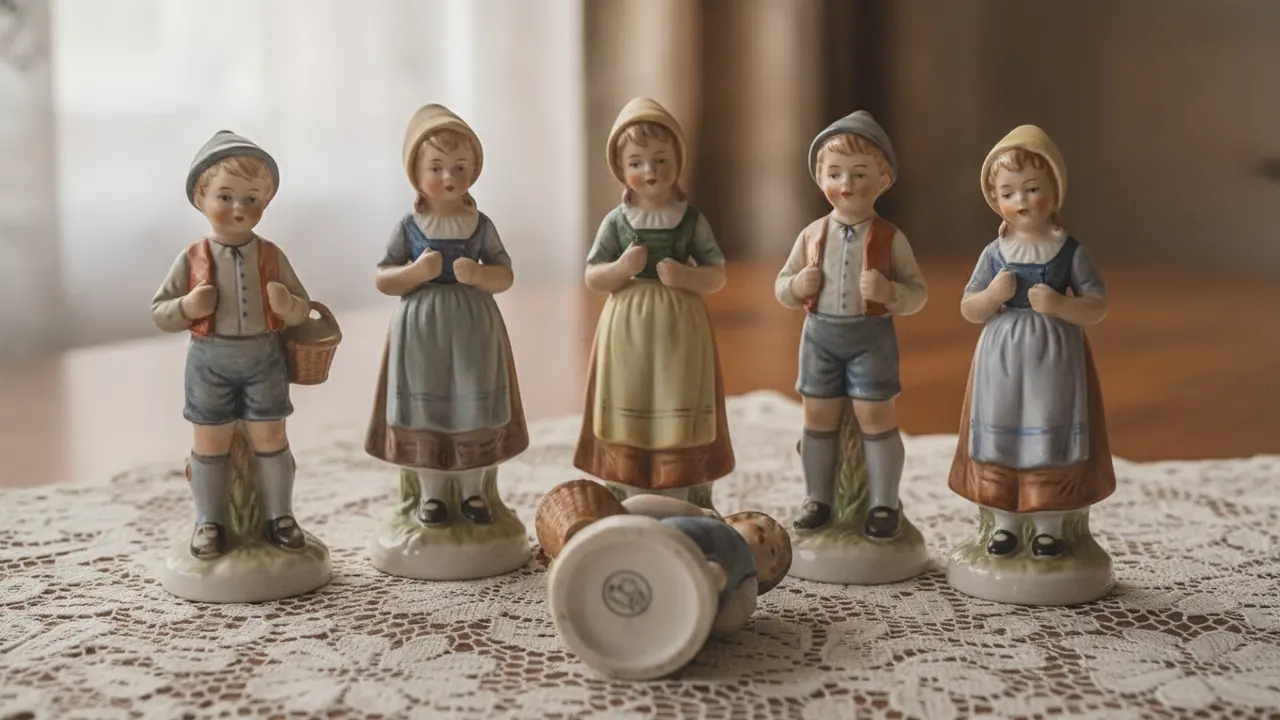
Goebel began commercial production of M.I. Hummel figurines in 1935. That means even the earliest production pieces are not yet 100 years old in 2026, though dealers often use the word antique loosely. Most are more accurately described as vintage collectibles; see the usual vintage and antique age distinctions if terminology affects an insurance list or estate inventory.
Start with the model number and the entire base
The model number is usually the best starting point. Turn the figurine over on a padded surface and photograph everything on the underside: the Goebel trademark, M.I. Hummel signature, incised model number, slash and suffix, painter's marks, copyright wording, size code and any paper label.
A number by itself is not enough. Different sizes or versions may share the same basic model number, while seller-created names can vary between catalogs and translated listings. Match the number to the pose, base shape, dimensions, paint scheme and trademark period.
- Measure the figure's full height, width and depth. Do not estimate from a photograph.
- Transcribe marks exactly, including slashes, suffix letters and faint incised digits.
- Take a straight-on photograph of the front and back, plus both sides.
- Photograph the underside in even light, then again with light coming from the side. Incised numbers often appear under raking light.
- Record every defect before cleaning or handling the figure further.
If a mark is hard to read, compare it with a reference for maker marks and factory labels. TIQ's antique identifier app can also read a photographed base and suggest era, model and value clues, but its result is an educational estimate, not authentication or a certified appraisal.
Do not confuse a model number with a TMK number. TMK-2 describes a trademark period; it is not the figurine's catalog number. Mold codes, size designations and later retailer stock numbers are separate again.
Hummel TMK trademark periods 1 to 9
The TMK system is a collector chronology based on changing Goebel trademarks. Dates overlap, and several published guides disagree at the edges, so the table is best used as a dating range. Goebel's company history confirms that commercial Hummel production began in 1935; the detailed TMK dates come mainly from collector references, including Wolfgang's Hummelhaus and published mark guides.
| Period | Common name | Approximate dates | What to look for |
|---|---|---|---|
| TMK-1 | Crown Mark or Crown-WG | 1935-1949/50 | A crown with intertwined WG initials for William Goebel. It may be incised, impressed or stamped. |
| TMK-2 | Full Bee | Generally the 1950s | A relatively detailed bee inside a V. Variations and overlapping dates are reported. |
| TMK-3 | Stylized Bee | About 1958-1972 | A simplified bee associated with the V-shaped design. |
| TMK-4 | Three-Line Mark | About 1964-1972 | Bee emblem with three lines of wording, often including © by W. Goebel and W. Germany. |
| TMK-5 | Last Bee or Goebel Bee | About 1972-1979 | The bee appears with the Goebel name instead of sitting in the earlier V arrangement. |
| TMK-6 | Missing Bee | About 1979-1991 | Goebel wording appears without a bee. |
| TMK-7 | New Crown or Hummel Mark | About 1991-1999 | A revised crown and Goebel/Hummel trademark used after German reunification. |
| TMK-8 | Millennium Bee | About 2000-2008 | A bee returns in a modern Goebel design. |
| TMK-9 | Manufaktur Rödental | After 2008/09 | Often a yellow-and-black bee with Original M.I. Hummel Germany and Manufaktur Rödental wording. |
TMK-9 needs a note. Some collectors call it the ninth period; another published reference calls the designation unofficial. That disagreement concerns its place in the traditional TMK sequence. A post-2008 Rödental mark is not counterfeit merely because it looks different from an older Goebel mark.
Marks may be stamped, impressed or incised. A stamped Crown mark is not automatically suspicious, and a faint or partly obscured mark does not automatically condemn a figure. Compare the exact design with dated mark variants, especially the changing bee shapes of the late 1950s.
What Crown and Full Bee marks really tell you
A Crown-WG mark dates a figurine to an early Goebel production period. A Full Bee usually points to early postwar production. Collectors seek both, but the mark only establishes part of the story.
The persistent mistake is to see a Crown or Full Bee and jump straight to a large asking price. Some early pieces are common. Others have damage, mismatched parts or weak demand. An intact later figurine in a scarce form can outsell an early, repaired example of a common model.
| The mark can help establish | The mark cannot establish by itself |
|---|---|
| An approximate production period | The exact year of manufacture |
| Consistency with a known Goebel trademark | Authenticity of the whole figurine |
| Possible collector interest in an early issue | Rarity or a specific dollar value |
| Which catalog and comparison sales to search | Whether repairs, repainting or replaced parts are present |
Use the trademark to narrow the search. Then verify the model and variant. Search with a formula such as: model number, suffix, measured height, TMK period and a short condition term. Searching only for Hummel Full Bee produces a mix of unrelated models and inflated dealer listings.
What actually sells
Buyers pay for a recognized model in the right size and variant, with clean original decoration and no hidden repair. Age can help, but demonstrated scarcity and condition usually have more influence than age alone.
- Exact-model demand is visible through repeated completed sales, not unsold listings.
- Scarce sizes, documented mold differences and discontinued variants need catalog or auction evidence.
- Larger, more complex groups may draw interest when complete. Size alone does not create value.
- Original boxes, certificates and retailer paperwork support completeness and identification. Packaging does not turn a common figure into a rare one.
- Specific provenance can help. An undocumented family story has little effect on market price.
- Later TMK figurines can sell well when the model is scarce, large, complete or part of a collected series.
The name used in a listing may be provisional. Hummel titles can vary by catalog, translation and collector usage. A convincing comparison has the same model number, shape, size, paint treatment and trademark period. If one of those differs, explain the difference instead of presenting the sale as an exact match.
There is no responsible single price chart for all Hummels. Broad guides tend to mix asking prices, old book values and sales with unknown condition. To work out what an inherited collectible may be worth, gather several recent sold results and adjust for visible differences. On Android, the Lens app can give a rough antique appraisal from a photograph, followed by manual checks against completed sales.
A useful sale record identifies the auction house or marketplace, date, model and variant, condition and realized amount. If a claimed record price lacks those details, leave it out of your estimate.
Damage can change the value sharply
Condition is often the deciding factor between two otherwise identical Hummels. Fingers, flowers, umbrella tips, tools, ribbons, instruments and hat edges are the first places to inspect. Repairs to these thin parts can disappear under carefully matched paint.
A five-minute condition check
- Set the figurine on a towel and use a bright light from the side.
- Inspect every projecting part with magnification. Compare left and right hands, flower stems and accessory ends.
- Look for glossy glue lines, altered texture or paint that crosses onto an adjoining surface.
- Check the underside and base edge for hairlines, filled chips, drilled holes and replaced felt.
- View pale areas for staining; inspect dark painted areas for flaking or retouching.
- Photograph crazing, firing flaws, cracks and repairs separately.
| Condition issue | Why buyers care |
|---|---|
| Missing finger, flower or accessory | The original form is incomplete, even if the loss looks minor. |
| Glued break | Repair lines may reopen, and repaint can conceal a larger fracture. |
| Hairline crack | A fine crack may run farther than it first appears. |
| Repainting or touch-up | Original hand-painted decoration has been altered. |
| Crazing | Severity varies, but stained or widespread crazing can reduce interest. |
| Factory firing flaw | This is a manufacturing irregularity, though it still needs disclosure. |
| Heavy cleaning or surface abrasion | Paint, sheen and evidence useful for examination may be lost. |
No chips is an incomplete condition description. A figure can have no open chips and still have a replaced hand, hairline, repaint, stain or missing accessory. Professional conservation may stabilize damage, but an untouched example in equivalent condition will generally be preferred. State restoration plainly.
Do not use bleach, abrasives, solvents or full immersion. Photograph the piece first. Dry dusting with a soft brush is safer than aggressive cleaning, particularly around matte paint and previously repaired projections.
Authenticity requires more than a bee mark
A genuine mark must agree with the figure above it. Copied trademarks and misleading descriptions exist, while Goebel made products that were not M.I. Hummel figurines. The words Germany, a bee symbol or a Goebel name are not enough on their own.
Compare the whole object with a documented catalog example:
- Pose, body proportions and base profile
- Face, hands and finger formation
- Clothing pattern, colors and accessory shape
- Model number, suffix and physical size
- M.I. Hummel signature style and location
- Trademark design appropriate to the claimed period
Hand painting creates small variation. Perfectly identical brushwork is not expected. Crude modeling, blurred faces, incorrect colors and an underside shape that does not match known examples are more serious warnings.
A copied model number can look convincing, so match the number to the form. Likewise, do not reject a figure only because its mark is stamped instead of incised. Early marks were applied in more than one way.
For a difficult piece, take base and profile photographs using the steps in identifying antiques from photos, then compare them with catalog illustrations and detailed auction photographs. Authentication from photographs may remain uncertain when the mark, restoration or ceramic body needs examination in person.
Build a defensible value estimate
A sound estimate is a range based on comparable sales. Begin with the exact model and expand the search only when there are too few results.
- Search the full model number, including any slash or suffix.
- Filter for sold or completed transactions. Ignore active asking prices at first.
- Separate sizes and TMK periods. A different height may be a different issue.
- Read condition reports and study all photographs. A low sale may reflect a repaired accessory; a high one may include a box or scarce variant.
- Record the sale date, venue, realized amount and buyer's premium treatment.
- Use several comparable results where possible, then explain any adjustment for damage, restoration, mark period or completeness.
Auction totals can be reported with or without buyer's premium. Marketplace prices can also omit tax and shipping. Record the basis consistently. Do not average figures that describe different sizes or badly mismatched condition.
For an estate cleanout, group ordinary examples only after each base has been photographed. Early marks and unusual model numbers are easy to miss in a cabinet full of similar children. The guide to sorting inherited items covers labeling and record keeping without separating objects from their paperwork.
Sell rare or uncertain pieces individually with full condition photographs. Common examples sometimes make more sense in small, coherent groups, but disclose each model number and defect. New collectors should also read the basic advice on buying and documenting collectibles before relying on old printed price guides.
Questions people ask
Are old Hummel figurines always valuable?
No. Some early Hummels are common, damaged or weakly collected, while certain later models have better demand. Model, variant, condition and completed sales determine the useful value range.
What does a Full Bee mark mean on a Hummel?
A Full Bee mark is generally associated with the 1950s TMK-2 period and shows a detailed bee within a V. It indicates an early production period but does not prove rarity or high value.
Is a Crown Mark Hummel rare?
A Crown-WG mark dates from approximately 1935-1949/50, but not every Crown model is rare. Scarcity must be supported by catalog information and a shortage of comparable sales.
Does crazing ruin a Hummel figurine's value?
Crazing does not make every Hummel unsalable, but widespread or stained crazing can reduce buyer interest. Compare it with uncrazed examples of the same model and trademark period.
Can a repaired Hummel still be sold?
Yes, repaired Hummels can sell when the restoration is disclosed and the price reflects it. Clear photographs of the repair, model number and full figure help buyers judge the work.
How can I tell if my Hummel is genuine?
Match the trademark, model number, dimensions, base shape, signature, modeling and paint scheme to documented examples. A bee mark or Goebel name alone is not proof of authenticity.