
Home / Collecting basics
Art Deco vs Art Nouveau: how to tell the styles apart
Art Deco vs Art Nouveau is easiest to identify by line and structure: Art Nouveau (about 1890 to 1914) bends into asymmetrical, plant-like curves, while Art Deco (mainly 1920 to 1939) favors symmetry, steps, chevrons, sunbursts and polished contrast. Check construction, marks and materials before dating an object, since both styles have been copied for decades.
Looking at shape and material...
While you wait: the TIQ app gives more accurate results, keeps your scan history and runs a reverse image search for similar items.


 Scan with your phone
to download
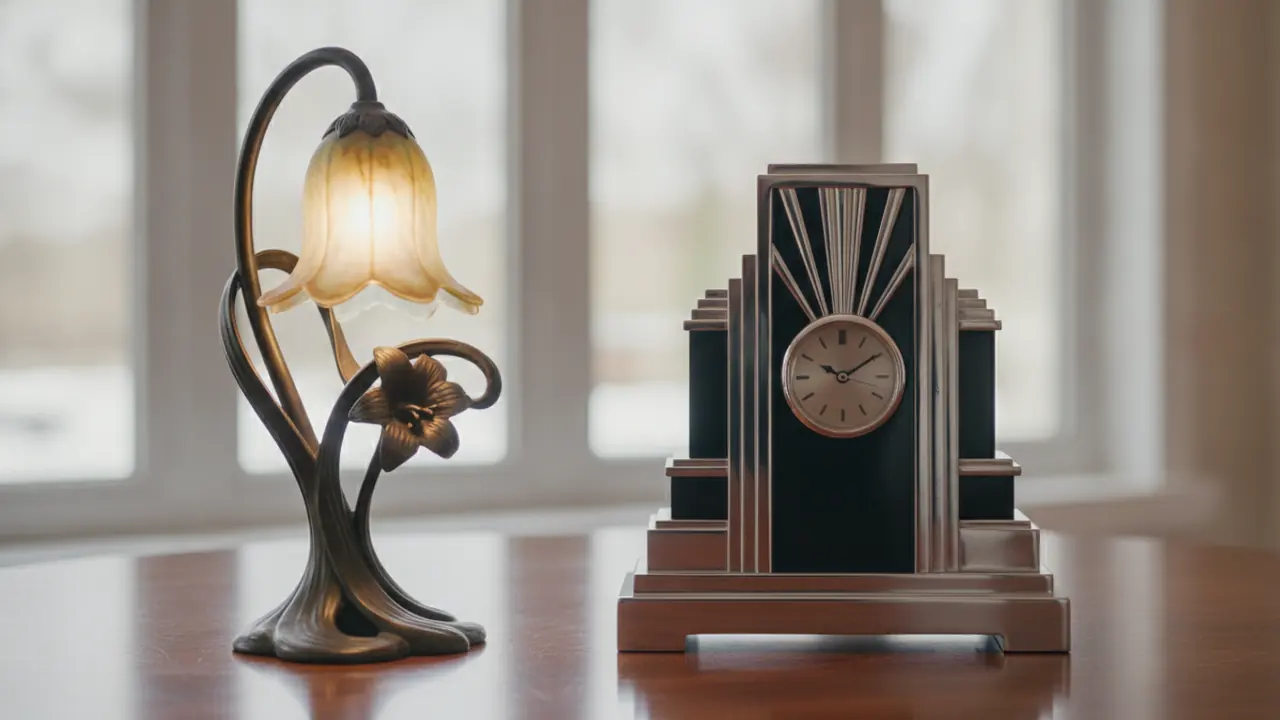
The quick visual test is movement. Art Nouveau appears to grow, twist or flow. Art Deco is ordered and architectural. That distinction works across furniture, jewelry, glass and posters, though regional styles and later revivals can blur the boundary.
The side-by-side differences
Art Nouveau usually has organic curves and uneven compositions; Art Deco tends to have geometry, symmetry and hard-edged contrast. Start with the silhouette, then examine decoration, surface and materials.
| Feature | Art Nouveau | Art Deco |
|---|---|---|
| Usual dates | About 1890 to 1914; peak production around 1895 to 1905 | Mainly 1920 to 1939, with earlier roots and later revivals |
| Dominant line | Whiplash curves, tendrils, flowing contours and asymmetry | Straight lines, steps, zigzags, chevrons, circles and sunbursts |
| Composition | Forms appear to grow or merge | Structured, symmetrical or divided into panels |
| Common imagery | Irises, lilies, orchids, vines, insects, birds and flowing hair | Fans, rays, skyscrapers, machines, stylized animals and geometric foliage |
| Surface | Textured, iridescent, softly modeled or visibly hand-worked | Polished, lacquered, smooth and sharply contrasted |
| Typical materials | Carved wood, wrought iron, horn, enamel, silver and opalescent glass | Chrome, stainless steel, lacquer, exotic veneers, platinum, diamonds and onyx |
| Color | Moss green, amber, mauve, brown and opal tones | Black, white, red, cobalt, emerald and metallic accents |
A flower does not make an object Art Nouveau. Geometry does not automatically make it Art Deco. Neoclassical ornament, Egyptian Revival, Cubism, Vienna Secession design and later machine-age work can produce similar shapes.
Dates, names and the overlap between movements
Art Nouveau came first. It developed in the late nineteenth century and had largely faded by the First World War. Art Deco reached its defining public moment at the 1925 Paris Exposition Internationale des Arts Décoratifs et Industriels Modernes, although some prewar objects now get called proto-Deco.
These are broad labels applied across different countries. An object cataloged as Art Nouveau may fit a more exact regional term:
- Jugendstil in German-speaking areas
- Vienna Secession or Secession style in Austria
- Stile Liberty in Italy
- École de Nancy for work associated with Nancy, France
The boundaries are untidy. Early Art Deco can retain floral ornament, and some Secession furniture has the geometry that beginners associate with Deco. Date an object through construction, documentation and marks as well as appearance. If you are unsure whether its age even qualifies it as an antique, compare the usual distinctions between vintage and antique.
Museum references are useful anchors. The Victoria and Albert Museum dates Alphonse Mucha's La Plume to 1897 and Job to 1898; it also records a Tiffany Favrile vase from about 1895. These documented objects help establish what period materials and design actually look like.
Furniture: inspect the silhouette and the hidden surfaces
On furniture, Art Nouveau curves appear in the structure itself; Art Deco geometry is often visible in the outline, veneer layout and hardware. Turn the piece around. The back, drawer sides and underside usually say more about age than a polished front.
Art Nouveau furniture may have an asymmetrical crest, undulating legs, elongated handles and carving derived from stems or flowers. Émile Gallé and Louis Majorelle are central names for the Nancy school. Gallé used marquetry depicting flowers, insects and other natural subjects, sometimes with inscriptions. Hector Guimard's furniture and interiors use integrated architectural curves that can look less botanical.
Art Deco cabinets, tables and seating tend toward strong symmetry, stepped profiles, radiating veneer, geometric inlay and sharply defined corners. Lacquer and chrome appear often. Émile-Jacques Ruhlmann, Süe et Mare, Pierre Chareau, Eileen Gray and Jean Dunand are useful comparison names, though commercial furniture may be unsigned.
| Area to inspect | What to look for |
|---|---|
| Drawers | Joinery, interior wear, secondary wood and replaced runners |
| Veneer | Pattern alignment, old repairs, fresh edges and uniform replacement sheets |
| Hardware | Original holes, modern screws, mismatched handles and newly plated metal |
| Back and underside | Labels, stamps, tool marks, later braces and synthetic finish |
| Surface | Wear where hands and feet would contact the piece, not random artificial distressing |
Machine-perfect repetition, fresh uniform veneer and copied labels warrant caution. A stepped cabinet might also be Streamline Moderne or a late twentieth-century revival. Use the broader furniture identification checklist before assigning a maker or date, and do not strip a finish or remove a paper label during inspection.
Jewelry: design is only the first clue
Art Nouveau jewelry is sculptural and organic; Art Deco jewelry is usually symmetrical, sharply bordered and built around calibrated stones. Magnification is essential because setting work, enamel, repairs and hallmarks may settle a question that the front view cannot.
Art Nouveau subjects include women with flowing hair, dragonflies, orchids, irises, butterflies, snakes and other natural forms. René Lalique, Georges Fouquet, Henri Vever, Lucien Gaillard and Tiffany & Co. are major reference points. Plique-à-jour and translucent enamel are characteristic, with design and color often taking precedence over large gemstones. Resin, opaque enamel and glass can imitate those effects.
Art Deco jewelry commonly combines platinum and diamonds with onyx or calibrated emeralds, rubies and sapphires. Look for pierced work visible on the reverse, geometric borders and millegrain edges. Genuine millegrain consists of tiny raised beads along an edge; period work can be slightly irregular under magnification while retaining sharp definition.
French eagle-head marks, British hallmarks with date letters, and American marks such as "PLAT" or "IRIDPLAT" may fit early twentieth-century platinum work. Read the complete group of marks. "750," "585" or a country stamp alone cannot supply a 1920s or 1930s date.
Inspect solder joints, stone cuts, setting style and wear together. Laser-cut geometry, cast surface texture, uniform modern beadwork and newly made settings are warning signs. Recut stones, replaced enamel, later ring shanks and brooch-to-pendant conversions can leave a piece partly period. Suspected ivory also needs separate identification and a check of current rules on restricted antique materials.
Glass: surface, mold work and signatures
Art Nouveau glass often has iridescence, layered color and botanical decoration. Art Deco glass moves toward repeated relief, simplified contours, stylized figures and symmetrical molded forms.
Louis Comfort Tiffany's Favrile glass is a key Art Nouveau reference, but iridescence by itself is not evidence of Tiffany manufacture. Gallé glass may have layered cameo carving, acid-etched flowers and engraved or applied signatures. Daum Nancy used cameo work, acid etching, enamel and applied decoration. Signature style, placement, technique and form all need to agree.
For Art Deco, René Lalique's clear, frosted and molded glass is a central comparison. Common subjects include stylized animals, figures, flowers and geometric patterns. Opalescent, satin and pressed surfaces also occur, and production using related techniques continued after the 1930s.
- Measure the piece and compare it with a documented factory form.
- Study mold seams, relief depth, weight, rim finish and pontil treatment.
- Photograph the mark from straight on and under raking light.
- Compare the mark's exact wording and placement with dated examples.
"Lalique France" must be dated in context because later production is common. Modern pressed copies can have a different weight, sharper mold lines or altered relief. Newly crisp signatures, artificial iridescence and excessive uniformity deserve examination, yet none settles authenticity alone. An unsigned vase may be period; a signed one may have an added or copied mark.
Posters and prints: identify the printing process
The image identifies the style; the paper and printing process help establish the period. Famous Art Nouveau and Art Deco posters have been reproduced so often that decorative reprints greatly outnumber first-period sheets in many online listings.
Art Nouveau posters often have sinuous borders, flattened decorative space, halo-like circles, stylized hair and lettering woven into the composition. Alphonse Mucha is the obvious reference. His commercial images appeared in different formats, states and later reprints, so recognizing the picture does not date the sheet.
Art Deco posters use bold diagonals, streamlined vehicles, simplified figures, geometric frames, sharp typography and blocks of strong color. Travel, rail and ocean-liner advertising supplied many familiar examples. Similar graphics remained in use later, which makes the advertiser, event, printer and issue history especially useful.
Under magnification, an original lithograph should show the character of separately printed colors. Modern digital prints may reveal regular printer dots or a continuous-tone surface. Check the margins for printer information, then inspect folds, paper stock, trimmed edges, linen backing and restoration. A signature printed as part of the image is different from a hand-signed impression.
Do not judge age from yellowing. Paper can be artificially toned, and a clean sheet may have spent decades protected from light. If you are buying remotely, ask for unframed photographs of the back, margins and lower printer line; the guide to reproductions and authentic antiques covers the same evidence-first method for other object types.
Marks, authenticity and value
A mark is one piece of evidence. Record the maker, factory, retailer, assay, patent, model, pattern, country and restoration marks before deciding what any single stamp means.
Photograph each mark in focus, first with the whole object visible and then close enough to preserve punctuation, letter spacing and symbols. TIQ, an antique appraisal tool for iPhone, can give an initial photo-based identification and value range; its results are educational estimates, so compare them with documented examples. For an antique appraisal app on Android, the same team's Lens app identifies objects including antiques.
The next step is object-specific research. Compare dimensions, construction, materials, signature position and technique with museum catalogs, maker archives and well-described auction lots. The guide to maker marks and labels explains how to separate a manufacturer from a retailer or importer. A famous name can be forged, transferred or added later.
Value depends on more than style. The main factors are confirmed maker and model, rarity, original materials, quality of execution, condition, completeness and documented ownership. Chips, cracks, refinishing, over-polishing, replacement stones, re-enameling and altered hardware can reduce value. A scarce piece with repairs may still command more interest than a common example in excellent condition.
For a defensible estimate, use sold examples with the same attribution, dimensions, material and condition. Record the sale date and lot description. The process in working out what an antique is worth explains why a broad price attached to "Art Deco vase" or "Art Nouveau brooch" has little use.
Provenance can resolve doubts that style cannot. Save invoices, old photographs, collection labels and family records, and follow a consistent method for documenting provenance. Before cleaning or repair, photograph every side. Original finishes, mounts and labels are easy to lose and hard to reconstruct.
Useful institutional references include the Victoria and Albert Museum's Art Nouveau collection, Lightner Museum exhibition materials and the Hallmark Society's guidance on Art Deco jewelry marks.
Questions people ask
Which came first, Art Nouveau or Art Deco?
Art Nouveau came first, developing around 1890 and declining by the First World War. Art Deco is mainly associated with the 1920s and 1930s.
Can an object be both Art Nouveau and Art Deco?
Some transitional objects combine organic ornament with emerging geometry, so cataloging can differ. Construction date, maker records and regional context usually support the most accurate label.
Is Alphonse Mucha Art Nouveau or Art Deco?
Alphonse Mucha is associated with Art Nouveau. His late nineteenth-century posters use flowing hair, botanical borders, circular framing and integrated lettering.
How can I tell if Lalique glass is old?
Compare the exact mark, dimensions, mold seams, relief, finish and weight with a documented Lalique form. The Lalique name alone cannot date the glass because later production and copied marks exist.
Is all Art Deco considered antique?
Period Art Deco from the 1920s and 1930s is generally old enough to be considered antique under the common 100-year guideline only as individual pieces cross that age. Later Art Deco-style revivals may be vintage or modern.
Are geometric rings always Art Deco?
No. Geometric rings were made before and after the Art Deco period, including many current reproductions; hallmarks, setting construction, stone cuts and documented age are needed for dating.